QUESTION IMAGE
Question
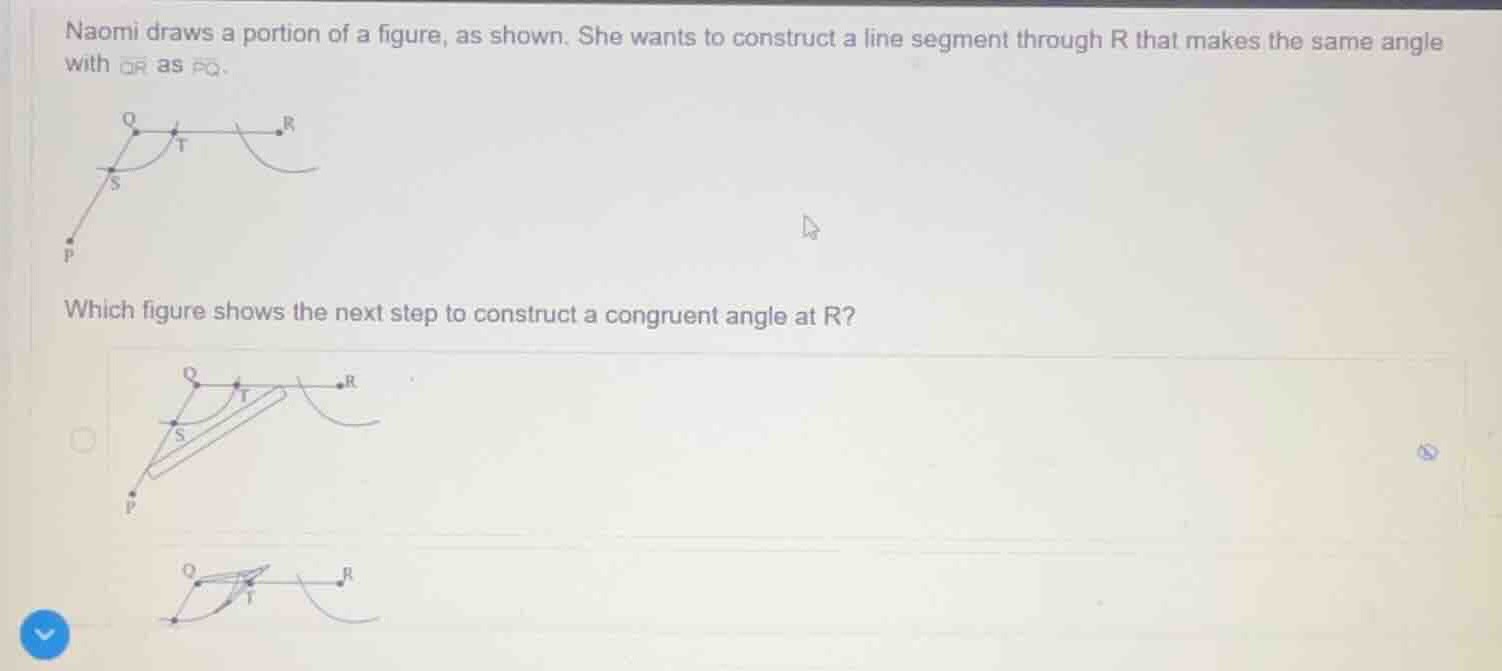
naomi draws a portion of a figure, as shown. she wants to construct a line segment through r that makes the same angle with qr as pq. which figure shows the next step to construct a congruent angle at r?
To solve this, we recall the steps for constructing a congruent angle: after drawing the arcs at the original angle (here, at \( Q \) with arcs through \( S \) and \( T \)) and the arc at \( R \), the next step is to measure the distance between the intersection points of the arcs at the original angle (e.g., \( S \) and \( T \)) and transfer that distance to the arc at \( R \). This is done using a compass to mark the length of \( ST \) on the arc at \( R \).
Looking at the options, the figure that shows using the compass to transfer the length from \( S \) to \( T \) (or the chord length of the arc at \( Q \)) to the arc at \( R \) is the correct next step. Typically, this involves placing the compass tip at \( R \)'s arc and marking the length equal to \( ST \).
Assuming the second figure (the one with the compass centered at \( R \)'s arc, matching the length of \( ST \)) is the correct one (since the first might be a different step, like drawing the initial arc, but here we need the step after the arc at \( R \) is drawn: transferring the chord length).
To construct a congruent angle at \( R \), after drawing arcs at \( Q \) (through \( S, T \)) and the arc at \( R \), the next step is to use a compass to measure the distance between \( S \) and \( T \) (chord length of the arc at \( Q \)) and transfer this length to the arc at \( R \). This matches the action shown in the second figure (with the compass marking the length on \( R \)'s arc).

Snap & solve any problem in the app
Get step-by-step solutions on Sovi AI
Photo-based solutions with guided steps
Explore more problems and detailed explanations
The second figure (with the compass centered on \( R \)'s arc, transferring the length of \( ST \)) is the correct next step. (If options are labeled, e.g., if the second option is labeled as B, then "B. [Description of the second figure]" would be the answer. Since the exact labels aren't fully visible, the key is the figure showing the compass transferring \( ST \)'s length to \( R \)'s arc.)