QUESTION IMAGE
Question
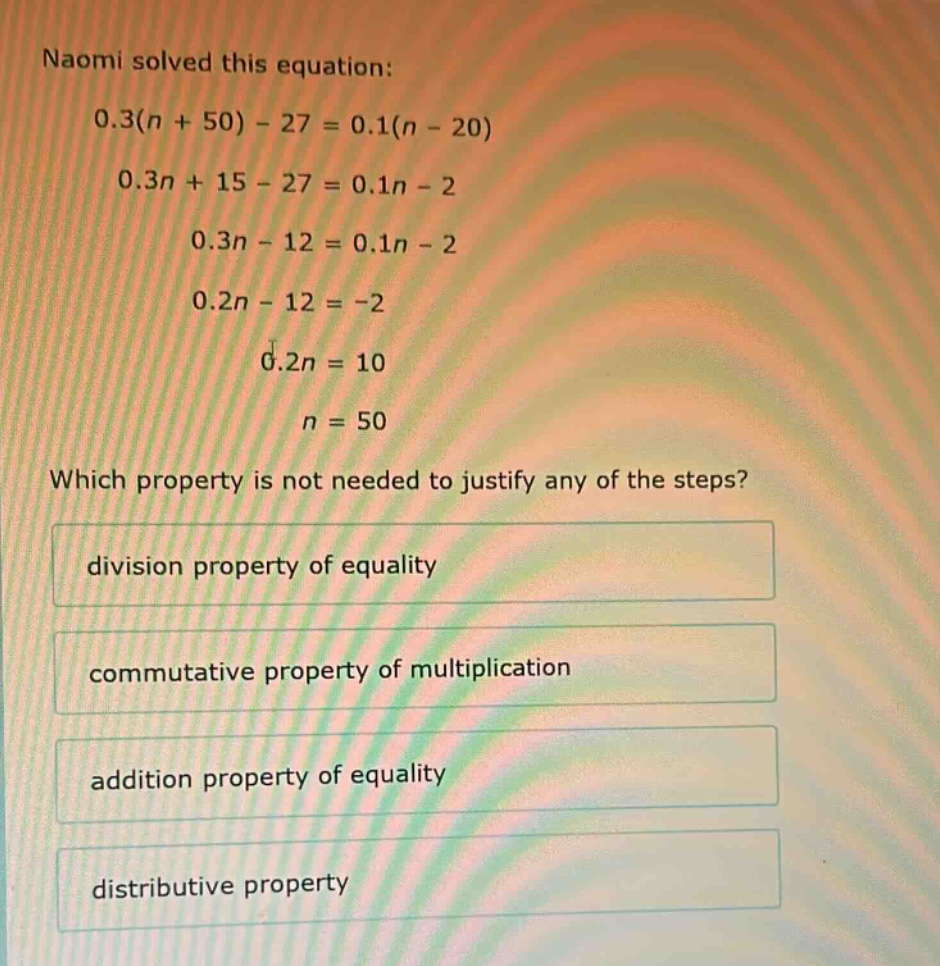
naomi solved this equation:
$0.3(n + 50) - 27 = 0.1(n - 20)$
$0.3n + 15 - 27 = 0.1n - 2$
$0.3n - 12 = 0.1n - 2$
$0.2n - 12 = -2$
$0.2n = 10$
$n = 50$
which property is not needed to justify any of the steps?
division property of equality
commutative property of multiplication
addition property of equality
distributive property
Brief Explanations
- Distributive Property: Used in the first step to expand $0.3(n+50)$ to $0.3n+15$ and $0.1(n-20)$ to $0.1n-2$.
- Addition Property of Equality: Used when adding $12$ to both sides ($0.2n -12 = -2 \to 0.2n = 10$) and when subtracting $0.1n$ from both sides ($0.3n -12 = 0.1n -2 \to 0.2n -12 = -2$).
- Division Property of Equality: Used in the final step to divide both sides of $0.2n=10$ by $0.2$ to solve for $n$.
- Commutative Property of Multiplication: This property (stating $a \times b = b \times a$) is not used in any step of solving this equation.

Snap & solve any problem in the app
Get step-by-step solutions on Sovi AI
Photo-based solutions with guided steps
Explore more problems and detailed explanations
commutative property of multiplication