QUESTION IMAGE
Question
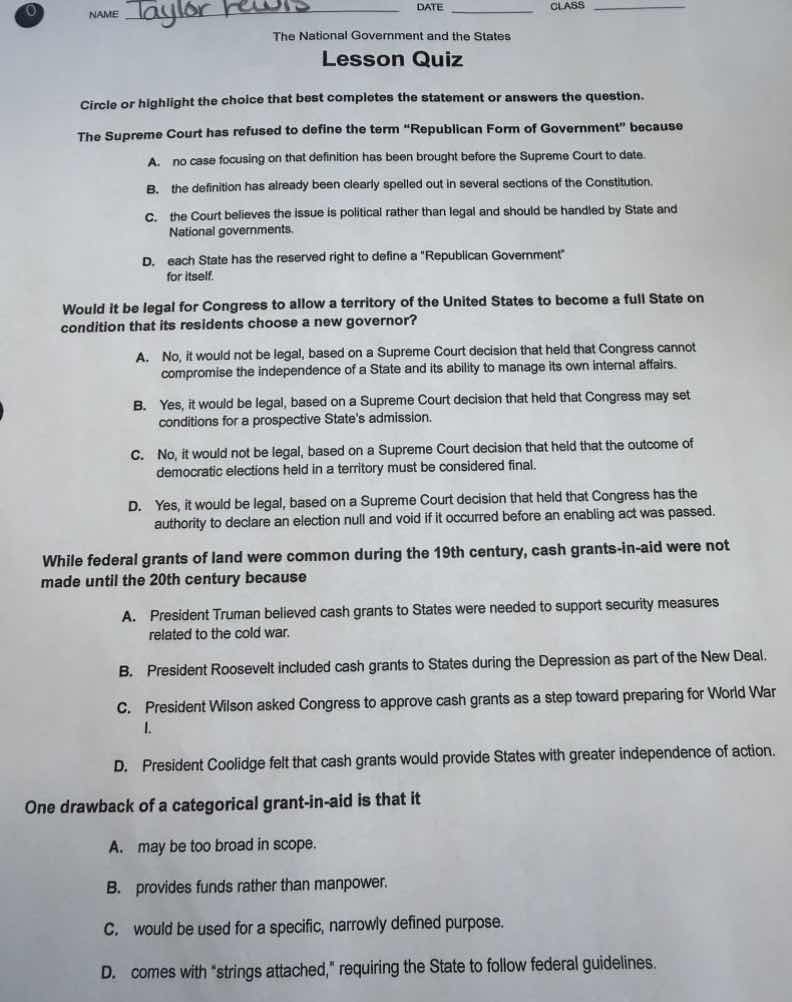
the national government and the states
lesson quiz
circle or highlight the choice that best completes the statement or answers the question.
the supreme court has refused to define the term
epublican form of government\ because
a. no case focusing on that definition has been brought before the supreme court to date.
b. the definition has already been clearly spelled out in several sections of the constitution.
c. the court believes the issue is political rather than legal and should be handled by state and national governments.
d. each state has the reserved right to define a
epublican government\
for itself.
would it be legal for congress to allow a territory of the united states to become a full state on
condition that its residents choose a new governor?
a. no, it would not be legal, based on a supreme court decision that held that congress cannot
compromise the independence of a state and its ability to manage its own internal affairs.
b. yes, it would be legal, based on a supreme court decision that held that congress may set
conditions for a prospective states admission.
c. no, it would not be legal, based on a supreme court decision that held that the outcome of
democratic elections in a territory must be considered final.
d. yes, it would be legal, based on a supreme court decision that held that congress has the
authority to declare an election null and void if it occurred before an enabling act was passed.
while federal grants of land were common during the 19th century, cash grants - in - aid were not
made until the 20th century because
a. president truman believed cash grants to states were needed to support security measures
related to the cold war.
b. president roosevelt included cash grants to states during the depression as part of the new deal.
c. president wilson asked congress to approve cash grants as a step toward preparing for world war
i.
d. president coolidge felt that cash grants would provide states with greater independence of action.
one drawback of a categorical grant - in - aid is that it
a. may be too broad in scope.
b. provides funds rather than manpower.
c. would be used for a specific, narrowly defined purpose.
d. comes with \strings attached,\ requiring the state to follow federal guidelines.
Question 1:
To determine why the Supreme Court refused to define "Republican Form of Government", we analyze each option:
- Option A: There have been cases related to governmental forms, so this is incorrect.
- Option B: The Constitution doesn't clearly define this term, so this is wrong.
- Option C: The Court views this as a political (not legal) issue for governments to handle, which matches the reasoning.
- Option D: States don't have the reserved right to define this independently in a way that overrides the Court's role, so this is incorrect.
For whether Congress can set the condition of choosing a new governor for statehood:
- Option A: The Supreme Court has ruled Congress can't compromise a state's internal affairs independence. Forcing a governor choice would interfere, so this is correct.
- Option B: Congress can set some conditions, but not those compromising internal affairs, so this is wrong.
- Option C: The issue isn't about election finality but state autonomy, so this is incorrect.
- Option D: Congress doesn't have the authority to nullify elections for this reason, and this is not relevant to the question, so this is wrong.
Regarding cash grants - in - aid timing:
- Option A: Truman was post - 20th century start, and the New Deal (Roosevelt) was the first major cash grant program in the 20th century, so this is incorrect.
- Option B: Roosevelt's New Deal during the Great Depression introduced cash grants - in - aid in the 20th century, which explains why they weren't common before.
- Option C: Wilson's actions were not related to cash grants - in - aid for states, so this is wrong.
- Option D: Coolidge's views don't explain the timing of cash grants - in - aid, so this is incorrect.

Snap & solve any problem in the app
Get step-by-step solutions on Sovi AI
Photo-based solutions with guided steps
Explore more problems and detailed explanations
C. the Court believes the issue is political rather than legal and should be handled by State and National governments.