QUESTION IMAGE
Question
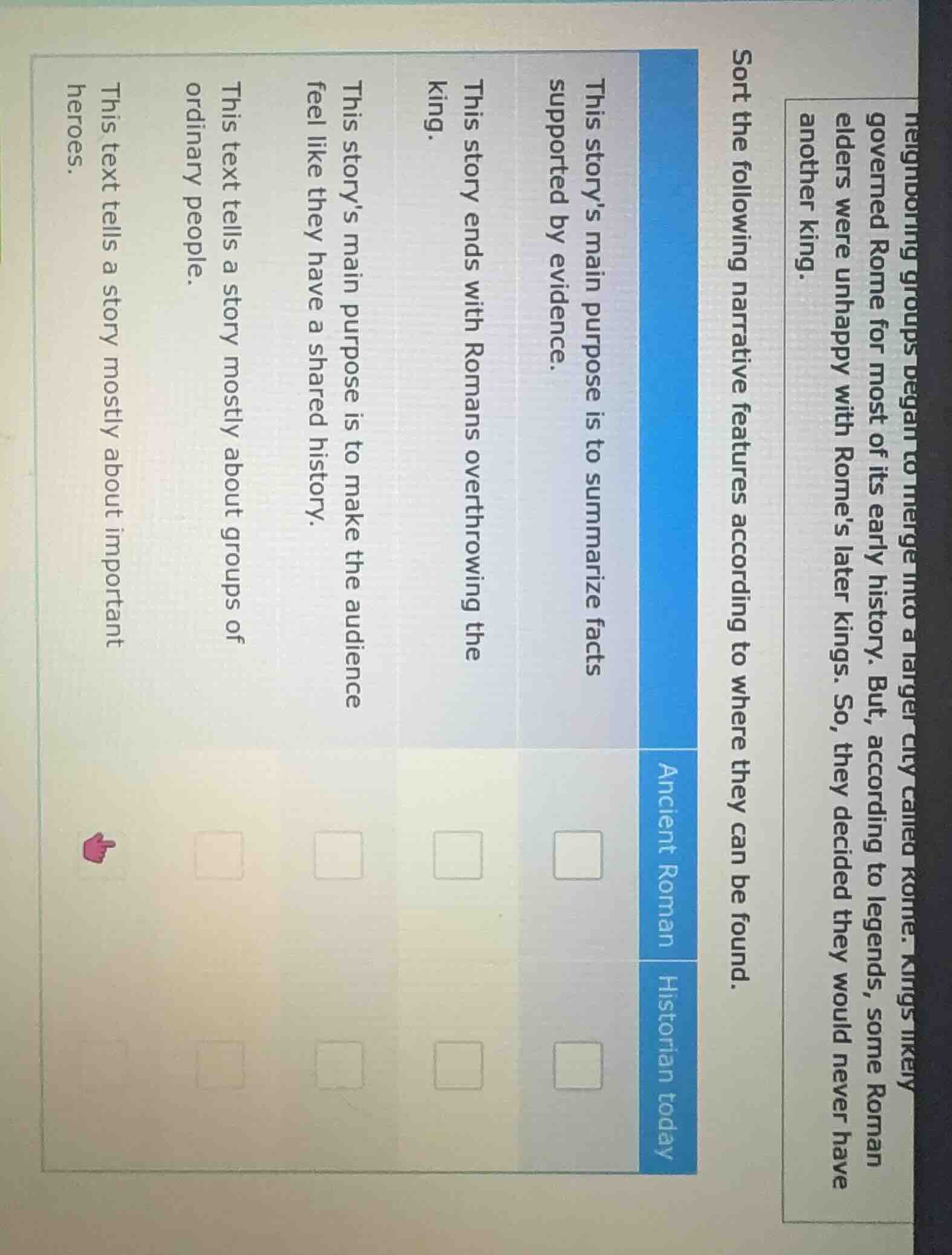
neighboring groups began to merge into a larger city called rome. kings likely governed rome for most of its early history. but, according to legends, some roman elders were unhappy with romes later kings. so, they decided they would never have another king.
sort the following narrative features according to where they can be found.
| ancient roman | historian today | |
|---|---|---|
| this story ends with romans overthrowing the king. | ||
| this storys main purpose is to make the audience feel like they have a shared history. | ||
| this text tells a story mostly about groups of ordinary people. | ||
| this text tells a story mostly about important heroes. |
To solve this, we analyze each narrative feature for "Ancient Roman" (the story about Rome's early history and overthrowing kings) and "Historian today" (focused on evidence - based summary or shared history feeling):
1. "This story’s main purpose is to summarize facts supported by evidence."
- Ancient Roman: Ancient Roman narratives (like legends) are more about storytelling, not evidence - based summary.
- Historian today: Historians today aim to summarize facts with evidence. So this belongs to Historian today.
2. "This story ends with Romans overthrowing the king."
- Ancient Roman: The text about Rome's early history (Ancient Roman context) includes overthrowing kings.
- Historian today: This is a specific event in Roman history, part of the Ancient Roman narrative. So this belongs to Ancient Roman.
3. "This story’s main purpose is to make the audience feel like they have a shared history."
- Ancient Roman: Ancient Roman stories (legends) were for their own community, not about shared history with a modern audience.
- Historian today: Historians today might want to create a sense of shared history. So this belongs to Historian today.
4. "This text tells a story mostly about groups of ordinary people."
- Ancient Roman: The text is about Rome's founding (groups merging) and overthrowing kings, not ordinary people.
- Historian today: Not a focus of a historian's summary here. (This might not fit well, but if we have to choose, maybe neither, but based on the options, perhaps no check. But following the task, we proceed.)
5. "This text tells a story mostly about important heroes."
- Ancient Roman: Ancient Roman legends often have heroic elements (founding, overthrowing), so this belongs to Ancient Roman.
Final Sorting:
- Ancient Roman:
- This story ends with Romans overthrowing the king.
- This text tells a story mostly about important heroes.
- Historian today:
- This story’s main purpose is to summarize facts supported by evidence.
- This story’s main purpose is to make the audience feel like they have a shared history.
(For the "groups of ordinary people" one, if we assume a mistake or mis - categorization, and if we have to place it, maybe no check as it doesn't fit well with either. But based on the given options and the text, the above is the most logical sorting.)

Snap & solve any problem in the app
Get step-by-step solutions on Sovi AI
Photo-based solutions with guided steps
Explore more problems and detailed explanations
To solve this, we analyze each narrative feature for "Ancient Roman" (the story about Rome's early history and overthrowing kings) and "Historian today" (focused on evidence - based summary or shared history feeling):
1. "This story’s main purpose is to summarize facts supported by evidence."
- Ancient Roman: Ancient Roman narratives (like legends) are more about storytelling, not evidence - based summary.
- Historian today: Historians today aim to summarize facts with evidence. So this belongs to Historian today.
2. "This story ends with Romans overthrowing the king."
- Ancient Roman: The text about Rome's early history (Ancient Roman context) includes overthrowing kings.
- Historian today: This is a specific event in Roman history, part of the Ancient Roman narrative. So this belongs to Ancient Roman.
3. "This story’s main purpose is to make the audience feel like they have a shared history."
- Ancient Roman: Ancient Roman stories (legends) were for their own community, not about shared history with a modern audience.
- Historian today: Historians today might want to create a sense of shared history. So this belongs to Historian today.
4. "This text tells a story mostly about groups of ordinary people."
- Ancient Roman: The text is about Rome's founding (groups merging) and overthrowing kings, not ordinary people.
- Historian today: Not a focus of a historian's summary here. (This might not fit well, but if we have to choose, maybe neither, but based on the options, perhaps no check. But following the task, we proceed.)
5. "This text tells a story mostly about important heroes."
- Ancient Roman: Ancient Roman legends often have heroic elements (founding, overthrowing), so this belongs to Ancient Roman.
Final Sorting:
- Ancient Roman:
- This story ends with Romans overthrowing the king.
- This text tells a story mostly about important heroes.
- Historian today:
- This story’s main purpose is to summarize facts supported by evidence.
- This story’s main purpose is to make the audience feel like they have a shared history.
(For the "groups of ordinary people" one, if we assume a mistake or mis - categorization, and if we have to place it, maybe no check as it doesn't fit well with either. But based on the given options and the text, the above is the most logical sorting.)