QUESTION IMAGE
Question
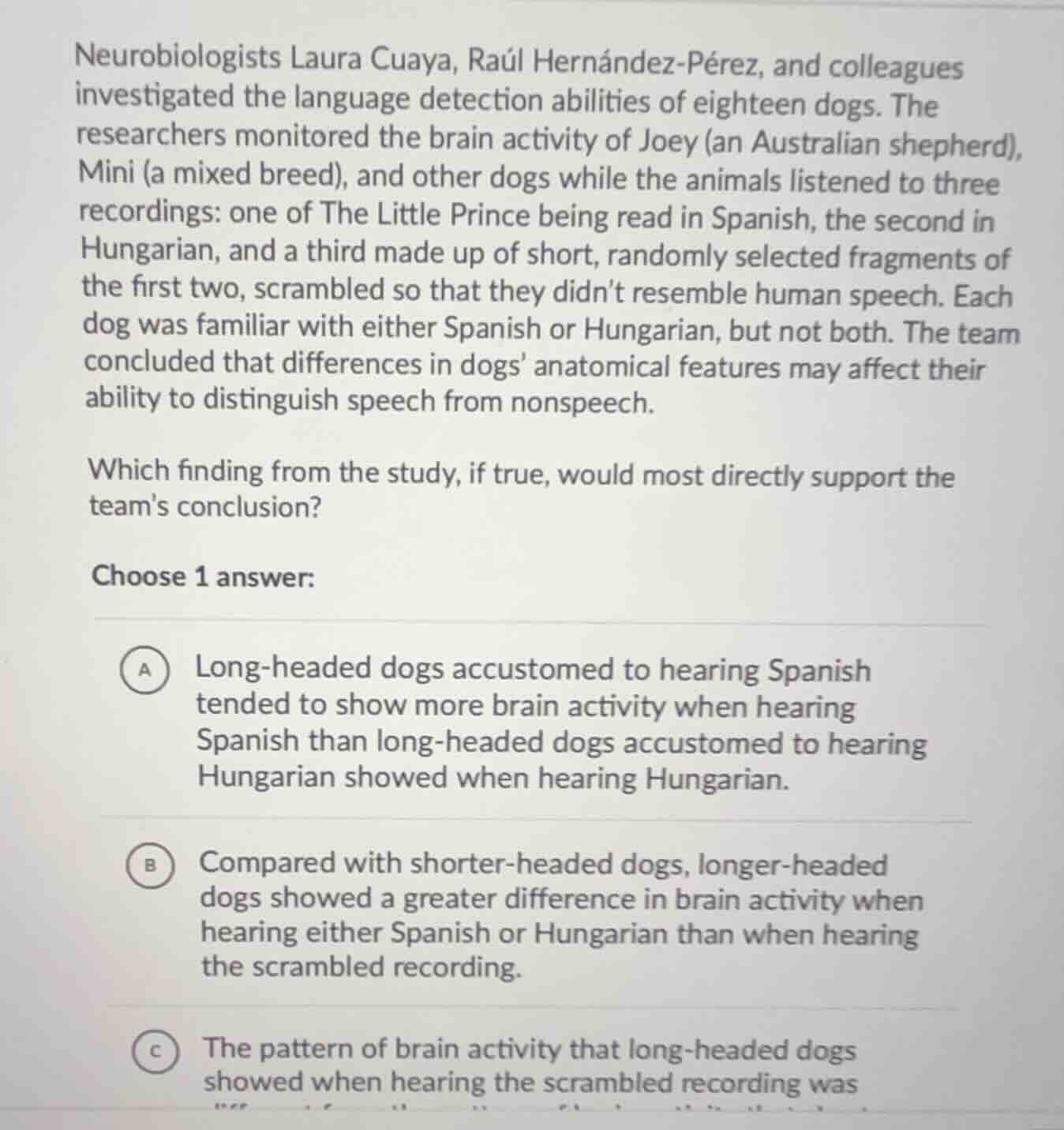
neurobiologists laura cuaya, raúl hernández-pérez, and colleagues investigated the language detection abilities of eighteen dogs. the researchers monitored the brain activity of joey (an australian shepherd), mini (a mixed breed), and other dogs while the animals listened to three recordings: one of the little prince being read in spanish, the second in hungarian, and a third made up of short, randomly selected fragments of the first two, scrambled so that they didn’t resemble human speech. each dog was familiar with either spanish or hungarian, but not both. the team concluded that differences in dogs’ anatomical features may affect their ability to distinguish speech from nonspeech.
which finding from the study, if true, would most directly support the team’s conclusion?
choose 1 answer:
a long-headed dogs accustomed to hearing spanish tended to show more brain activity when hearing spanish than long-headed dogs accustomed to hearing hungarian showed when hearing hungarian.
b compared with shorter-headed dogs, longer-headed dogs showed a greater difference in brain activity when hearing either spanish or hungarian than when hearing the scrambled recording.
c the pattern of brain activity that long-headed dogs showed when hearing the scrambled recording was
The team's conclusion is that dogs' anatomical features (here, head shape as a proxy) affect their ability to distinguish speech from nonspeech. We need a finding that links anatomical features (head length) to the ability to distinguish speech (Spanish/Hungarian) from nonspeech (scrambled recording).
- Option A compares brain activity between long - headed dogs familiar with different languages. It focuses on language familiarity within the same head - shape group, not on distinguishing speech from nonspeech based on anatomy.
- Option B compares longer - headed and shorter - headed dogs. It shows that longer - headed dogs have a greater difference in brain activity when hearing speech (Spanish/Hungarian) versus nonspeech (scrambled recording). This directly links the anatomical feature (head length) to the ability to distinguish speech from nonspeech, supporting the conclusion. (Note: The third option is incomplete, but from the given options, B is the best fit.)

Snap & solve any problem in the app
Get step-by-step solutions on Sovi AI
Photo-based solutions with guided steps
Explore more problems and detailed explanations
B. Compared with shorter - headed dogs, longer - headed dogs showed a greater difference in brain activity when hearing either Spanish or Hungarian than when hearing the scrambled recording.