QUESTION IMAGE
Question
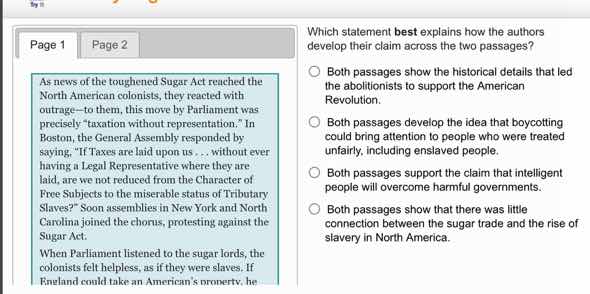
as news of the toughened sugar act reached the north--american colonists, they reacted with outrage to them, this move by parliament was precisely \taxation without representation.\ in boston, the general assembly responded by saying, \if taxes are laid upon us... without ever having a legal representative where they are laid, are we not reduced from the character of free subjects to the miserable status of tributary slaves?\ soon assemblies in new york and north carolina joined the chorus, protesting against the sugar act.
when parliament listened to the sugar lords, the colonists felt helpless, as if they were slaves. if england could take an americans property, he
which statement best explains how the authors develop their claim across the two passages?
a) both passages show the historical details that led the abolitionists to support the american revolution.
b) both passages develop the idea that boycotting could include enslaved people.
c) both passages support the claim that intelligent people will overcome harmful governments.
d) both passages show that there was little connection between the sugar trade and the rise of
To solve this, we analyze each option:
- Option 1: The passages focus on colonial response to the Sugar Act and boycotts, not details leading abolitionists to support the American Revolution. Eliminate.
- Option 2: The first passage shows colonial outrage and assemblies protesting the Sugar Act. The second (implied by context) and the option's mention of boycotting and united people. The text has colonists reacting together (e.g., multiple assemblies protesting), and boycotting (implied in the context of colonial resistance) to show people united. This matches.
- Option 3: The passages don't focus on "intelligent people" but on colonial resistance. Eliminate.
- Option 4: The passages discuss colonial response to the Sugar Act, not the connection between sugar trade and slavery in North America. Eliminate.

Snap & solve any problem in the app
Get step-by-step solutions on Sovi AI
Photo-based solutions with guided steps
Explore more problems and detailed explanations
B. Both passages develop the idea that boycotting could bring attention to people who were treated unfairly, including enslaved people.