QUESTION IMAGE
Question
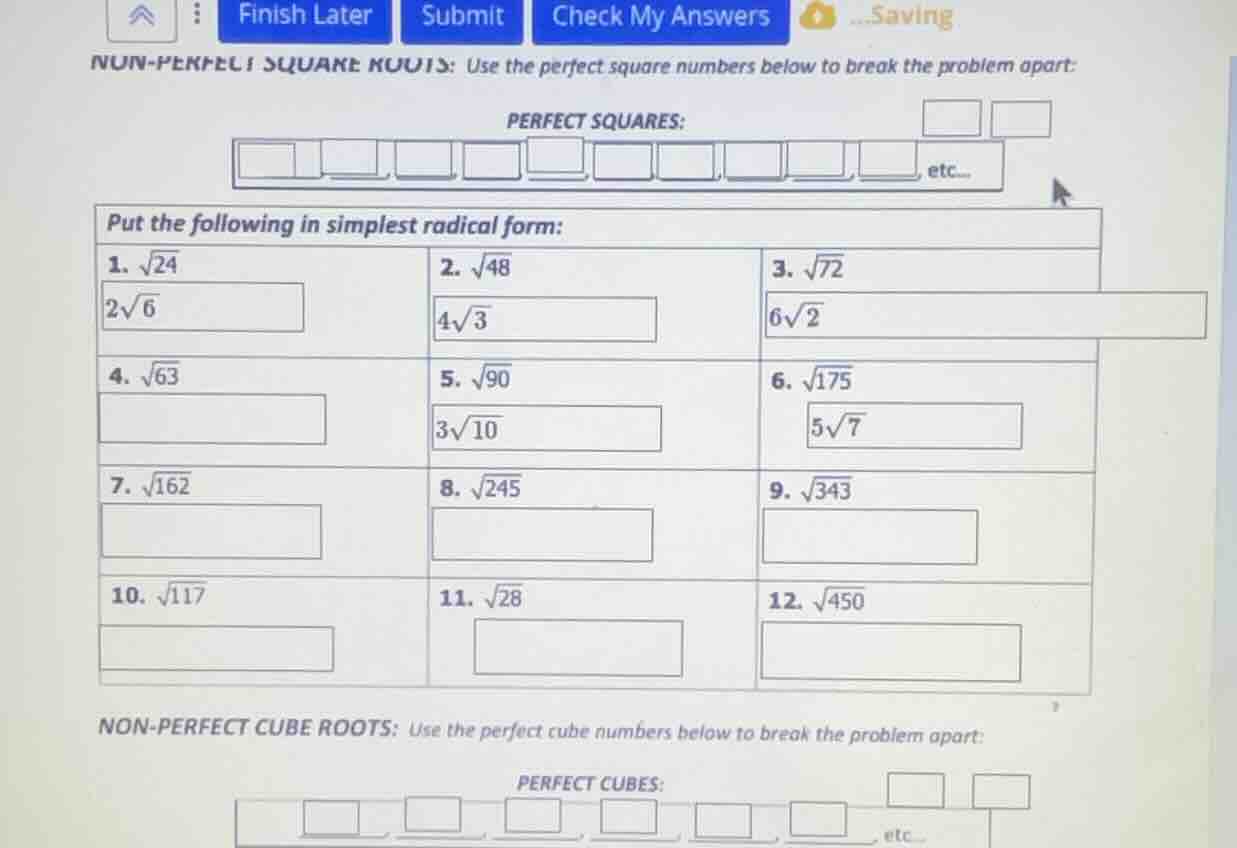
non-perfect square roots: use the perfect square numbers below to break the problem apart:
perfect squares:
□ □ □ □ □ □ □ □ □ □, etc....
put the following in simplest radical form:
- √24
2√6
- √48
4√3
- √72
6√2
- √63
- √90
3√10
- √175
5√7
- √162
- √245
- √343
- √117
- √28
- √450
non-perfect cube roots: use the perfect cube numbers below to break the problem apart:
perfect cubes:
□ □ □ □ □ □ □, etc....
To solve these problems, we need to simplify each radical by factoring out the largest perfect square factor from the radicand (the number inside the square root).
Problem 4: $\boldsymbol{\sqrt{63}}$
Step 1: Factor the radicand
We factor 63 to find the largest perfect square factor. We know that $63 = 9 \times 7$, and 9 is a perfect square ($3^2 = 9$).
Step 2: Apply the square root property
Using the property $\sqrt{ab} = \sqrt{a} \times \sqrt{b}$ (where $a \geq 0$ and $b \geq 0$), we can rewrite $\sqrt{63}$ as $\sqrt{9 \times 7} = \sqrt{9} \times \sqrt{7}$.
Step 3: Simplify the perfect square root
Since $\sqrt{9} = 3$, we have $3 \times \sqrt{7} = 3\sqrt{7}$.
Problem 7: $\boldsymbol{\sqrt{162}}$
Step 1: Factor the radicand
Factor 162: $162 = 81 \times 2$, and 81 is a perfect square ($9^2 = 81$).
Step 2: Apply the square root property
$\sqrt{162} = \sqrt{81 \times 2} = \sqrt{81} \times \sqrt{2}$.
Step 3: Simplify the perfect square root
Since $\sqrt{81} = 9$, we get $9 \times \sqrt{2} = 9\sqrt{2}$.
Problem 8: $\boldsymbol{\sqrt{245}}$
Step 1: Factor the radicand
Factor 245: $245 = 49 \times 5$, and 49 is a perfect square ($7^2 = 49$).
Step 2: Apply the square root property
$\sqrt{245} = \sqrt{49 \times 5} = \sqrt{49} \times \sqrt{5}$.
Step 3: Simplify the perfect square root
Since $\sqrt{49} = 7$, we have $7 \times \sqrt{5} = 7\sqrt{5}$.
Problem 9: $\boldsymbol{\sqrt{343}}$
Step 1: Factor the radicand
Factor 343: $343 = 49 \times 7$, and 49 is a perfect square ($7^2 = 49$).
Step 2: Apply the square root property
$\sqrt{343} = \sqrt{49 \times 7} = \sqrt{49} \times \sqrt{7}$.
Step 3: Simplify the perfect square root
Since $\sqrt{49} = 7$, we get $7 \times \sqrt{7} = 7\sqrt{7}$.
Problem 10: $\boldsymbol{\sqrt{117}}$
Step 1: Factor the radicand
Factor 117: $117 = 9 \times 13$, and 9 is a perfect square ($3^2 = 9$).
Step 2: Apply the square root property
$\sqrt{117} = \sqrt{9 \times 13} = \sqrt{9} \times \sqrt{13}$.
Step 3: Simplify the perfect square root
Since $\sqrt{9} = 3$, we have $3 \times \sqrt{13} = 3\sqrt{13}$.
Problem 11: $\boldsymbol{\sqrt{28}}$
Step 1: Factor the radicand
Factor 28: $28 = 4 \times 7$, and 4 is a perfect square ($2^2 = 4$).
Step 2: Apply the square root property
$\sqrt{28} = \sqrt{4 \times 7} = \sqrt{4} \times \sqrt{7}$.
Step 3: Simplify the perfect square root
Since $\sqrt{4} = 2$, we get $2 \times \sqrt{7} = 2\sqrt{7}$.
Problem 12: $\boldsymbol{\sqrt{450}}$
Step 1: Factor the radicand
Factor 450: $450 = 225 \times 2$, and 225 is a perfect square ($15^2 = 225$).
Step 2: Apply the square root property
$\sqrt{450} = \sqrt{225 \times 2} = \sqrt{225} \times \sqrt{2}$.
Step 3: Simplify the perfect square root
Since $\sqrt{225} = 15$, we have $15 \times \sqrt{2} = 15\sqrt{2}$.
Final Answers:
- $\boldsymbol{3\sqrt{7}}$
- $\boldsymbol{9\sqrt{2}}$
- $\boldsymbol{7\sqrt{5}}$
- $\boldsymbol{7\sqrt{7}}$
- $\boldsymbol{3\sqrt{13}}$
- $\boldsymbol{2\sqrt{7}}$
- $\boldsymbol{15\sqrt{2}}$

Snap & solve any problem in the app
Get step-by-step solutions on Sovi AI
Photo-based solutions with guided steps
Explore more problems and detailed explanations
To solve these problems, we need to simplify each radical by factoring out the largest perfect square factor from the radicand (the number inside the square root).
Problem 4: $\boldsymbol{\sqrt{63}}$
Step 1: Factor the radicand
We factor 63 to find the largest perfect square factor. We know that $63 = 9 \times 7$, and 9 is a perfect square ($3^2 = 9$).
Step 2: Apply the square root property
Using the property $\sqrt{ab} = \sqrt{a} \times \sqrt{b}$ (where $a \geq 0$ and $b \geq 0$), we can rewrite $\sqrt{63}$ as $\sqrt{9 \times 7} = \sqrt{9} \times \sqrt{7}$.
Step 3: Simplify the perfect square root
Since $\sqrt{9} = 3$, we have $3 \times \sqrt{7} = 3\sqrt{7}$.
Problem 7: $\boldsymbol{\sqrt{162}}$
Step 1: Factor the radicand
Factor 162: $162 = 81 \times 2$, and 81 is a perfect square ($9^2 = 81$).
Step 2: Apply the square root property
$\sqrt{162} = \sqrt{81 \times 2} = \sqrt{81} \times \sqrt{2}$.
Step 3: Simplify the perfect square root
Since $\sqrt{81} = 9$, we get $9 \times \sqrt{2} = 9\sqrt{2}$.
Problem 8: $\boldsymbol{\sqrt{245}}$
Step 1: Factor the radicand
Factor 245: $245 = 49 \times 5$, and 49 is a perfect square ($7^2 = 49$).
Step 2: Apply the square root property
$\sqrt{245} = \sqrt{49 \times 5} = \sqrt{49} \times \sqrt{5}$.
Step 3: Simplify the perfect square root
Since $\sqrt{49} = 7$, we have $7 \times \sqrt{5} = 7\sqrt{5}$.
Problem 9: $\boldsymbol{\sqrt{343}}$
Step 1: Factor the radicand
Factor 343: $343 = 49 \times 7$, and 49 is a perfect square ($7^2 = 49$).
Step 2: Apply the square root property
$\sqrt{343} = \sqrt{49 \times 7} = \sqrt{49} \times \sqrt{7}$.
Step 3: Simplify the perfect square root
Since $\sqrt{49} = 7$, we get $7 \times \sqrt{7} = 7\sqrt{7}$.
Problem 10: $\boldsymbol{\sqrt{117}}$
Step 1: Factor the radicand
Factor 117: $117 = 9 \times 13$, and 9 is a perfect square ($3^2 = 9$).
Step 2: Apply the square root property
$\sqrt{117} = \sqrt{9 \times 13} = \sqrt{9} \times \sqrt{13}$.
Step 3: Simplify the perfect square root
Since $\sqrt{9} = 3$, we have $3 \times \sqrt{13} = 3\sqrt{13}$.
Problem 11: $\boldsymbol{\sqrt{28}}$
Step 1: Factor the radicand
Factor 28: $28 = 4 \times 7$, and 4 is a perfect square ($2^2 = 4$).
Step 2: Apply the square root property
$\sqrt{28} = \sqrt{4 \times 7} = \sqrt{4} \times \sqrt{7}$.
Step 3: Simplify the perfect square root
Since $\sqrt{4} = 2$, we get $2 \times \sqrt{7} = 2\sqrt{7}$.
Problem 12: $\boldsymbol{\sqrt{450}}$
Step 1: Factor the radicand
Factor 450: $450 = 225 \times 2$, and 225 is a perfect square ($15^2 = 225$).
Step 2: Apply the square root property
$\sqrt{450} = \sqrt{225 \times 2} = \sqrt{225} \times \sqrt{2}$.
Step 3: Simplify the perfect square root
Since $\sqrt{225} = 15$, we have $15 \times \sqrt{2} = 15\sqrt{2}$.
Final Answers:
- $\boldsymbol{3\sqrt{7}}$
- $\boldsymbol{9\sqrt{2}}$
- $\boldsymbol{7\sqrt{5}}$
- $\boldsymbol{7\sqrt{7}}$
- $\boldsymbol{3\sqrt{13}}$
- $\boldsymbol{2\sqrt{7}}$
- $\boldsymbol{15\sqrt{2}}$