QUESTION IMAGE
Question
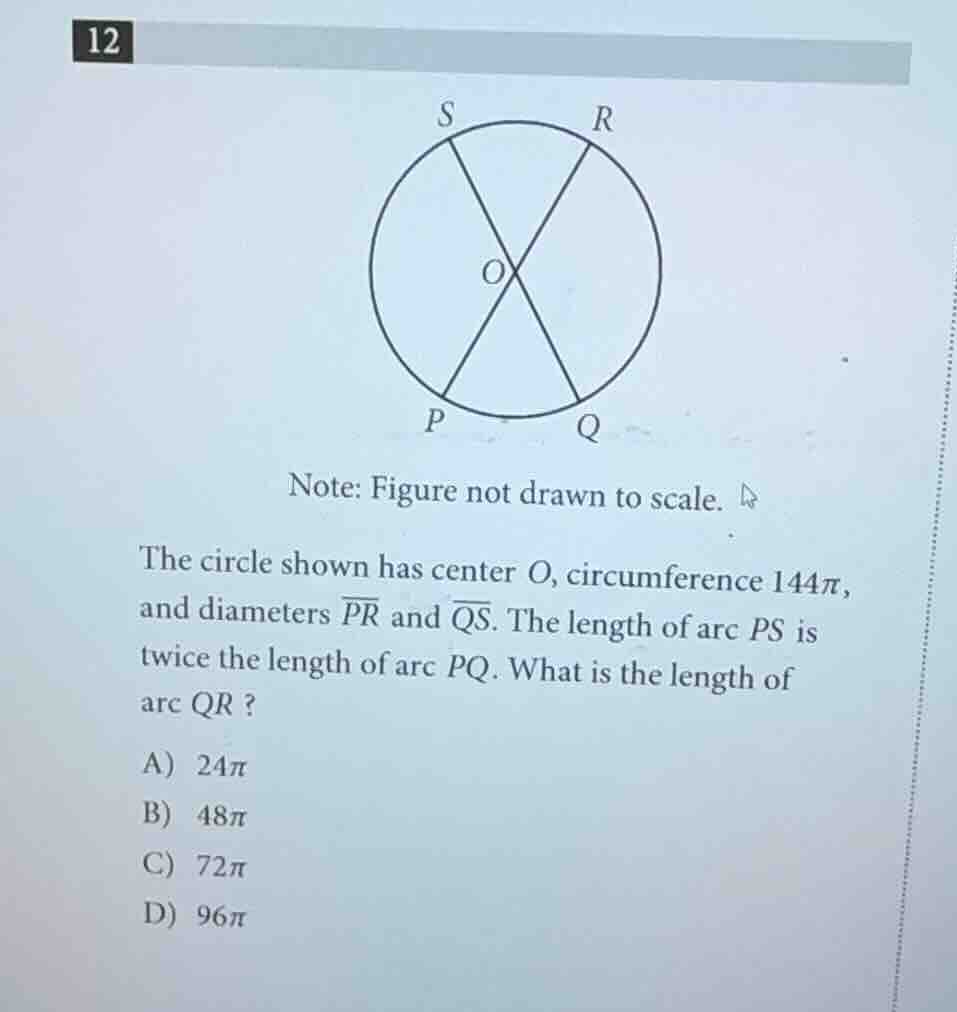
note: figure not drawn to scale. the circle shown has center o, circumference 144π, and diameters \\(overline{pr}\\) and \\(overline{qs}\\). the length of arc ps is twice the length of arc pq. what is the length of arc qr ? a) 24π b) 48π c) 72π d) 96π
Step1: Recall arc length and circle properties
The circumference of a circle is \( C = 144\pi \). Since \( PR \) and \( QS \) are diameters, they intersect at the center \( O \), so vertical angles are equal and the sum of arcs around a circle is the circumference. Let the length of arc \( PQ = x \), then arc \( PS = 2x \). Also, note that arc \( PQ \) and arc \( SR \) are equal (vertical angles), arc \( PS \) and arc \( QR \) are equal (vertical angles) because the vertical angles formed by the intersecting diameters imply equal arc lengths for opposite arcs. Wait, actually, let's think in terms of the sum of arcs. The arcs \( PQ \), \( QR \), \( RS \), \( SP \) make up the whole circle? Wait no, the diameters divide the circle into four arcs: \( PQ \), \( QR \), \( RS \), \( SP \). But since \( PR \) and \( QS \) are diameters, the sum of arc \( PQ \) and arc \( QR \) should be a semicircle? Wait no, actually, the circumference is \( 144\pi \), so a semicircle (half the circle) would be \( \frac{144\pi}{2}=72\pi \). Wait, let's correct: the two diameters \( PR \) and \( QS \) intersect at \( O \), so they form vertical angles. So arc \( PQ \) and arc \( SR \) are equal, arc \( PS \) and arc \( QR \) are equal. Also, the sum of arc \( PQ + arc PS \) should be a semicircle? Wait, no. Wait, the circle is 360 degrees, so the circumference is \( 144\pi \). Let's denote arc \( PQ = x \), then arc \( PS = 2x \). Since \( PR \) is a diameter, the arc \( PQR \) (wait, no, \( PR \) is a diameter, so the arc from \( P \) to \( R \) is a semicircle, length \( \frac{144\pi}{2}=72\pi \). Similarly, \( QS \) is a diameter, so arc from \( Q \) to \( S \) is a semicircle, length \( 72\pi \). Wait, maybe better to use the fact that the sum of arc \( PQ \) and arc \( PS \) is equal to the semicircle? Wait, no, \( PR \) is a diameter, so the arc from \( P \) to \( R \) is a semicircle (180 degrees), so arc \( PQ + arc QR = semicircle \) (72π), and \( QS \) is a diameter, so arc \( QR + arc RS = semicircle \) (72π). But also, arc \( PS = 2 arc PQ \), and arc \( PS = arc QR \) (vertical angles), arc \( PQ = arc SR \) (vertical angles). Let's let arc \( PQ = x \), then arc \( PS = 2x \). Since \( PR \) is a diameter, the arc from \( P \) to \( R \) is \( arc PQ + arc QR = x + 2x = 3x \)? Wait, no, that can't be, because a semicircle is 72π. Wait, no, I think I made a mistake. Let's start over.
The circumference \( C = 144\pi \). The circle is divided into four arcs by the two diameters: \( PQ \), \( QR \), \( RS \), \( SP \). Since the diameters intersect at \( O \), the vertical angles are equal, so \( \angle POQ = \angle ROS \) (so arc \( PQ = arc RS \)) and \( \angle POS = \angle QOR \) (so arc \( PS = arc QR \)). Let arc \( PQ = x \), then arc \( RS = x \). Let arc \( PS = y \), then arc \( QR = y \). The total circumference is \( x + y + x + y = 2x + 2y = 144\pi \), so \( x + y = 72\pi \) (which is a semicircle, makes sense because each diameter divides the circle into two semicircles). Now, the problem states that the length of arc \( PS \) is twice the length of arc \( PQ \), so \( y = 2x \). Now we have two equations: \( x + y = 72\pi \) and \( y = 2x \). Substitute \( y = 2x \) into \( x + y = 72\pi \): \( x + 2x = 72\pi \) → \( 3x = 72\pi \) → \( x = 24\pi \). Then \( y = 2x = 48\pi \). But arc \( QR = y \), so arc \( QR = 48\pi \)? Wait, no, wait. Wait, if \( y = 2x \) and \( x + y = 72\pi \), then \( x = 24\pi \), \( y = 48\pi \). But arc \( QR = y \), so that's 48π? Wait, but let's check again. Wait, the two diameters: \( PR \) and \( QS…

Snap & solve any problem in the app
Get step-by-step solutions on Sovi AI
Photo-based solutions with guided steps
Explore more problems and detailed explanations
B) 48π