QUESTION IMAGE
Question
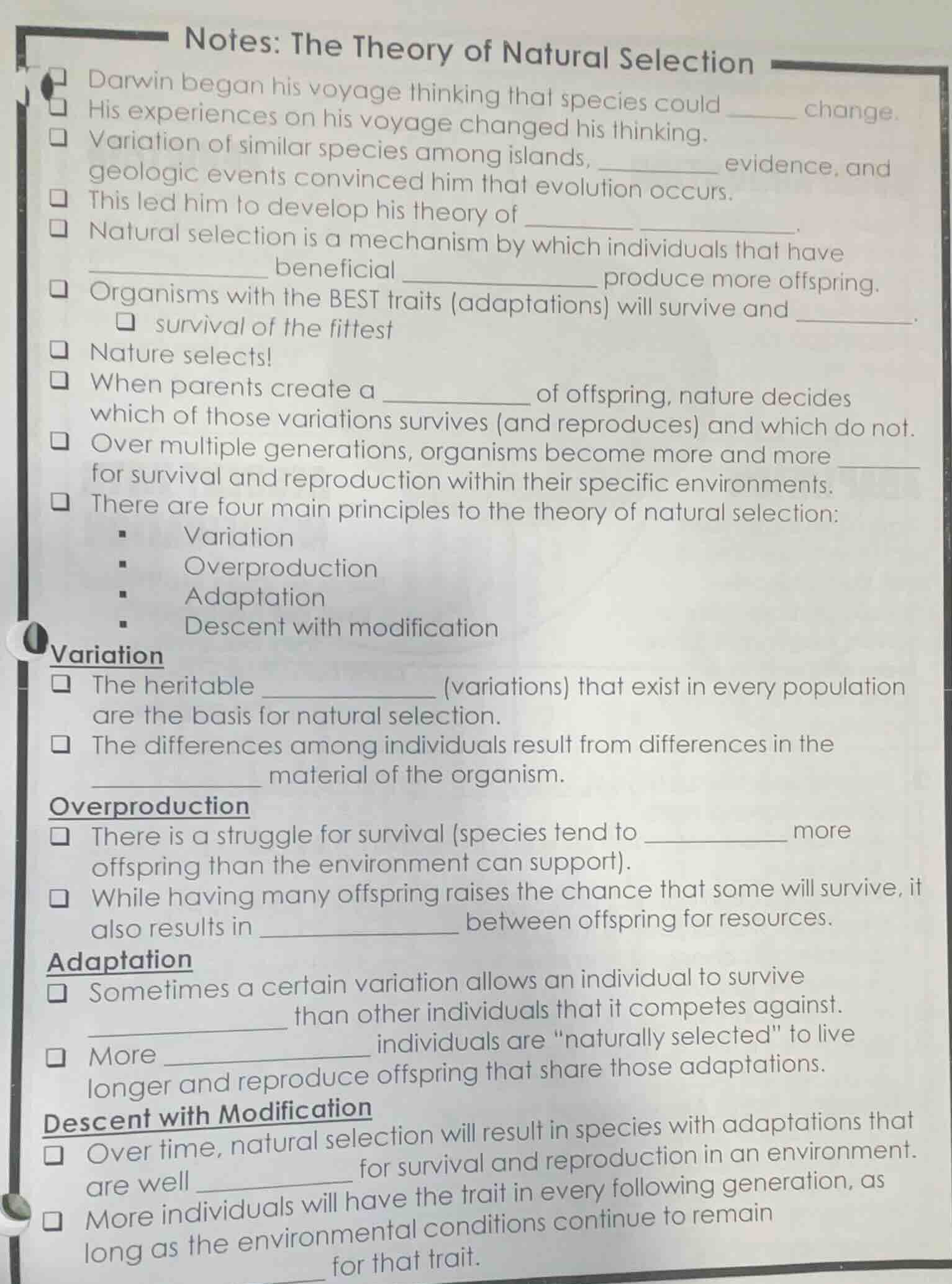
notes: the theory of natural selection
darwin began his voyage thinking that species could ____ change.
his experiences on his voyage changed his thinking.
variation of similar species among islands, ______ evidence, and geologic events convinced him that evolution occurs.
this led him to develop his theory of ____ ____.
natural selection is a mechanism by which individuals that have ____ beneficial ____ produce more offspring.
organisms with the best traits (adaptations) will survive and ______.
survival of the fittest
nature selects!
when parents create a ______ of offspring, nature decides which of those variations survives (and reproduces) and which do not.
over multiple generations, organisms become more and more ______ for survival and reproduction within their specific environments.
there are four main principles to the theory of natural selection:
- variation
- overproduction
- adaptation
- descent with modification
variation
the heritable ______ (variations) that exist in every population are the basis for natural selection.
the differences among individuals result from differences in the ______ material of the organism.
overproduction
there is a struggle for survival (species tend to ______ more offspring than the environment can support).
while having many offspring raises the chance that some will survive, it also results in ______ between offspring for resources.
adaptation
sometimes a certain variation allows an individual to survive ______ than other individuals that it competes against.
more ______ individuals are
aturally selected\ to live longer and reproduce offspring that share those adaptations.
descent with modification
over time, natural selection will result in species with adaptations that are well ______ for survival and reproduction in an environment.
more individuals will have the trait in every following generation, as long as the environmental conditions continue to remain ______ for that trait.
These blanks are filled based on core concepts of Darwin's Theory of Natural Selection, including his initial views, evidence for evolution, and the four key principles of the theory.

Snap & solve any problem in the app
Get step-by-step solutions on Sovi AI
Photo-based solutions with guided steps
Explore more problems and detailed explanations
- Darwin began his voyage thinking that species could not change.
- Variation of similar species among islands, fossil evidence, and geologic events convinced him that evolution occurs.
- This led him to develop his theory of natural selection.
- Natural selection is a mechanism by which individuals that have inheritable beneficial traits produce more offspring.
- Organisms with the BEST traits (adaptations) will survive and reproduce.
- When parents create a variety of offspring, nature decides which of those variations survives (and reproduces) and which do not.
- Over multiple generations, organisms become more and more adapted for survival and reproduction within their specific environments.
- The heritable differences (variations) that exist in every population are the basis for natural selection.
- The differences among individuals result from differences in the genetic material of the organism.
- There is a struggle for survival (species tend to produce more offspring than the environment can support).
- While having many offspring raises the chance that some will survive, it also results in competition between offspring for resources.
- Sometimes a certain variation allows an individual to survive better than other individuals that it competes against.
- More favorable/adapted individuals are "naturally selected" to live longer and reproduce offspring that share those adaptations.
- Over time, natural selection will result in species with adaptations that are well suited for survival and reproduction in an environment.
- More individuals will have the trait in every following generation, as long as the environmental conditions continue to remain favorable for that trait.