QUESTION IMAGE
Question
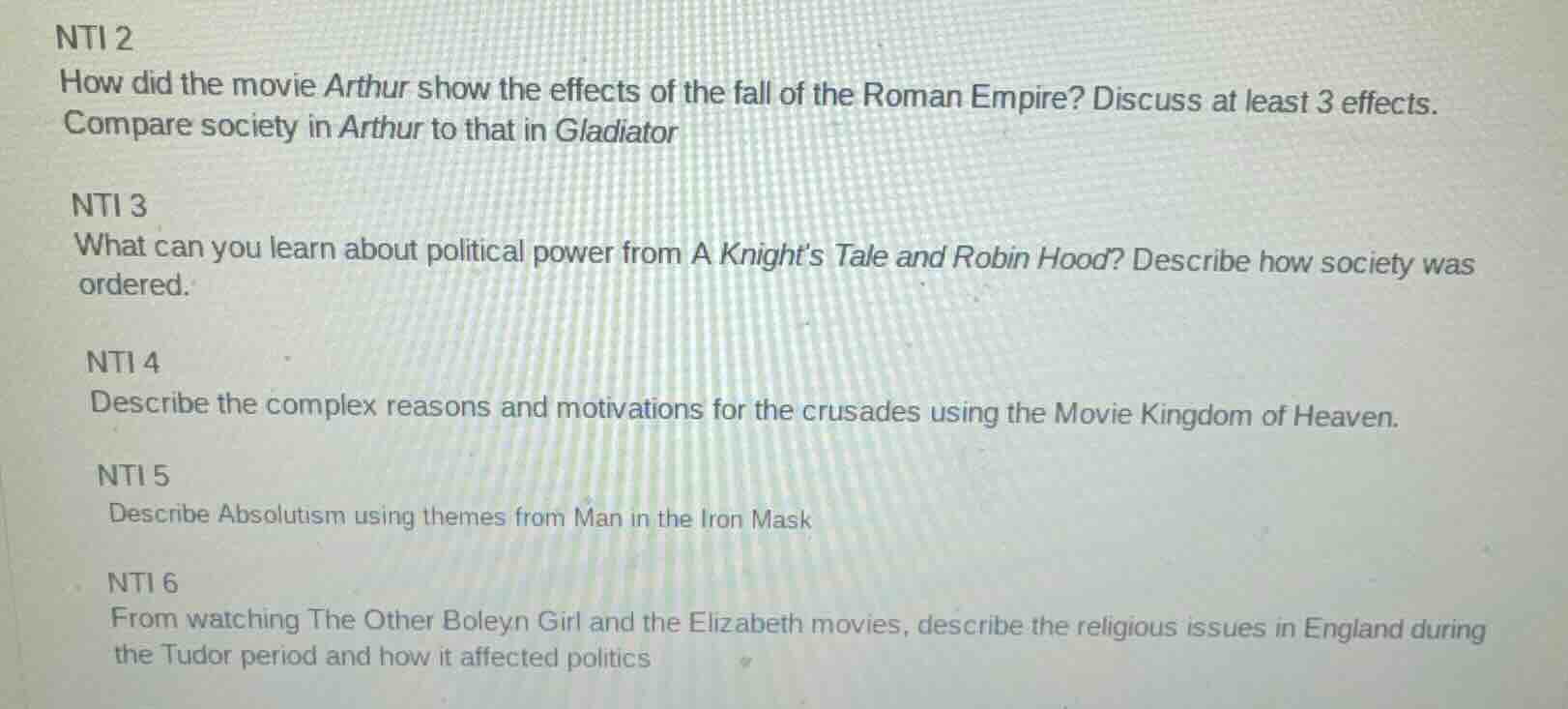
nti 2
how did the movie arthur show the effects of the fall of the roman empire? discuss at least 3 effects.
compare society in arthur to that in gladiator
nti 3
what can you learn about political power from a knight’s tale and robin hood? describe how society was
ordered.
nti 4
describe the complex reasons and motivations for the crusades using the movie kingdom of heaven.
nti 5
describe absolutism using themes from man in the iron mask
nti 6
from watching the other boleyn girl and the elizabeth movies, describe the religious issues in england during
the tudor period and how it affected politics
NTI 2
- *Effects of Roman Empire's Fall in Arthur***:
- Collapse of Centralized Governance: The film shows fragmented British kingdoms warring without Roman imperial authority, with local warlords seizing power instead of a unified administration.
- Cultural and Linguistic Shift: It depicts the blending of Roman cultural remnants (like military tactics) with Celtic Anglo-Saxon traditions, as Roman influence fades and local identities reemerge.
- Economic Instability: The breakdown of Roman trade networks leads to a subsistence-based economy, with communities relying on local production rather than long-distance Roman trade routes.
- *Society Comparison (Arthur vs. Gladiator)*:
- Arthur is set in the post-Roman "dark age" of Britain, with a decentralized, tribal-like society focused on survival and local power struggles. Gladiator is set in the height of Roman imperial power, with a highly centralized, urbanized society structured around the Roman state, emperor worship, and a rigid class system (patricians, plebeians, slaves).
NTI 3
- Political Power Lessons:
- A Knight's Tale shows that political and social power in medieval society was tied to birth and title, but also could be subverted through performance and charisma (William Thatcher passing as a knight). Robin Hood emphasizes that illegitimate or oppressive power (from the corrupt prince/king) can be challenged by popular support, framing power as accountable to the people's well-being.
- Societal Order:
- Both films depict a feudal order: a strict hierarchy with monarchs/nobles at the top, followed by knights, then peasants and commoners. Power is concentrated in the landed elite, with commoners subject to their laws and taxes, though Robin Hood highlights tensions when elites abuse this order.
NTI 4
- Religious Motivation: The film frames the Crusades as a call from the Catholic Church, with characters driven by the desire to reclaim the Holy Land (Jerusalem) for Christianity, seeing it as a sacred duty to protect pilgrims and religious sites.
- Political Ambition: Secular leaders, like the ambitious noblemen and the weakening Byzantine Empire, use the Crusades to expand territorial power, seize wealth, and distract from internal political conflicts in Europe.
- Economic Incentive: Lower-class participants are motivated by the promise of plunder, land, and escape from poverty in Europe, while merchants seek new trade routes in the Middle East that the Crusades would open up.
NTI 5
- Centralization of Power: The film depicts King Louis XIV as a ruler who consolidates all authority in himself, controlling the military, nobility, and state institutions, eliminating any competing centers of power (like the twin brother he imprisons).
- Control of the Elite: Louis forces nobles to live at Versailles, where he monitors their actions, curtails their independent power bases, and uses patronage to ensure their loyalty, making them dependent on the monarch's favor.
- Suppression of Dissent: The iron mask itself symbolizes absolutism's ability to crush opposition; any threat to the monarch's absolute rule (like the rightful twin heir) is imprisoned and silenced to maintain unchallenged authority.
NTI 6
- Religious Issues: The Tudor period saw the split from the Catholic Church under Henry VIII (to annul his marriage and establish the Church of England), followed by religious conflict between Catholics and Protestants. The Other Boleyn Girl shows tensions from Henry's break…

Snap & solve any problem in the app
Get step-by-step solutions on Sovi AI
Photo-based solutions with guided steps
Explore more problems and detailed explanations
NTI 2
- Effects of Roman fall in Arthur:
- Fragmented, warring local kingdoms
- Blending of Roman and Celtic cultures
- Collapsed trade, subsistence economy
- Society comparison: Arthur has a decentralized, post-imperial survival-focused society; Gladiator has a centralized, urban, class-stratified Roman imperial society.
NTI 3
- Political power: Power is tied to birth (but can be subverted by charisma in A Knight's Tale); oppressive power faces popular challenge in Robin Hood.
- Societal order: Feudal hierarchy with monarchs/nobles at the top, commoners subject to elite rule, with tensions over elite abuse.
NTI 4
Crusade motivations in Kingdom of Heaven:
- Religious duty to reclaim the Holy Land
- Political ambition to expand territorial power
- Economic opportunity for plunder and trade access
NTI 5
Absolutism in Man in the Iron Mask:
- Total centralization of power in the monarch
- Control of the nobility through court surveillance and patronage
- Brutal suppression of all political dissent
NTI 6
- Religious issues: England's split from the Catholic Church under Henry VIII, violent Catholic-Protestant conflict under Elizabeth I.
- Political impact: Religious policy was used to consolidate royal power, and religious factionalism threatened political stability, requiring rulers to balance or suppress opposing groups.