QUESTION IMAGE
Question
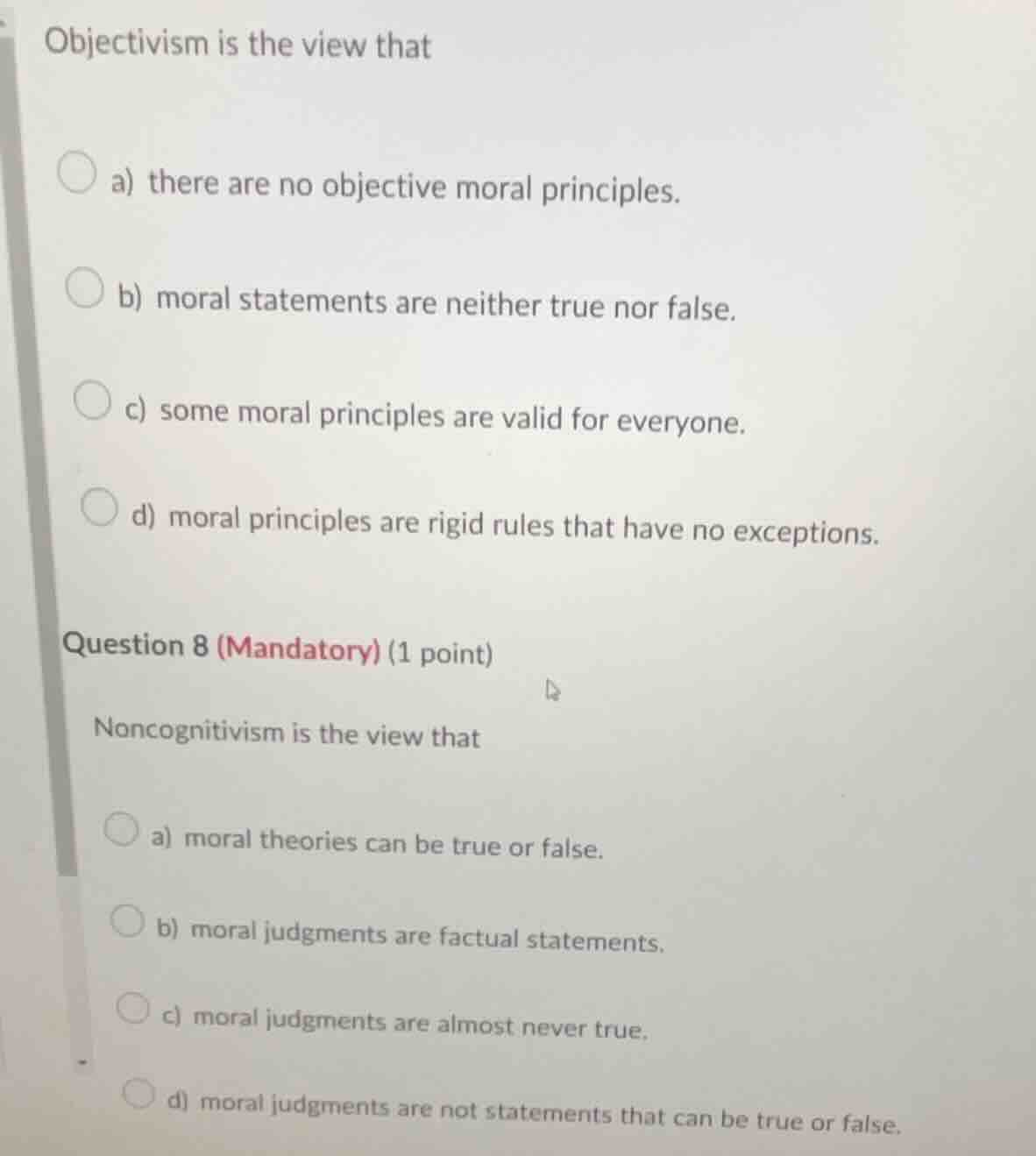
objectivism is the view that
a) there are no objective moral principles.
b) moral statements are neither true nor false.
c) some moral principles are valid for everyone.
d) moral principles are rigid rules that have no exceptions.
question 8 (mandatory) (1 point)
noncognitivism is the view that
a) moral theories can be true or false.
b) moral judgments are factual statements.
c) moral judgments are almost never true.
d) moral judgments are not statements that can be true or false.
For the first question: Objectivism in ethics holds that there are moral principles that apply universally to all people. Option a describes moral nihilism, option b describes noncognitivism, and option d misrepresents objectivism (it does not require absolute rigidity without exceptions).
For the second question: Noncognitivism is the meta-ethical view that moral judgments do not function as factual statements that can be proven true or false, instead they express attitudes or prescriptions. Options a and b align with cognitivist views, and option c does not match the core of noncognitivism.

Snap & solve any problem in the app
Get step-by-step solutions on Sovi AI
Photo-based solutions with guided steps
Explore more problems and detailed explanations
- c) some moral principles are valid for everyone.
- d) moral judgments are not statements that can be true or false.