QUESTION IMAGE
Question
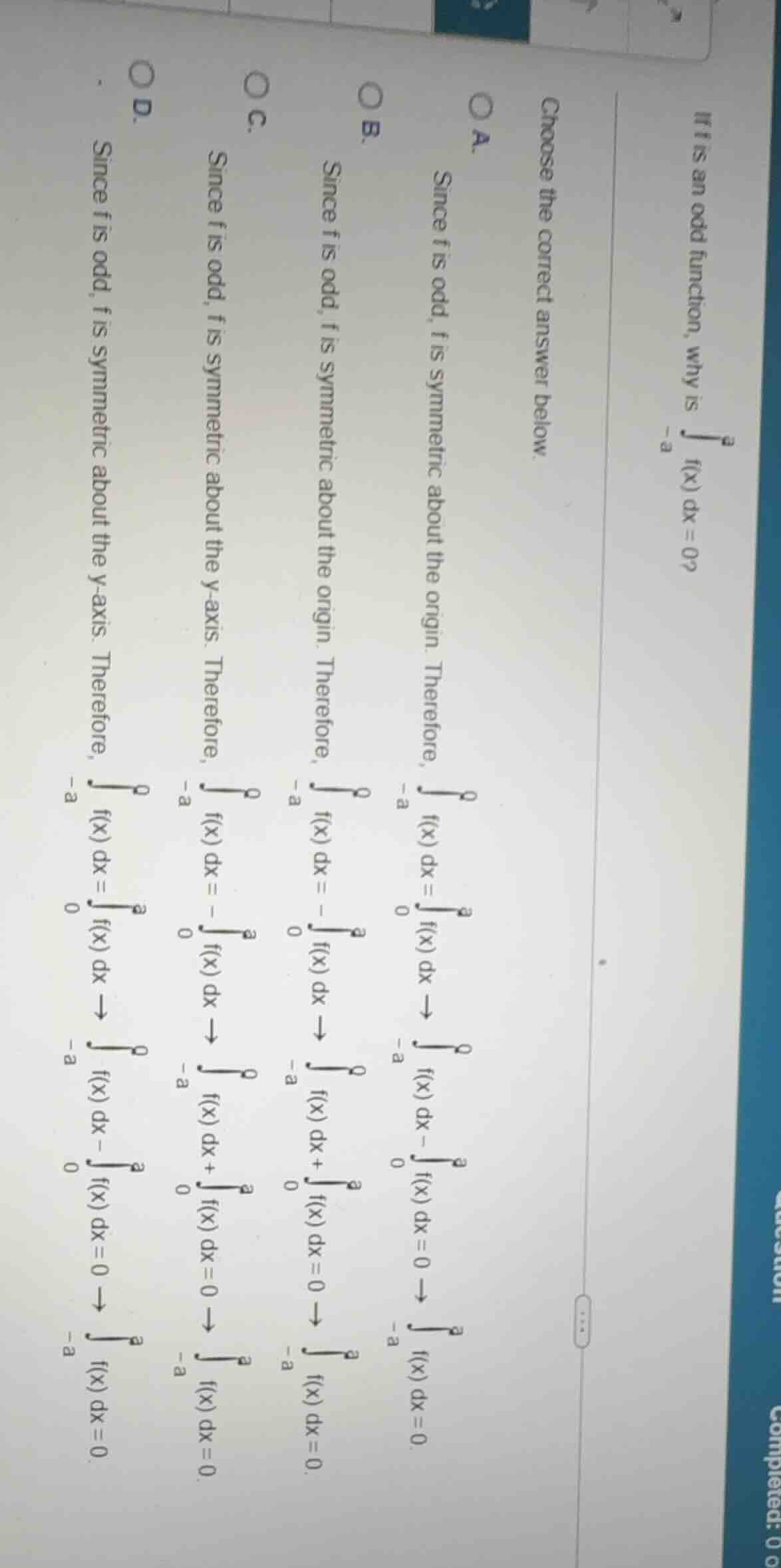
if f is an odd function, why is \\(\int_{-a}^{a} f(x) \\, dx = 0\\)?
choose the correct answer below.
a. since f is odd, f is symmetric about the origin. therefore, \\(\int_{-a}^{0} f(x) \\, dx = \int_{0}^{a} f(x) \\, dx \
ightarrow \int_{-a}^{0} f(x) \\, dx - \int_{0}^{a} f(x) \\, dx = 0 \
ightarrow \int_{-a}^{a} f(x) \\, dx = 0\\).
b. since f is odd, f is symmetric about the origin. therefore, \\(\int_{-a}^{0} f(x) \\, dx = -\int_{0}^{a} f(x) \\, dx \
ightarrow \int_{-a}^{0} f(x) \\, dx + \int_{0}^{a} f(x) \\, dx = 0 \
ightarrow \int_{-a}^{a} f(x) \\, dx = 0\\).
c. since f is odd, f is symmetric about the y - axis. therefore, \\(\int_{-a}^{0} f(x) \\, dx = -\int_{0}^{a} f(x) \\, dx \
ightarrow \int_{-a}^{0} f(x) \\, dx + \int_{0}^{a} f(x) \\, dx = 0 \
ightarrow \int_{-a}^{a} f(x) \\, dx = 0\\).
d. since f is odd, f is symmetric about the y - axis. therefore, \\(\int_{-a}^{0} f(x) \\, dx = \int_{0}^{a} f(x) \\, dx \
ightarrow \int_{-a}^{0} f(x) \\, dx - \int_{0}^{a} f(x) \\, dx = 0 \
ightarrow \int_{-a}^{a} f(x) \\, dx = 0\\).
An odd function is symmetric about the origin, meaning $f(-x) = -f(x)$. When splitting the definite integral over $[-a,a]$ into two parts $\int_{-a}^{0} f(x)dx + \int_{0}^{a} f(x)dx$, a substitution shows $\int_{-a}^{0} f(x)dx = -\int_{0}^{a} f(x)dx$. Adding these two equal and opposite values gives 0. Options A and D incorrectly state odd functions are symmetric about the y-axis (that is for even functions), and option A uses an incorrect sign relationship for the integrals. Option C incorrectly claims odd functions are symmetric about the y-axis.

Snap & solve any problem in the app
Get step-by-step solutions on Sovi AI
Photo-based solutions with guided steps
Explore more problems and detailed explanations
B. Since f is odd, f is symmetric about the origin. Therefore, $\int_{-a}^{0} f(x) dx = -\int_{0}^{a} f(x) dx
ightarrow \int_{-a}^{0} f(x) dx + \int_{0}^{a} f(x) dx = 0
ightarrow \int_{-a}^{a} f(x) dx = 0$