QUESTION IMAGE
Question
one and two-step equations
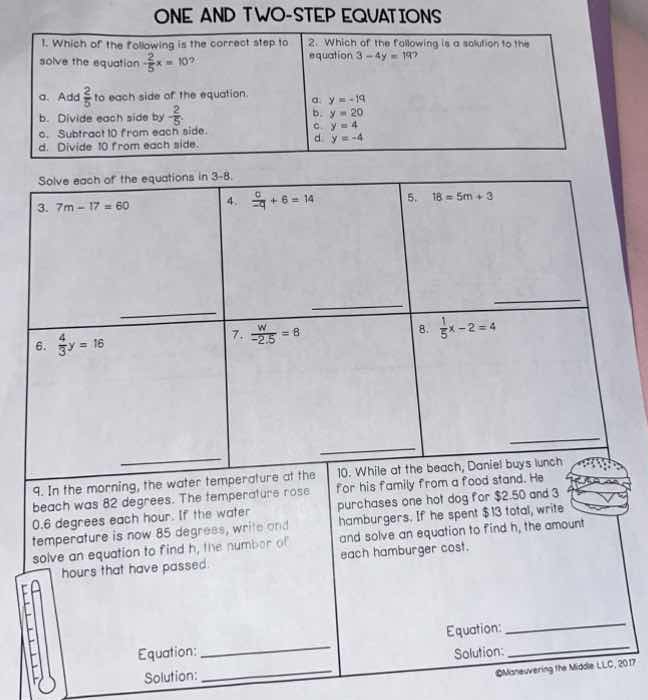
- which of the following is the correct step to solve the equation \\(-\frac{2}{5}x = 10\\)?
a. add \\(\frac{2}{5}\\) to each side of the equation.
b. divide each side by \\(-\frac{2}{5}\\).
c. subtract 10 from each side.
d. divide 10 from each side.
- which of the following is a solution to the equation \\(d - 4y = 19\\)?
a. \\(y = -19\\)
b. \\(y = 20\\)
c. \\(y = -4\\)
d. \\(y = 4\\)
solve each of the equations in 3 - 8.
- \\(7m - 17 = 60\\)
- \\(-\frac{a}{9} + 6 = 14\\)
- \\(18 = 5m + 3\\)
- \\(\frac{4}{3}y = 16\\)
- \\(\frac{w}{-2.5} = 8\\)
- \\(\frac{1}{5}x - 2 = 4\\)
- in the morning, the water temperature at the beach was 82 degrees. the temperature rose 0.6 degrees each hour. if the water temperature is now 85 degrees, write and solve an equation to find \\(h\\), the number of hours that have passed.
equation: \\_________
solution: \\_________
- while at the beach, daniel buys lunch for his family from a food stand. he purchases one hot dog for $2.50 and 3 hamburgers. if he spent $13 total, write and solve an equation to find \\(h\\), the amount each hamburger cost.
equation: \\_________
solution: \\_________
\\(\text{©unraveling the middle llc, 2017}\\)
Question 1
To solve \(\frac{2}{5}x = 10\), we need to isolate \(x\). The coefficient of \(x\) is \(\frac{2}{5}\), so we can divide each side by \(\frac{2}{5}\) (or multiply by its reciprocal \(\frac{5}{2}\)) to solve for \(x\). Option a is incorrect as adding \(\frac{2}{5}\) won't isolate \(x\). Option c is incorrect as subtracting 10 is not the right operation. Option d is incorrect as dividing 10 from each side is not the correct method.
Step 1: Start with the equation \(d - 4y=19\)? Wait, maybe it's a typo, probably \(0 - 4y = 19\) or \(x - 4y=19\), but likely the equation is \(- 4y=19\)? Wait, no, let's check the options. Let's solve for \(y\) in \(-4y = 19\)? No, wait the options are \(y = - 19\), \(y = 20\), \(y=-\frac{19}{4}\), \(y = - 4\). Wait, maybe the equation is \(d - 4y=19\) with \(d = - 21\)? No, maybe the original equation is \(-4y=19\)? Wait, no, let's re - examine. Wait, maybe the equation is \(x-4y = 19\) with \(x = - 21\)? No, perhaps the equation is \(-4y=19\), then \(y=-\frac{19}{4}=-4.75\), but that's not in the options. Wait, maybe the equation is \(d - 4y=19\) with \(d=-21\), then \(-21 - 4y=19\), add 21 to both sides: \(-4y=40\), \(y = - 10\), no. Wait, maybe the equation is \(0-4y = 19\), then \(y=-\frac{19}{4}\approx - 4.75\), but the option c is \(y =-\frac{19}{4}\) (if we consider \(y =-\frac{19}{4}\)). Wait, maybe the equation is \(x - 4y=19\) with \(x = - 21\), no. Alternatively, maybe the equation is \(d-4y = 19\) and \(d=-21\), then \(-21-4y = 19\), \(-4y=40\), \(y=-10\), no. Wait, perhaps there is a typo and the equation is \(-4y = 19\), then \(y =-\frac{19}{4}\), which is option c.
Step 1: Given the equation (assuming it's \(-4y=19\))
We have the equation \(-4y = 19\)
Step 2: Solve for \(y\)
Divide both sides by \(-4\): \(y=\frac{19}{-4}=-\frac{19}{4}\)
Step 1: Start with the equation \(7m-17 = 60\)
We need to isolate the term with \(m\) first. Add 17 to both sides of the equation.
\(7m-17 + 17=60 + 17\)
Step 2: Simplify the equation
Simplifying both sides, we get \(7m=77\)
Step 3: Solve for \(m\)
Divide both sides by 7: \(m=\frac{77}{7}=11\)

Snap & solve any problem in the app
Get step-by-step solutions on Sovi AI
Photo-based solutions with guided steps
Explore more problems and detailed explanations
b. Divide each side by \(\frac{2}{5}\)