QUESTION IMAGE
Question
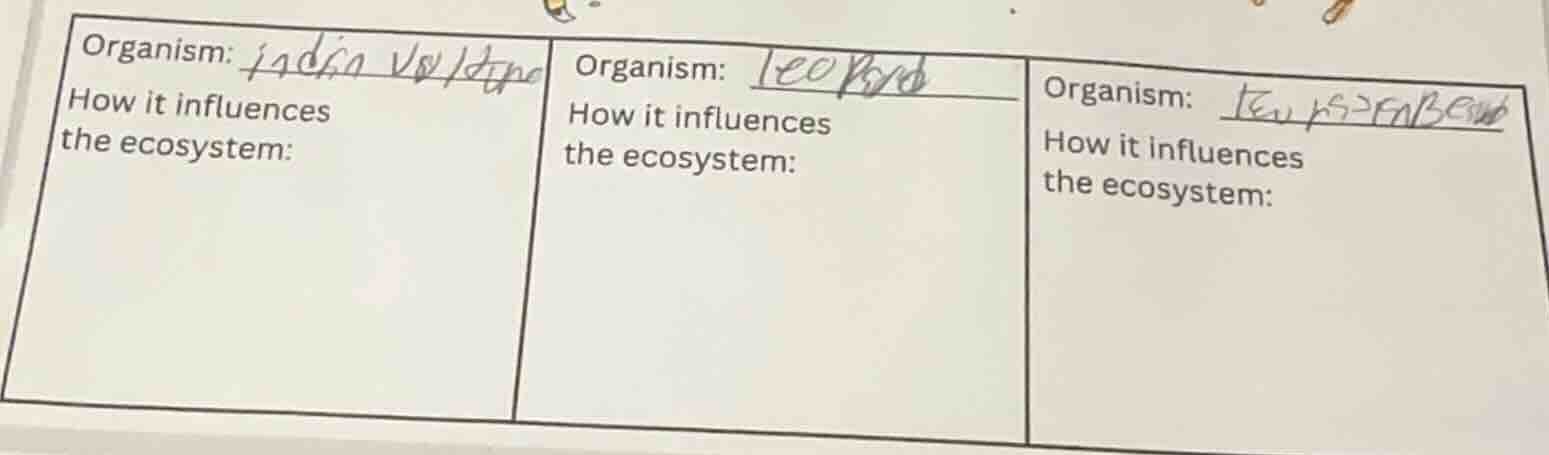
organism:
how it influences
the ecosystem:
organism:
how it influences
the ecosystem:
organism:
how it influences
the ecosystem:
To complete this task, we analyze each organism and its ecological influence:
First Organism: Indian Vulture (assuming "India Vulture" was intended)
- Ecological Role: Scavenger. Feeds on carrion (dead animals).
- Influence: Controls disease spread by consuming carcasses, preventing the proliferation of pathogens. Also recycles nutrients back into the ecosystem.
Second Organism: Leopard
- Ecological Role: Apex predator.
- Influence: Regulates prey populations (e.g., deer, rodents), maintaining balance in the food web. Prey species’ behavior (e.g., foraging patterns) is shaped by leopard presence, which in turn affects vegetation (e.g., reduced overgrazing).
Third Organism: Honey Bee (assuming "Honey Bee" was intended)
- Ecological Role: Pollinator.
- Influence: Facilitates plant reproduction (pollination) for many flowering plants, including crops. This supports plant diversity, provides food for other organisms, and is critical for agriculture (e.g., fruit production).
Filled Table (example):
| Organism | How it influences the ecosystem |
|---|---|
| Leopard | Regulates prey populations, maintaining food web balance and shaping prey behavior/vegetation. |
| Honey Bee | Pollinates flowering plants, supporting plant diversity and agricultural productivity. |
(Note: If the third organism was misspelled, adjust based on the correct species. The key is to link the organism’s role—scavenger, predator, pollinator, etc.—to its ecological impact.)

Snap & solve any problem in the app
Get step-by-step solutions on Sovi AI
Photo-based solutions with guided steps
Explore more problems and detailed explanations
To complete this task, we analyze each organism and its ecological influence:
First Organism: Indian Vulture (assuming "India Vulture" was intended)
- Ecological Role: Scavenger. Feeds on carrion (dead animals).
- Influence: Controls disease spread by consuming carcasses, preventing the proliferation of pathogens. Also recycles nutrients back into the ecosystem.
Second Organism: Leopard
- Ecological Role: Apex predator.
- Influence: Regulates prey populations (e.g., deer, rodents), maintaining balance in the food web. Prey species’ behavior (e.g., foraging patterns) is shaped by leopard presence, which in turn affects vegetation (e.g., reduced overgrazing).
Third Organism: Honey Bee (assuming "Honey Bee" was intended)
- Ecological Role: Pollinator.
- Influence: Facilitates plant reproduction (pollination) for many flowering plants, including crops. This supports plant diversity, provides food for other organisms, and is critical for agriculture (e.g., fruit production).
Filled Table (example):
| Organism | How it influences the ecosystem |
|---|---|
| Leopard | Regulates prey populations, maintaining food web balance and shaping prey behavior/vegetation. |
| Honey Bee | Pollinates flowering plants, supporting plant diversity and agricultural productivity. |
(Note: If the third organism was misspelled, adjust based on the correct species. The key is to link the organism’s role—scavenger, predator, pollinator, etc.—to its ecological impact.)