QUESTION IMAGE
Question
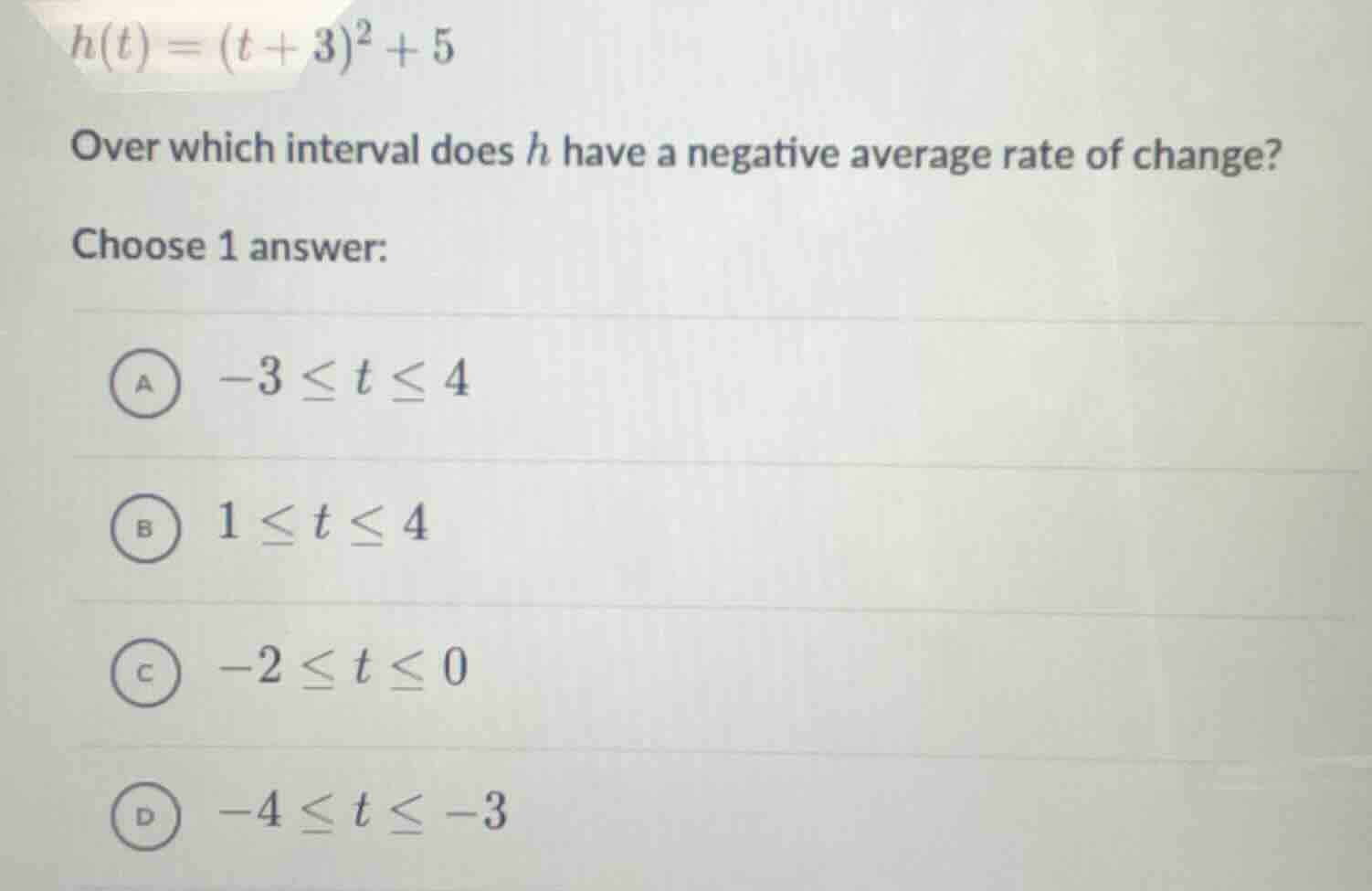
h(t) = (t + 3)^2 + 5
over which interval does h have a negative average rate of change?
choose 1 answer:
a -3 ≤ t ≤ 4
b 1 ≤ t ≤ 4
c -2 ≤ t ≤ 0
d -4 ≤ t ≤ -3
The function \( h(t) = (t + 3)^2 + 5 \) is a quadratic function in vertex form \( y = a(x - h)^2 + k \), where the vertex is at \( (-3, 5) \) and since \( a = 1 > 0 \), the parabola opens upwards. The function is decreasing to the left of the vertex (\( t < -3 \)) and increasing to the right of the vertex (\( t > -3 \)). The average rate of change over an interval \([a, b]\) is given by \( \frac{h(b) - h(a)}{b - a} \). For the average rate of change to be negative, the function must be decreasing over the interval, which occurs when \( a < b < -3 \) (since the function decreases before \( t = -3 \)).
Let's analyze each option:
- Option A: \( -3 \leq t \leq 4 \). Here, \( t \) starts at the vertex (\( t = -3 \)) and goes to \( t = 4 \). Since the parabola opens upwards, the function is increasing for \( t > -3 \). So the average rate of change will be positive.
- Option B: \( 1 \leq t \leq 4 \). This is in the increasing part (\( t > -3 \)), so the average rate of change is positive.
- Option C: \( -2 \leq t \leq 0 \). This is also in the increasing part (\( t > -3 \)), so the average rate of change is positive.
- Option D: \( -4 \leq t \leq -3 \). Here, \( t \) is from \( -4 \) (which is left of the vertex \( t = -3 \)) to \( -3 \) (the vertex). Since the function is decreasing for \( t < -3 \), as \( t \) increases from \( -4 \) to \( -3 \), \( h(t) \) will increase? Wait, no. Wait, the vertex is at \( t = -3 \), and the parabola opens upwards. So when \( t \) is less than \( -3 \), as \( t \) increases towards \( -3 \), \( h(t) \) decreases? Wait, no. Let's compute \( h(-4) \) and \( h(-3) \):
- \( h(-4) = (-4 + 3)^2 + 5 = (-1)^2 + 5 = 1 + 5 = 6 \)
- \( h(-3) = (-3 + 3)^2 + 5 = 0 + 5 = 5 \)
So the average rate of change over \( [-4, -3] \) is \( \frac{h(-3) - h(-4)}{-3 - (-4)} = \frac{5 - 6}{1} = -1 \), which is negative.
Wait, maybe I made a mistake earlier. Let's re-express the function: \( h(t) = (t + 3)^2 + 5 = t^2 + 6t + 9 + 5 = t^2 + 6t + 14 \). The derivative (slope) is \( h'(t) = 2t + 6 \). The function is decreasing when \( h'(t) < 0 \):
\( 2t + 6 < 0 \implies 2t < -6 \implies t < -3 \). So the function is decreasing for \( t < -3 \) and increasing for \( t > -3 \).
So for an interval to have a negative average rate of change, the interval must be entirely within \( t < -3 \) (where the function is decreasing) or have \( h(b) < h(a) \) when \( a < b \).
Let's check each interval:
- Option D: \( a = -4 \), \( b = -3 \). \( h(-4) = 6 \), \( h(-3) = 5 \). So \( h(b) - h(a) = 5 - 6 = -1 \), and \( b - a = -3 - (-4) = 1 \). So average rate of change is \( \frac{-1}{1} = -1 \), which is negative.
For the other options:
- Option A: \( a = -3 \), \( b = 4 \). \( h(-3) = 5 \), \( h(4) = (4 + 3)^2 + 5 = 49 + 5 = 54 \). \( h(b) - h(a) = 54 - 5 = 49 \), \( b - a = 7 \). Average rate: \( 49 / 7 = 7 \) (positive).
- Option B: \( a = 1 \), \( b = 4 \). \( h(1) = (1 + 3)^2 + 5 = 16 + 5 = 21 \), \( h(4) = 54 \). \( 54 - 21 = 33 \), \( 4 - 1 = 3 \). Average rate: \( 33 / 3 = 11 \) (positive).
- Option C: \( a = -2 \), \( b = 0 \). \( h(-2) = (-2 + 3)^2 + 5 = 1 + 5 = 6 \), \( h(0) = (0 + 3)^2 + 5 = 9 + 5 = 14 \). \( 14 - 6 = 8 \), \( 0 - (-2) = 2 \). Average rate: \( 8 / 2 = 4 \) (positive).
So the only interval with a negative average rate of change is Option D.

Snap & solve any problem in the app
Get step-by-step solutions on Sovi AI
Photo-based solutions with guided steps
Explore more problems and detailed explanations
D. \( -4 \leq t \leq -3 \)