QUESTION IMAGE
Question
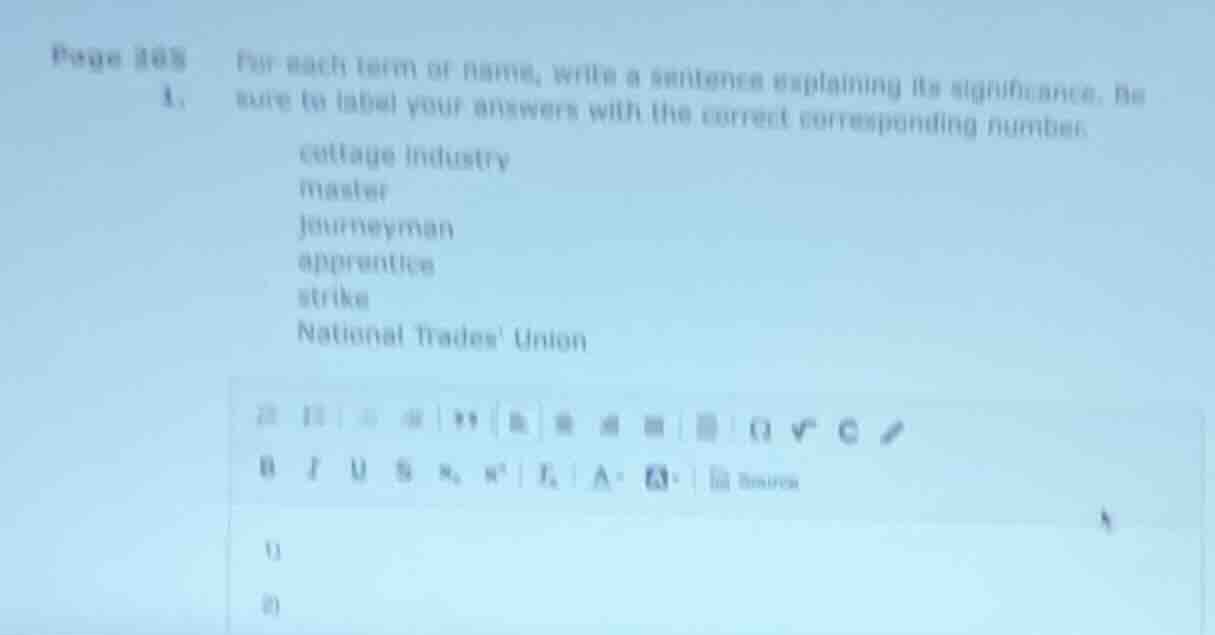
page 185 a. for each term or name, write a sentence explaining its significance. be sure to label your answers with the correct corresponding number. cottage industry master journeyman apprentice strike national trades union
Brief Explanations
- cottage industry: Defined small-scale, home-based production that was foundational to pre-industrial economies, allowing rural households to generate income without centralized factories.
- master: Refers to a highly skilled, experienced craftsperson who owned a workshop, trained lower-level workers, and controlled the production process in guild systems.
- journeyman: A skilled worker who completed apprenticeship, traveled to gain experience, and worked for wages under a master before potentially becoming one themselves.
- apprentice: A young trainee who learned a trade from a master in exchange for labor, often over several years, to gain the skills needed for the craft.
- strike: A collective work stoppage by workers to demand better wages, working conditions, or rights, a key tool for labor advocacy in industrial and pre-industrial settings.
- National Trades' Union: An early 19th-century U.S. federation of trade unions that united skilled workers across crafts, laying groundwork for modern labor organizing.

Snap & solve any problem in the app
Get step-by-step solutions on Sovi AI
Photo-based solutions with guided steps
Explore more problems and detailed explanations
- cottage industry: A small-scale, home-based production system that enabled pre-industrial rural households to earn income outside of centralized factory settings.
- master: A highly skilled craftsperson who owned a workshop, trained less experienced workers, and oversaw production in traditional guild-based economies.
- journeyman: A skilled worker who finished an apprenticeship, traveled to build experience, and worked for wages under a master craftsperson.
- apprentice: A young trainee who learned a trade from a master craftsperson through years of on-the-job labor in exchange for skill instruction.
- strike: A collective work stoppage by workers to negotiate for improved wages, safer working conditions, or better labor rights.
- National Trades' Union: An early U.S. labor federation (1834) that united skilled workers across different crafts, helping to establish collective bargaining as a labor strategy.