QUESTION IMAGE
Question
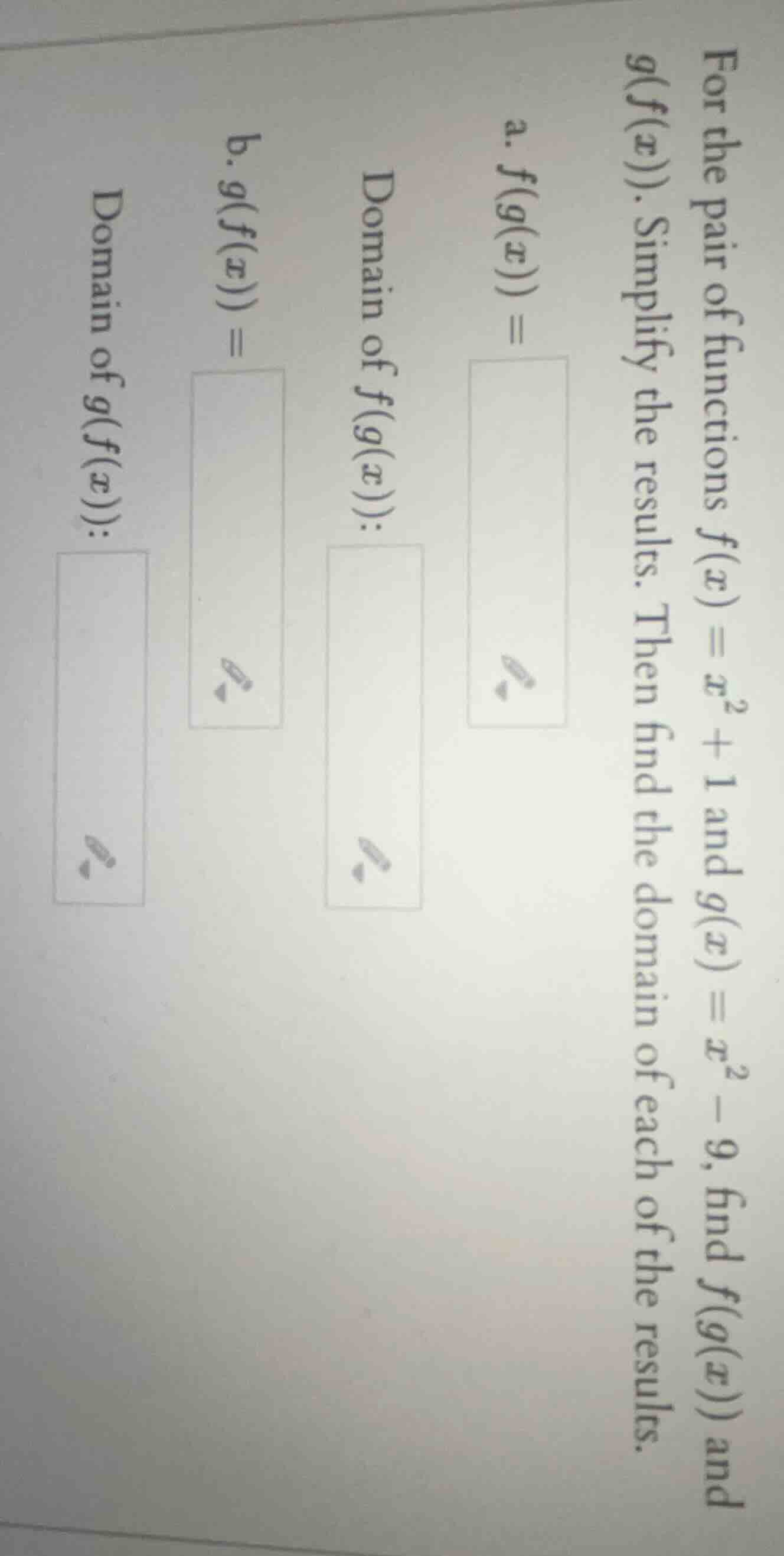
for the pair of functions ( f(x) = x^2 + 1 ) and ( g(x) = x^2 - 9 ), find ( f(g(x)) ) and ( g(f(x)) ). simplify the results. then find the domain of each of the results.
a. ( f(g(x)) = )
domain of ( f(g(x)) ):
b. ( g(f(x)) = )
domain of ( g(f(x)) ):
Part a: \( f(g(x)) \) and its domain
Step 1: Substitute \( g(x) \) into \( f(x) \)
We know \( f(x) = x^2 + 1 \) and \( g(x) = x^2 - 9 \). To find \( f(g(x)) \), we replace every \( x \) in \( f(x) \) with \( g(x) \).
So, \( f(g(x)) = (g(x))^2 + 1 \). Substituting \( g(x)=x^2 - 9 \) into this, we get:
\( f(g(x))=(x^2 - 9)^2 + 1 \)
Step 2: Expand the expression
Using the formula \( (a - b)^2=a^2 - 2ab + b^2 \) where \( a = x^2 \) and \( b=9 \), we have:
\( (x^2 - 9)^2=(x^2)^2-2\times x^2\times9 + 9^2=x^4-18x^2 + 81 \)
Then \( f(g(x))=x^4-18x^2 + 81+1=x^4-18x^2 + 82 \)
Step 3: Find the domain of \( f(g(x)) \)
The function \( f(g(x))=x^4-18x^2 + 82 \) is a polynomial function. Polynomial functions are defined for all real numbers. So the domain is all real numbers, which in interval notation is \( (-\infty,\infty) \)
Part b: \( g(f(x)) \) and its domain
Step 1: Substitute \( f(x) \) into \( g(x) \)
We know \( g(x)=x^2 - 9 \) and \( f(x)=x^2 + 1 \). To find \( g(f(x)) \), we replace every \( x \) in \( g(x) \) with \( f(x) \).
So, \( g(f(x))=(f(x))^2 - 9 \). Substituting \( f(x)=x^2 + 1 \) into this, we get:
\( g(f(x))=(x^2 + 1)^2 - 9 \)
Step 2: Expand the expression
Using the formula \( (a + b)^2=a^2 + 2ab + b^2 \) where \( a = x^2 \) and \( b = 1 \), we have:
\( (x^2 + 1)^2=(x^2)^2+2\times x^2\times1+1^2=x^4 + 2x^2+1 \)
Then \( g(f(x))=x^4 + 2x^2+1 - 9=x^4 + 2x^2-8 \)
Step 3: Find the domain of \( g(f(x)) \)
The function \( g(f(x))=x^4 + 2x^2-8 \) is a polynomial function. Polynomial functions are defined for all real numbers. So the domain is all real numbers, which in interval notation is \( (-\infty,\infty) \)
Final Answers
a.
\( f(g(x))=\boldsymbol{x^4-18x^2 + 82} \)
Domain of \( f(g(x)) \): \(\boldsymbol{(-\infty,\infty)}\)
b.
\( g(f(x))=\boldsymbol{x^4 + 2x^2-8} \)
Domain of \( g(f(x)) \): \(\boldsymbol{(-\infty,\infty)}\)

Snap & solve any problem in the app
Get step-by-step solutions on Sovi AI
Photo-based solutions with guided steps
Explore more problems and detailed explanations
Part a: \( f(g(x)) \) and its domain
Step 1: Substitute \( g(x) \) into \( f(x) \)
We know \( f(x) = x^2 + 1 \) and \( g(x) = x^2 - 9 \). To find \( f(g(x)) \), we replace every \( x \) in \( f(x) \) with \( g(x) \).
So, \( f(g(x)) = (g(x))^2 + 1 \). Substituting \( g(x)=x^2 - 9 \) into this, we get:
\( f(g(x))=(x^2 - 9)^2 + 1 \)
Step 2: Expand the expression
Using the formula \( (a - b)^2=a^2 - 2ab + b^2 \) where \( a = x^2 \) and \( b=9 \), we have:
\( (x^2 - 9)^2=(x^2)^2-2\times x^2\times9 + 9^2=x^4-18x^2 + 81 \)
Then \( f(g(x))=x^4-18x^2 + 81+1=x^4-18x^2 + 82 \)
Step 3: Find the domain of \( f(g(x)) \)
The function \( f(g(x))=x^4-18x^2 + 82 \) is a polynomial function. Polynomial functions are defined for all real numbers. So the domain is all real numbers, which in interval notation is \( (-\infty,\infty) \)
Part b: \( g(f(x)) \) and its domain
Step 1: Substitute \( f(x) \) into \( g(x) \)
We know \( g(x)=x^2 - 9 \) and \( f(x)=x^2 + 1 \). To find \( g(f(x)) \), we replace every \( x \) in \( g(x) \) with \( f(x) \).
So, \( g(f(x))=(f(x))^2 - 9 \). Substituting \( f(x)=x^2 + 1 \) into this, we get:
\( g(f(x))=(x^2 + 1)^2 - 9 \)
Step 2: Expand the expression
Using the formula \( (a + b)^2=a^2 + 2ab + b^2 \) where \( a = x^2 \) and \( b = 1 \), we have:
\( (x^2 + 1)^2=(x^2)^2+2\times x^2\times1+1^2=x^4 + 2x^2+1 \)
Then \( g(f(x))=x^4 + 2x^2+1 - 9=x^4 + 2x^2-8 \)
Step 3: Find the domain of \( g(f(x)) \)
The function \( g(f(x))=x^4 + 2x^2-8 \) is a polynomial function. Polynomial functions are defined for all real numbers. So the domain is all real numbers, which in interval notation is \( (-\infty,\infty) \)
Final Answers
a.
\( f(g(x))=\boldsymbol{x^4-18x^2 + 82} \)
Domain of \( f(g(x)) \): \(\boldsymbol{(-\infty,\infty)}\)
b.
\( g(f(x))=\boldsymbol{x^4 + 2x^2-8} \)
Domain of \( g(f(x)) \): \(\boldsymbol{(-\infty,\infty)}\)