QUESTION IMAGE
Question
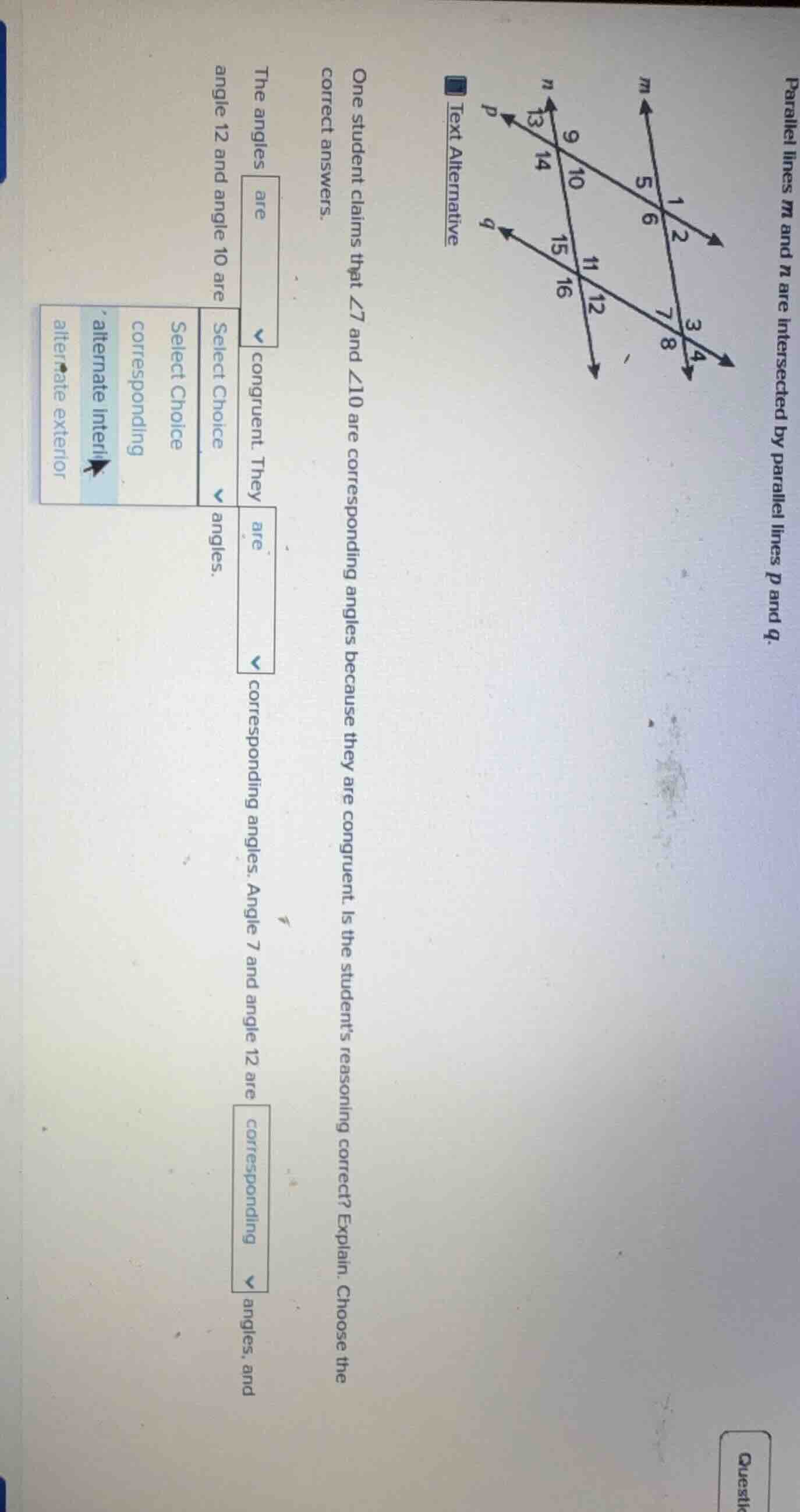
parallel lines m and n are intersected by parallel lines p and q. one student claims that ∠7 and ∠10 are corresponding angles because they are congruent. is the student’s reasoning correct? explain. choose the correct answers. the angles are congruent. they are corresponding angles. angle 7 and angle 12 are corresponding angles, and angle 12 and angle 10 are angles. select choice select choice angles. select choice corresponding alternate interior alternate exterior
Step1: Recall Corresponding Angles
Corresponding angles are equal when lines are parallel, but the definition is about their position (same relative position at each intersection), not just congruence. $\angle7$ and $\angle10$: Check their positions. Lines \(m\) and \(n\) are parallel, cut by \(p\) and \(q\). $\angle7$ is at the intersection of \(m\) and \(q\), $\angle10$ at \(n\) and \(p\) – not corresponding. $\angle7$ and $\angle11$ would be corresponding, but $\angle10$ and $\angle7$: actually, $\angle7$ and $\angle10$ – wait, let's re - examine. Wait, the student claims $\angle7$ and $\angle10$ are corresponding because congruent. But corresponding angles are defined by their position (same corner, e.g., top - right at each intersection), not by congruence. Also, $\angle12$ and $\angle10$: $\angle10$ and $\angle12$ – let's see the lines. Lines \(p\) and \(q\) are parallel? Wait, no, \(m\) and \(n\) are parallel, cut by \(p\) and \(q\). Wait, the correct reasoning: Corresponding angles are equal (congruent) because lines are parallel, but the converse (if congruent, then corresponding) is not the definition. The student's reasoning is wrong because corresponding angles are defined by their relative position (same position at each intersection of parallel lines and a transversal), not just by being congruent. Also, for $\angle12$ and $\angle10$: $\angle10$ and $\angle12$ – let's check the angles. $\angle10$ and $\angle12$: are they alternate interior? Wait, no, let's get back. The first blank: The angles "are not" congruent? Wait, no, wait. Wait, $\angle7$ and $\angle10$: when lines \(m\) and \(n\) are parallel, cut by transversal \(q\)? No, transversals are \(p\) and \(q\). Wait, maybe I misread. Let's start over.
The student says $\angle7$ and $\angle10$ are corresponding because congruent. But corresponding angles are equal (congruent) when lines are parallel (due to the parallel lines - transversal theorem), but the definition of corresponding angles is about their position (same relative location at each intersection of the transversal with the parallel lines), not about being congruent. So the student's reasoning is incorrect because congruence alone doesn't make them corresponding; corresponding angles are defined by their position. Now, for the angle pairs: $\angle12$ and $\angle10$ – let's see. Lines \(p\) and \(q\) are parallel? Wait, \(m\) and \(n\) are parallel, cut by \(p\) and \(q\). $\angle10$ is on \(n\) and \(p\), $\angle12$ is on \(q\) and \(n\)? Wait, no, the diagram: \(m\) and \(n\) are parallel, \(p\) and \(q\) are transversals? Wait, no, the problem says "Parallel lines \(m\) and \(n\) are intersected by parallel lines \(p\) and \(q\)". So we have two sets of parallel lines: \(m\parallel n\) and \(p\parallel q\). So, $\angle7$ is at the intersection of \(m\) and \(q\), $\angle10$ is at the intersection of \(n\) and \(p\). Their positions are not corresponding (corresponding angles should be at the same relative position for each transversal - parallel line intersection). Now, $\angle12$ and $\angle10$: $\angle10$ and $\angle12$ – since \(p\parallel q\) (wait, are \(p\) and \(q\) parallel? The problem says "Parallel lines \(m\) and \(n\) are intersected by parallel lines \(p\) and \(q\)", so \(p\parallel q\) and \(m\parallel n\). So, for \(p\parallel q\) cut by \(n\), $\angle10$ and $\angle12$: $\angle10$ is on \(n\) and \(p\), $\angle12$ is on \(n\) and \(q\). So they are alternate interior angles (between \(p\) and \(q\), inside the parallel lines \(p\) and \(q\), on alternate sides of \(n\)).
Step2:…

Snap & solve any problem in the app
Get step-by-step solutions on Sovi AI
Photo-based solutions with guided steps
Explore more problems and detailed explanations
The student's reasoning is incorrect. Corresponding angles are defined by their relative position (same position at each intersection of a transversal with parallel lines), not just by being congruent. $\angle7$ and $\angle10$ do not have corresponding positions. $\angle12$ and $\angle10$ are alternate interior angles. So the first blank: "are not", the second blank (for $\angle12$ and $\angle10$): "alternate interior". (Filling the blanks as per the problem's dropdowns: First dropdown: "are not", second dropdown for $\angle12$ and $\angle10$: "alternate interior")