QUESTION IMAGE
Question
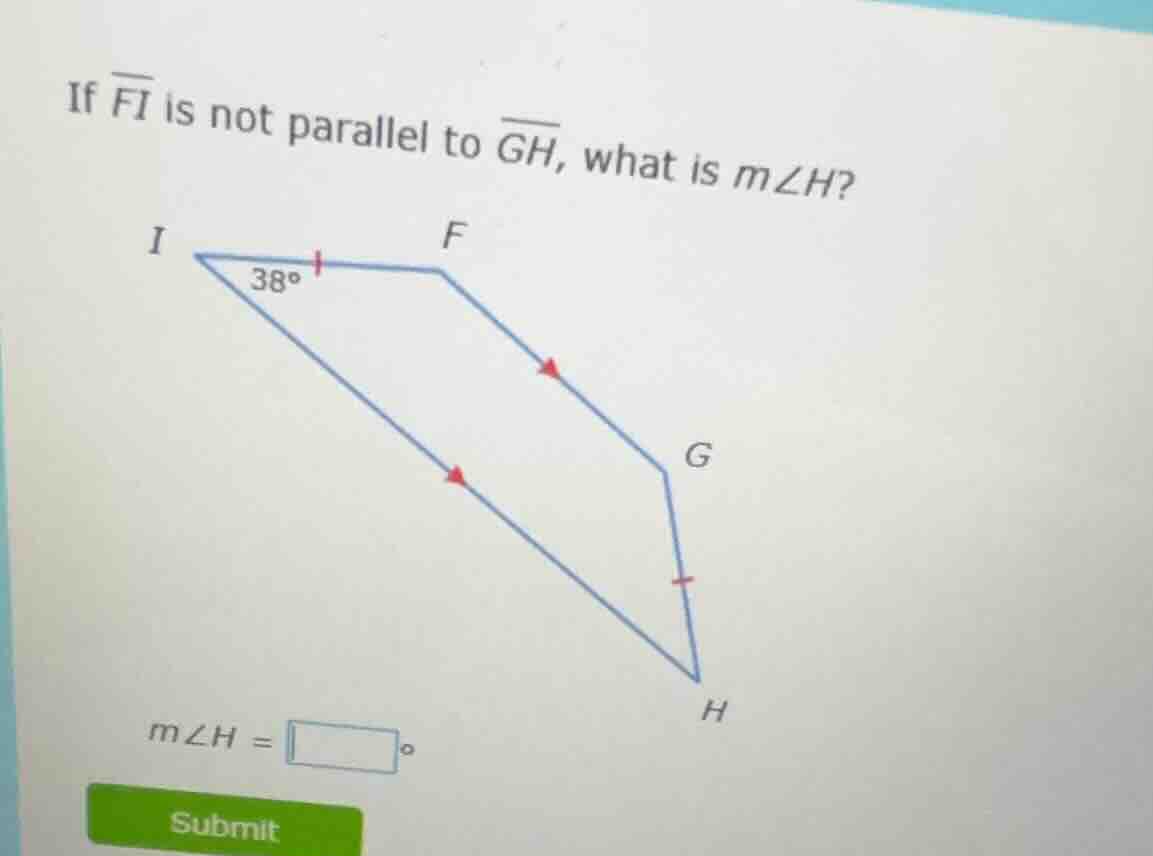
if $overline{fi}$ is not parallel to $overline{gh}$, what is $mangle h$?
$mangle h = square^circ$
submit
Step1: Identificar el tipo de figura
La figura es un trapecio isósceles (ya que $\overline{FI} \cong \overline{GH}$ y $\overline{FG} \parallel \overline{IH}$ por las flechas que indican paralelismo). En este tipo de figura, los ángulos consecutivos entre los lados no paralelos son suplementarios.
Step2: Calcular el ángulo $\angle H$
Como $\angle I$ y $\angle H$ son ángulos consecutivos entre los lados no paralelos, se cumple que:
$$m\angle I + m\angle H = 180^\circ$$
Sustituimos $m\angle I = 38^\circ$:
$$38^\circ + m\angle H = 180^\circ$$
Despejamos $m\angle H$:
$$m\angle H = 180^\circ - 38^\circ$$

Snap & solve any problem in the app
Get step-by-step solutions on Sovi AI
Photo-based solutions with guided steps
Explore more problems and detailed explanations
$142^\circ$