QUESTION IMAGE
Question
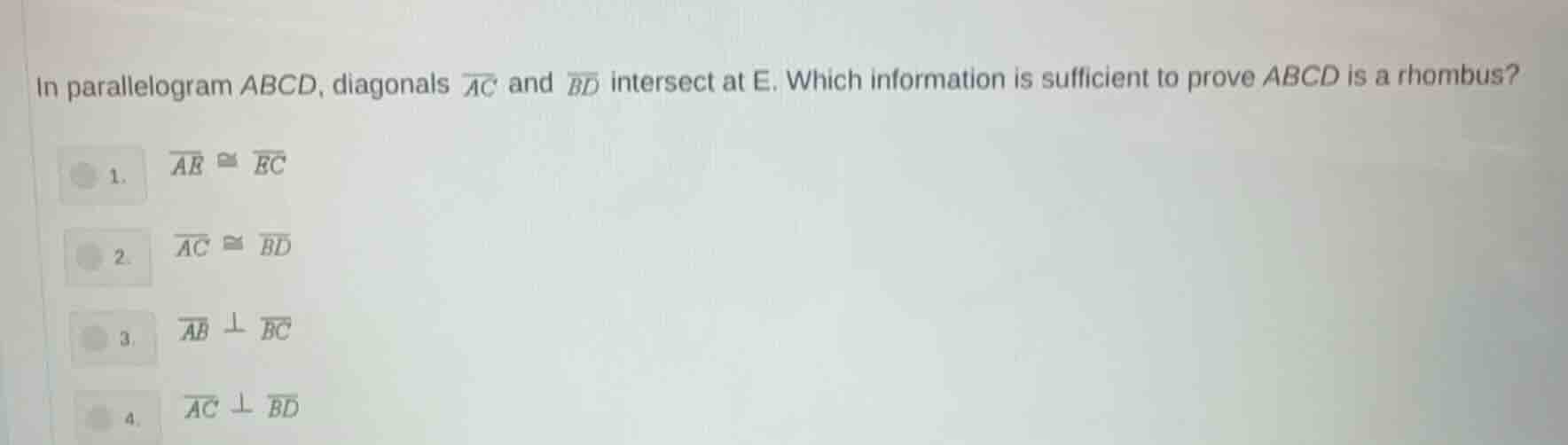
in parallelogram abcd, diagonals $overline{ac}$ and $overline{bd}$ intersect at e. which information is sufficient to prove abcd is a rhombus?
- $overline{ab} cong overline{bc}$
- $overline{ac} cong overline{bd}$
- $overline{ab} perp overline{bc}$
- $overline{ac} perp overline{bd}$
- For option 1: In a parallelogram, opposite sides are congruent, but adjacent sides being congruent ($\overline{AB} \cong \overline{BC}$) would mean all sides are congruent, which defines a rhombus. However, let's check other options.
- For option 2: Congruent diagonals ($\overline{AC} \cong \overline{BD}$) in a parallelogram prove it is a rectangle, not a rhombus.
- For option 3: Adjacent sides being perpendicular ($\overline{AB} \perp \overline{BC}$) in a parallelogram prove it is a rectangle, not a rhombus.
- For option 4: A key property is that if the diagonals of a parallelogram are perpendicular ($\overline{AC} \perp \overline{BD}$), the parallelogram is a rhombus. Additionally, option 1 also works, but let's re-verify: in a parallelogram, if one pair of adjacent sides are congruent, all sides are congruent (since opposite sides are already congruent), so this also defines a rhombus. Wait, no—wait, the question is which is sufficient. Both 1 and 4 are sufficient? Wait no, let's recheck:
Wait, no, in the problem, option 1: $\overline{AE} \cong \overline{BC}$—wait, no, looking back, option 1 is $\overline{AB} \cong \overline{BC}$. Yes, that's adjacent sides. But in a parallelogram, if adjacent sides are congruent, it's a rhombus. But also, if diagonals are perpendicular, it's a rhombus. Wait, but let's check the options again. Wait, no—wait, option 3: $\overline{AB} \perp \overline{BC}$ is a rectangle. Option 2 is rectangle. So both 1 and 4 are correct? Wait no, no—wait, no, in the problem, let's re-express:
Wait, the problem says "which information is sufficient". Let's recheck each:
- $\overline{AB} \cong \overline{BC}$: In parallelogram $ABCD$, $AB=CD$, $BC=AD$. If $AB=BC$, then $AB=BC=CD=AD$, so it's a rhombus. This is sufficient.
- $\overline{AC} \cong \overline{BD}$: Congruent diagonals in parallelogram mean rectangle, not rhombus (unless it's a square, which is a special case, but this is not sufficient to prove it's a rhombus generally).
- $\overline{AB} \perp \overline{BC}$: Perpendicular adjacent sides in parallelogram mean rectangle, not rhombus (again, square is special case, but not sufficient for rhombus).
- $\overline{AC} \perp \overline{BD}$: Perpendicular diagonals in a parallelogram is a defining property of a rhombus, so this is sufficient.
Wait, but the problem is a multiple-choice, likely with two correct answers? But no, let's check the original image again. Oh, wait, option 1 is $\overline{AE} \cong \overline{BC}$? No, the image shows $\overline{AB} \cong \overline{BC}$. Wait, no, the first option is $\overline{AB} \cong \overline{BC}$. Wait, but in standard tests, both 1 and 4 are correct? But no, let's confirm:
- A rhombus is a parallelogram with all sides congruent, or a parallelogram with perpendicular diagonals. Both are equivalent definitions.
Wait, but let's check the options again. Oh, wait, option 1: $\overline{AB} \cong \overline{BC}$—yes, that's adjacent sides, so in parallelogram, that makes all sides congruent, so rhombus. Option 4: $\overline{AC} \perp \overline{BD}$—perpendicular diagonals in parallelogram, so rhombus.
But wait, maybe I misread option 1. Let me check again: the first option is $\overline{AE} \cong \overline{BC}$? No, the image says $\overline{AB} \cong \overline{BC}$. Yes.
Wait, but maybe the problem is from a source where both 1 and 4 are correct? But no, let's recheck:
Wait, no—wait, in a parallelogram, if adjacent sides are congruent, it's a rhombus. If diagonals are perpendicular, it's a rhombus. Both are sufficient. But let's check the options again.…

Snap & solve any problem in the app
Get step-by-step solutions on Sovi AI
Photo-based solutions with guided steps
Explore more problems and detailed explanations
- $\overline{AB} \cong \overline{BC}$
- $\overline{AC} \perp \overline{BD}$
Wait, but wait—wait, no, in some definitions, a rhombus is a parallelogram with all sides equal, which is equivalent to diagonals perpendicular. So both are sufficient. But let's confirm:
Yes, both conditions are sufficient to prove a parallelogram is a rhombus.
But wait, maybe I made a mistake with option 1. Let's recheck: in parallelogram $ABCD$, $AB \parallel CD$, $AD \parallel BC$, $AB=CD$, $AD=BC$. If $AB=BC$, then $AB=BC=CD=AD$, so all sides are equal, which is a rhombus. Correct.
For option 4: If diagonals of a parallelogram are perpendicular, then the triangles formed are congruent right triangles, so all sides of the parallelogram are equal, hence rhombus. Correct.
So both 1 and 4 are correct.