QUESTION IMAGE
Question
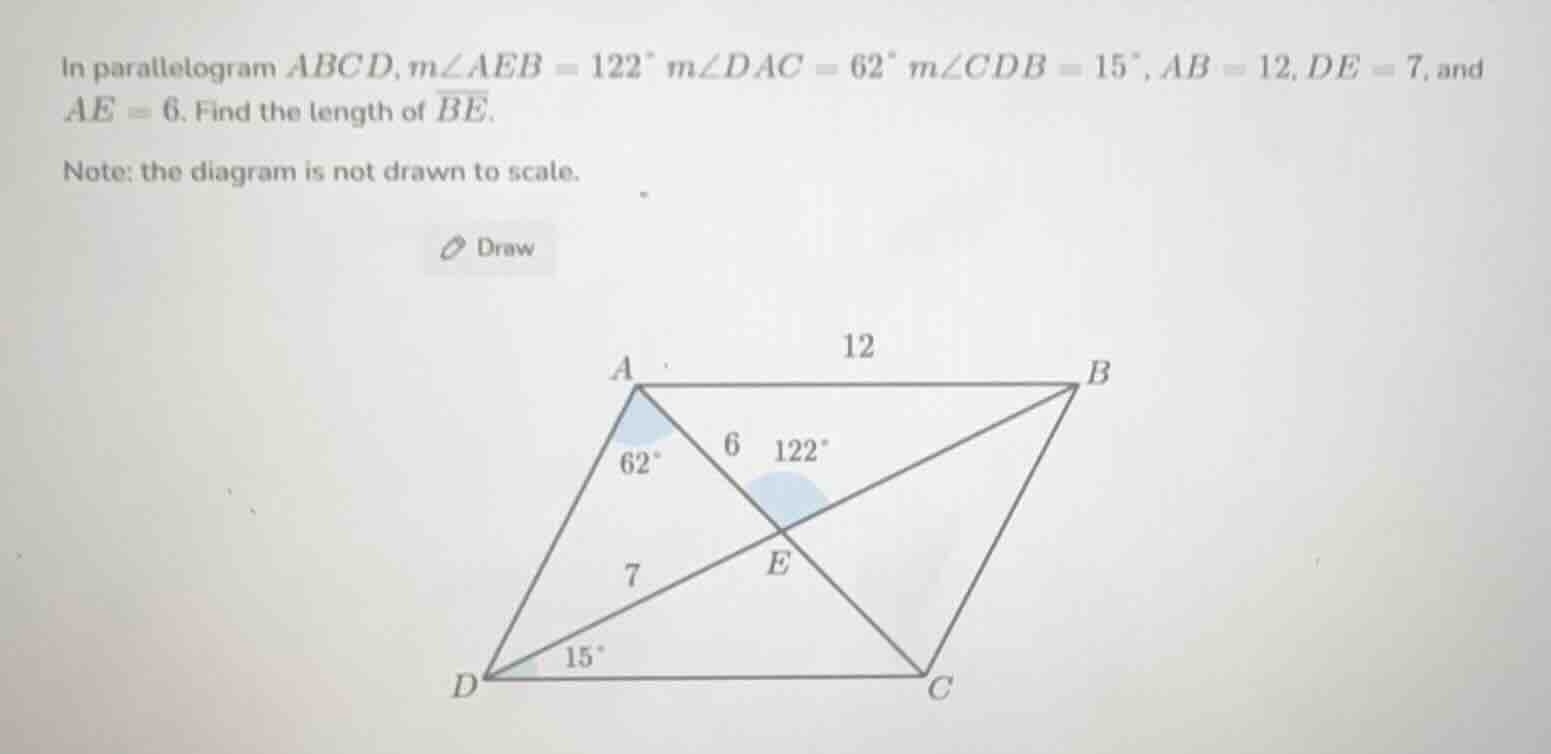
in parallelogram (abcd), (mangle aeb = 122^circ), (mangle dac = 62^circ), (mangle cdb = 15^circ), (ab = 12), (de = 7), and (ae = 6). find the length of (overline{be}).
note: the diagram is not drawn to scale.
Step1: Identify Triangle Properties
In parallelogram \(ABCD\), \(AB \parallel CD\) and \(AD \parallel BC\). We can use the Law of Sines or Law of Cosines in \(\triangle AEB\) or related triangles. Let's check angles: \(\angle AEB = 122^\circ\), \(AE = 6\), \(AB = 12\). Wait, maybe we can use the Law of Cosines in \(\triangle AEB\)? Wait, no, let's check if we can find angles. Wait, \(\angle DAC = 62^\circ\), and \(AB \parallel CD\), so \(\angle BAC = \angle DCA\) (alternate interior angles). But maybe we can use the Law of Sines in \(\triangle AED\) and \(\triangle BEC\)? Wait, no, let's look at \(\triangle AEB\). Wait, \(AE = 6\), \(AB = 12\), \(\angle AEB = 122^\circ\). Wait, no, maybe we can use the Law of Cosines in \(\triangle AEB\)? Wait, no, let's check the angles. Wait, \(\angle AEB = 122^\circ\), so the supplementary angle is \(58^\circ\), but maybe not. Wait, another approach: In parallelogram, diagonals bisect each other? No, in a parallelogram, diagonals bisect each other, but here \(E\) is the intersection of diagonals? Wait, in a parallelogram, diagonals bisect each other, so \(AE = EC\) and \(DE = EB\)? Wait, no, that's only if it's a parallelogram, but wait, \(DE = 7\), \(AE = 6\). Wait, no, maybe I made a mistake. Wait, the problem says it's a parallelogram, so diagonals bisect each other, so \(AE = EC\) and \(DE = EB\). But \(DE = 7\), so \(EB = 7\)? But that contradicts? Wait, no, maybe the diagram is not to scale. Wait, no, let's re-examine. Wait, the problem gives \(m\angle AEB = 122^\circ\), \(m\angle DAC = 62^\circ\), \(m\angle CDB = 15^\circ\), \(AB = 12\), \(DE = 7\), \(AE = 6\). Wait, maybe we can use the Law of Sines in \(\triangle AED\) and \(\triangle BEC\), but maybe the key is that in a parallelogram, \(AB \parallel CD\), so \(\angle ABD = \angle CDB = 15^\circ\) (alternate interior angles). Then in \(\triangle AEB\), we have \(AE = 6\), \(AB = 12\), \(\angle AEB = 122^\circ\), and \(\angle EAB = \angle DAC = 62^\circ\)? Wait, \(\angle DAC = 62^\circ\), so \(\angle EAB = 62^\circ\). Then in \(\triangle AEB\), angles: \(\angle EAB = 62^\circ\), \(\angle AEB = 122^\circ\), so \(\angle EBA = 180 - 62 - 122 = -4^\circ\)? That can't be. Wait, maybe I messed up the angles. Wait, \(\angle AEB = 122^\circ\), so its supplementary angle is \(58^\circ\). Wait, maybe \(\angle EAD = 62^\circ\), and \(AD \parallel BC\), so \(\angle DAC = \angle BCA = 62^\circ\). Wait, maybe the correct approach is to use the Law of Sines in \(\triangle AEB\) and \(\triangle DEA\). Wait, \(\angle AED = 180 - 122 = 58^\circ\) (linear pair). In \(\triangle AED\), we have \(AE = 6\), \(DE = 7\), \(\angle AED = 58^\circ\), \(\angle EAD = 62^\circ\), so \(\angle EDA = 180 - 62 - 58 = 60^\circ\)? But the problem says \(\angle CDB = 15^\circ\), which is \(\angle EDA = 15^\circ\)? Wait, this is confusing. Wait, maybe the problem has a typo, but no, let's check again. Wait, the key is that in a parallelogram, \(AB = CD = 12\), \(AD = BC\). Wait, maybe we can use the Law of Cosines in \(\triangle AEB\). Wait, \(AE = 6\), \(AB = 12\), \(\angle EAB = 62^\circ\), \(\angle AEB = 122^\circ\). Wait, no, the sum of angles in a triangle is \(180^\circ\), so \(62 + 122 = 184\), which is more than \(180\), so that's impossible. Therefore, my initial assumption is wrong. Wait, maybe \(\angle DAC = 62^\circ\) is \(\angle EAD = 62^\circ\), and \(\angle AEB = 122^\circ\), so \(\angle AED = 58^\circ\). Then in \(\triangle AED\), angles: \(\angle EAD = 62^\circ\), \(\angle AED = 58^\circ\), so \(\angle EDA = 60^\circ\), but the problem says \(\angle CDB = 1…

Snap & solve any problem in the app
Get step-by-step solutions on Sovi AI
Photo-based solutions with guided steps
Explore more problems and detailed explanations
\(7\)