QUESTION IMAGE
Question
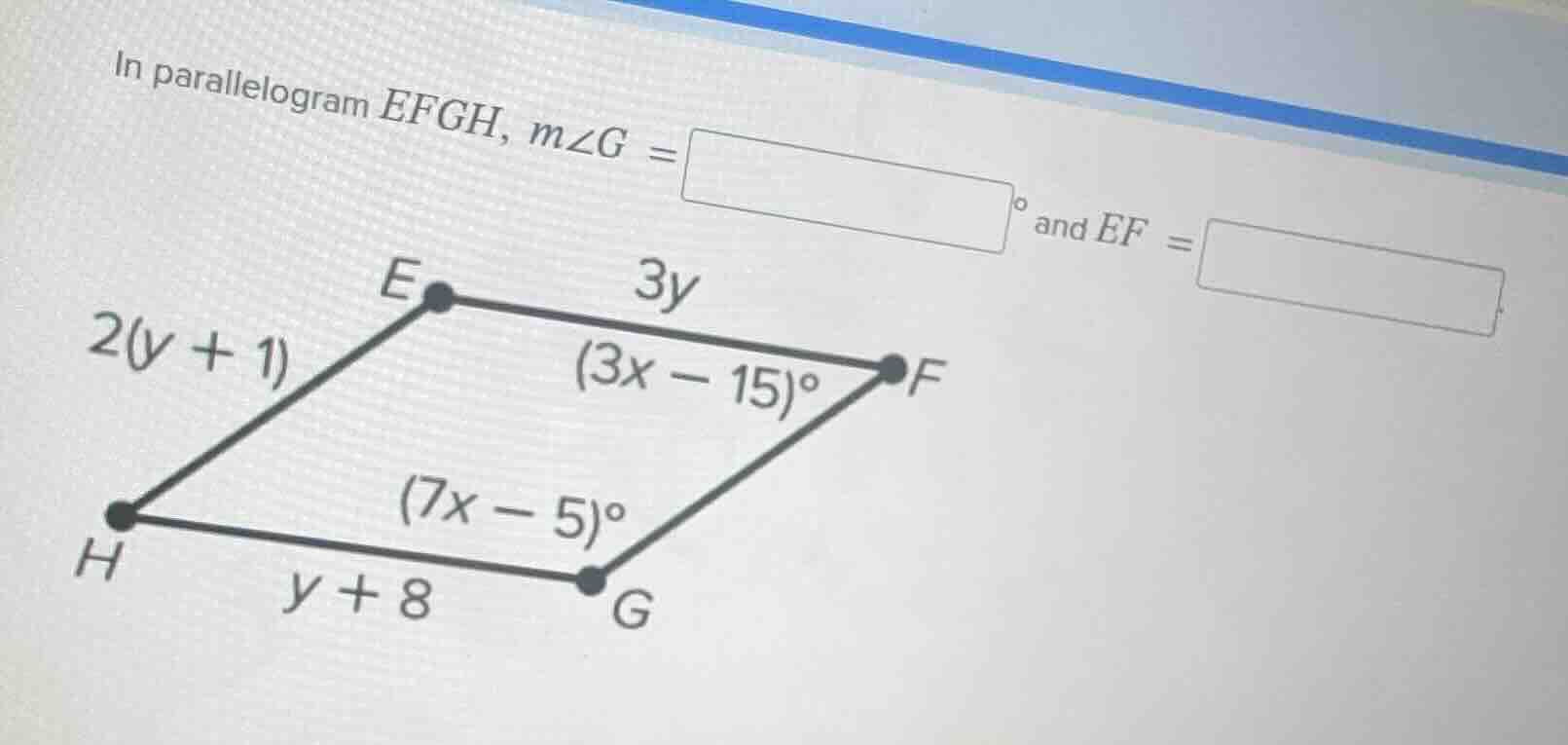
in parallelogram efgh, $m\angle g = \square^{\circ}$ and $ef = \square$.
the parallelogram has vertices e, f, g, h. side e to f is labeled $3y$, f to g is labeled $(3x - 15)^{circ}$, g to h is labeled $y + 8$, h to e is labeled $2(y + 1)$, and angle at g is labeled $(7x - 5)^{circ}$.
Step1: Solve for \( x \) using adjacent angles in parallelogram
In a parallelogram, adjacent angles are supplementary. So, \( (3x - 15)^\circ + (7x - 5)^\circ = 180^\circ \).
Simplify: \( 3x - 15 + 7x - 5 = 180 \)
\( 10x - 20 = 180 \)
Add 20 to both sides: \( 10x = 200 \)
Divide by 10: \( x = 20 \)
Step2: Find \( m\angle G \)
\( m\angle G = (7x - 5)^\circ \). Substitute \( x = 20 \):
\( 7(20) - 5 = 140 - 5 = 135^\circ \)
Step3: Solve for \( y \) using opposite sides in parallelogram
In a parallelogram, opposite sides are equal. So, \( EH = FG \) and \( EF = HG \). Let's use \( EH = 2(y + 1) \) and \( FG = y + 8 \)? Wait, no, \( EH \) and \( FG \)? Wait, \( EH \) is \( 2(y + 1) \), \( HG \) is \( y + 8 \), \( EF \) is \( 3y \), \( FG \) is... Wait, in parallelogram \( EFGH \), sides: \( EF \) and \( HG \) are opposite, \( EH \) and \( FG \) are opposite. Wait, \( EH = 2(y + 1) \), \( FG \) – wait, no, \( EH \) and \( FG \) should be equal? Wait, no, looking at the diagram: \( EH = 2(y + 1) \), \( HG = y + 8 \), \( EF = 3y \), \( FG \) – wait, maybe \( EH = FG \) and \( EF = HG \). Wait, \( EF = 3y \), \( HG = y + 8 \)? No, that can't be. Wait, maybe \( EH = FG \) and \( EF = HG \). Wait, \( EH = 2(y + 1) \), \( FG \) – no, \( EH \) is \( 2(y + 1) \), \( FG \) is... Wait, maybe I misread. Wait, the sides: \( EH = 2(y + 1) \), \( HG = y + 8 \), \( EF = 3y \), and \( FG \) – wait, no, in parallelogram, opposite sides are equal. So \( EF = HG \) and \( EH = FG \). Wait, \( EF = 3y \), \( HG = y + 8 \)? No, that would be \( 3y = y + 8 \), so \( 2y = 8 \), \( y = 4 \). Wait, let's check: if \( EF = HG \), then \( 3y = y + 8 \), so \( 2y = 8 \), \( y = 4 \). Alternatively, \( EH = FG \): \( 2(y + 1) = \) – but \( FG \) is not given. Wait, maybe the other pair: \( EH = 2(y + 1) \), \( FG \) – no, maybe the problem has \( EH = FG \) as \( 2(y + 1) \) and \( FG \) is... Wait, maybe I made a mistake. Wait, let's use \( EF = HG \). \( EF = 3y \), \( HG = y + 8 \)? No, that would be \( 3y = y + 8 \), \( y = 4 \). Let's check \( EH = 2(y + 1) \), if \( y = 4 \), \( EH = 2(5) = 10 \), \( FG \) – wait, \( FG \) is not given, but \( EF = 3y = 12 \), \( HG = y + 8 = 12 \), so that works. Alternatively, \( EH = 2(y + 1) \), \( FG \) – maybe \( FG \) is equal to \( EH \), but \( FG \) is not labeled. Wait, maybe the correct opposite sides: \( EF \) and \( HG \) are opposite, so \( EF = HG \), so \( 3y = y + 8 \), so \( 2y = 8 \), \( y = 4 \). Then \( EF = 3y = 12 \). Let's confirm with \( EH = 2(y + 1) = 2(5) = 10 \), and \( FG \) – if \( FG = EH \), then \( FG = 10 \), but we don't have \( FG \) labeled. Alternatively, maybe \( EH = FG \) and \( EF = HG \). Wait, \( EH = 2(y + 1) \), \( FG \) – no, maybe the problem has \( EH = FG \) as \( 2(y + 1) \) and \( FG \) is... Wait, maybe I should use \( EH = FG \): \( 2(y + 1) = \) – but \( FG \) is not given. Wait, perhaps the diagram has \( EH = 2(y + 1) \), \( HG = y + 8 \), \( EF = 3y \), and \( FG \) – no, maybe the correct opposite sides are \( EH = FG \) and \( EF = HG \). Wait, let's solve \( 2(y + 1) = y + 8 \)? No, \( 2(y + 1) = y + 8 \) would be \( 2y + 2 = y + 8 \), \( y = 6 \). Then \( EF = 3y = 18 \), \( HG = y + 8 = 14 \), which is not equal. So that's wrong. So the correct opposite sides must be \( EF = HG \), so \( 3y = y + 8 \), \( y = 4 \). Then \( EF = 12 \), \( HG = 12 \), \( EH = 2(4 + 1) = 10 \), \( FG \) – if \( FG = EH \), then \( FG = 10 \), which is consistent. So \( y = 4 \).
Step4: Find \( EF \)
\( EF = 3y \), \( y = 4 \), so \( EF = 3(4) = 12 \).

Snap & solve any problem in the app
Get step-by-step solutions on Sovi AI
Photo-based solutions with guided steps
Explore more problems and detailed explanations
\( m\angle G = 135^\circ \), \( EF = 12 \)