QUESTION IMAGE
Question
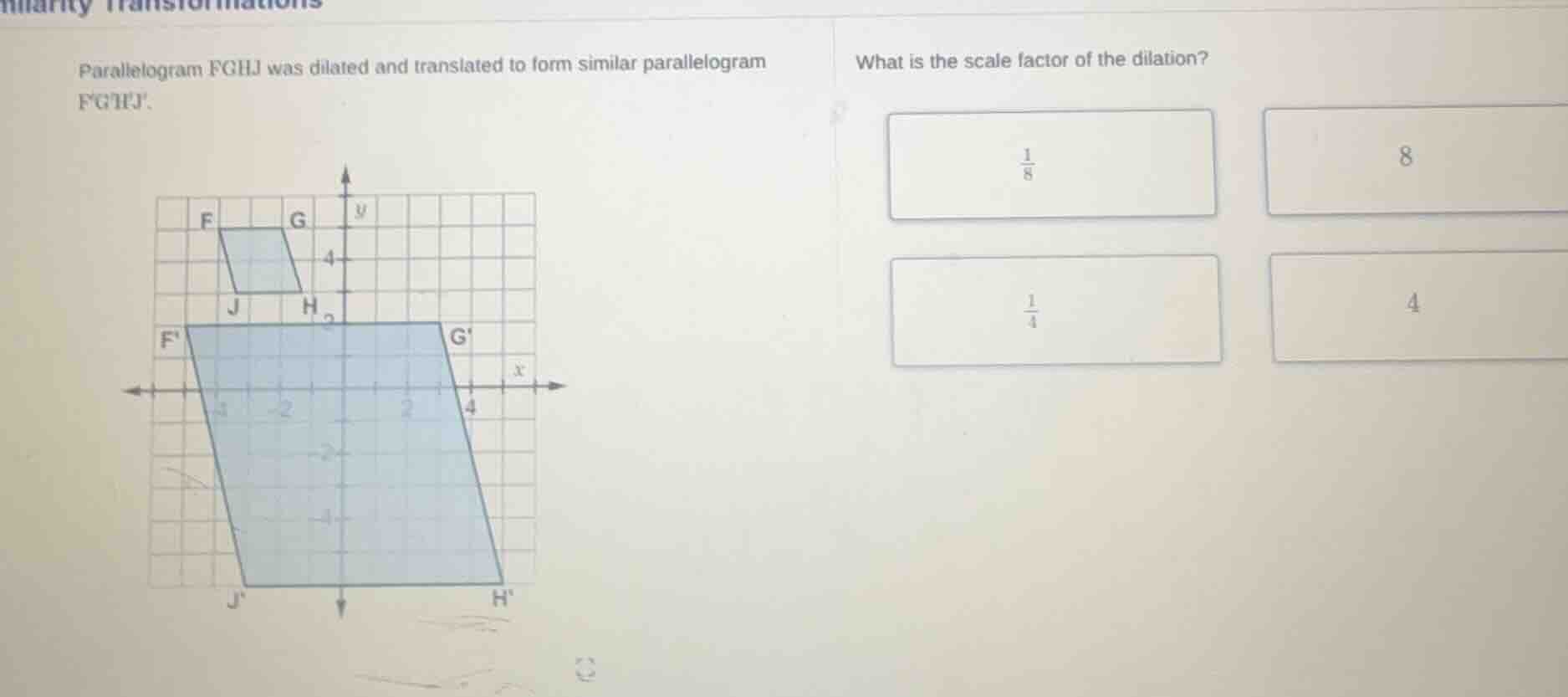
parallelogram fghj was dilated and translated to form similar parallelogram fghj. what is the scale factor of the dilation? options: \\(\frac{1}{8}\\), 8, \\(\frac{1}{4}\\), 4
Step1: Find length of FG
From the grid, FG spans 2 units (e.g., from x - coordinate of F to G).
Step2: Find length of F'G'
F'G' spans 8 units (from x - coordinate of F' to G').
Step3: Calculate scale factor
Scale factor = $\frac{\text{Length of image (F'G')}}{\text{Length of pre - image (FG)}}$ = $\frac{8}{2}$ = 4. Wait, no, wait. Wait, maybe I mixed up. Wait, actually, the pre - image is FGHIJ (the smaller one) and the image is F'G'H'J' (the larger one). Wait, let's check the y - axis. The height of the smaller parallelogram: from y = 3 to y = 5? Wait, no, looking at the grid, the smaller parallelogram (FGHJ) has a horizontal side FG with length 2 (from x=-4 to x = - 2? Wait, maybe better to count the number of grid squares. Let's take the horizontal side: for the original parallelogram (FGHJ), the length of FG: let's see the coordinates. Let's assume each grid square is 1 unit. Let's find the length of FG: from F to G, the horizontal distance. Suppose F is at (-4,5) and G is at (-2,5), so length FG = 2. Then F' is at (-5,1) and G' is at (3,1), so length F'G' = 3 - (-5)=8. So scale factor is $\frac{\text{length of F'G'}}{\text{length of FG}}$ = $\frac{8}{2}$ = 4? Wait, but wait, maybe the other way. Wait, no, dilation scale factor: if the image is larger, scale factor is greater than 1. Wait, but let's check the vertical side. The original parallelogram: from y = 3 to y = 5, so height 2. The new parallelogram: from y = - 5 to y = 1, so height 6? Wait, no, maybe I messed up the coordinates. Wait, the smaller parallelogram is above the x - axis, the larger is below? Wait, no, the smaller one: let's look at the y - coordinates. The smaller parallelogram (FGHJ) has vertices around y = 4, 5. The larger one (F'G'H'J') has vertices around y = 1, - 5. Wait, maybe the length of FG: let's count the number of grid units. Let's take the horizontal side of the smaller parallelogram: it spans 2 grid units. The horizontal side of the larger parallelogram spans 8 grid units. So scale factor is 8/2 = 4? Wait, but the options include 4. Wait, but wait, maybe I had it reversed. Wait, no, dilation: if the image is larger, scale factor is image length over pre - image length. So pre - image (original) length FG = 2, image length F'G' = 8, so scale factor is 8/2 = 4. Wait, but let's check again. Wait, maybe the vertical side. The height of the smaller parallelogram: from y = 3 to y = 5, so height 2. The height of the larger parallelogram: from y = - 5 to y = 1, so height 6? No, that doesn't match. Wait, maybe I made a mistake. Wait, let's look at the horizontal sides. The smaller parallelogram (FGHJ) has a horizontal side with length 2 (2 grid squares). The larger parallelogram (F'G'H'J') has a horizontal side with length 8 (8 grid squares). So scale factor is 8/2 = 4. So the scale factor is 4.

Snap & solve any problem in the app
Get step-by-step solutions on Sovi AI
Photo-based solutions with guided steps
Explore more problems and detailed explanations
4