QUESTION IMAGE
Question
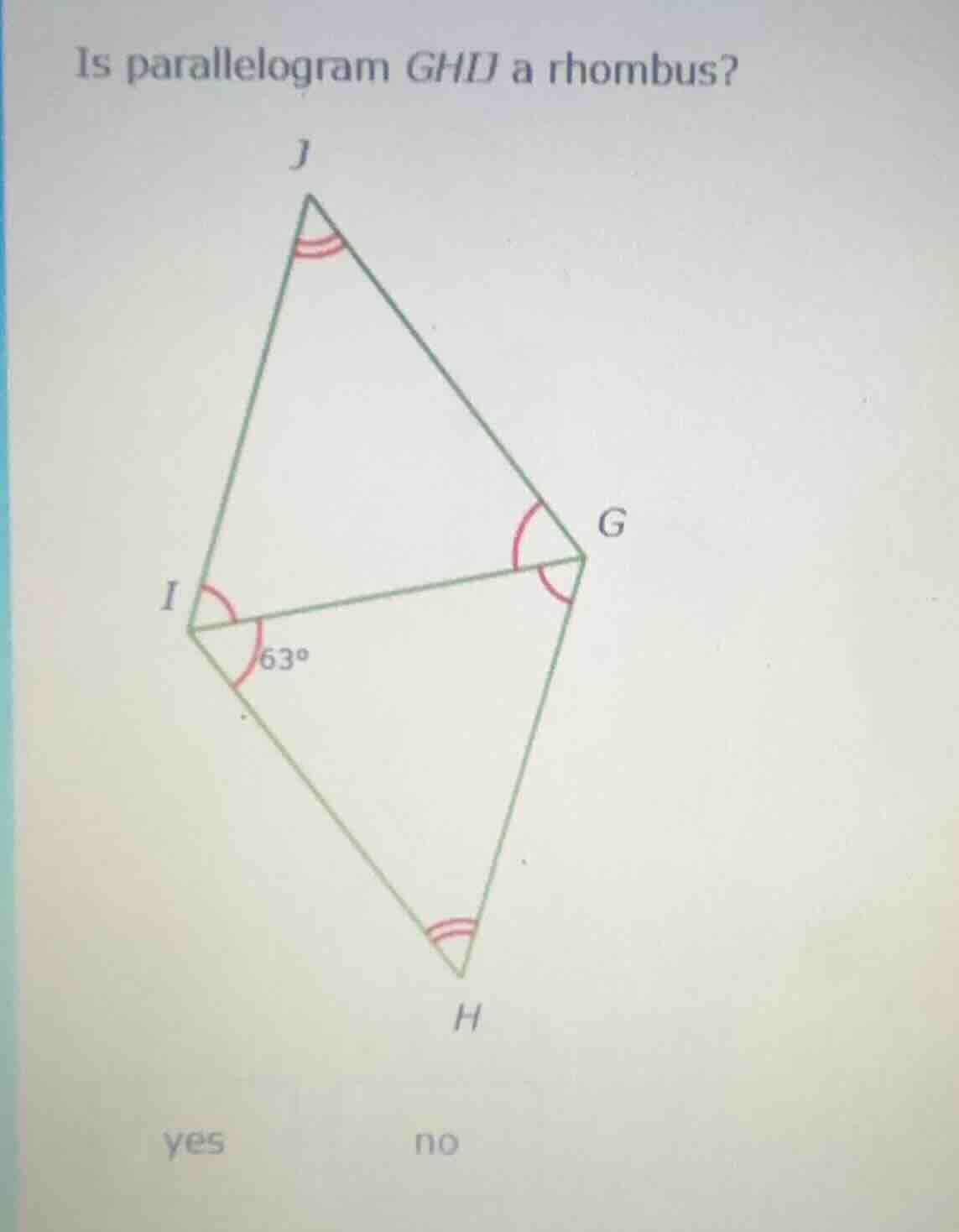
is parallelogram ghij a rhombus?
yes \t\tno
Step1: Recall rhombus properties
A rhombus is a parallelogram with all sides equal, and its diagonals bisect the angles. In a parallelogram, opposite sides are equal, and opposite angles are equal. Also, in a parallelogram, if a diagonal bisects an angle, then the parallelogram is a rhombus.
Step2: Analyze the given parallelogram
In parallelogram \( GHIJ \), the diagonal \( GI \) (assuming the vertices are \( G, H, I, J \) in order, and the diagonal is \( GI \)) is shown to create angles. The markings indicate that the diagonal bisects the angles at \( J \), \( I \), \( G \), and \( H \) (from the arc markings). Also, the angle at \( I \) is \( 63^\circ \), and due to the parallelogram properties and angle - bisecting diagonal, we can infer that all sides are equal. Since a parallelogram with all sides equal (or with diagonals bisecting the angles) is a rhombus, we can conclude that parallelogram \( GHIJ \) (assuming the name in the problem has a typo and it's \( GHIJ \)) is a rhombus.

Snap & solve any problem in the app
Get step-by-step solutions on Sovi AI
Photo-based solutions with guided steps
Explore more problems and detailed explanations
yes