QUESTION IMAGE
Question
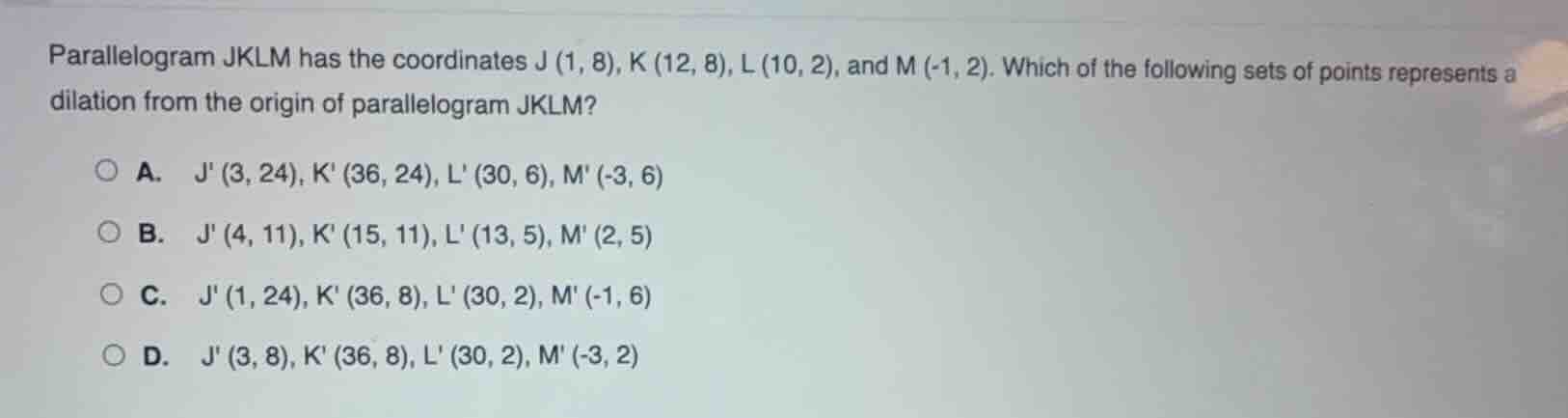
parallelogram jklm has the coordinates j (1, 8), k (12, 8), l (10, 2), and m (-1, 2). which of the following sets of points represents a dilation from the origin of parallelogram jklm?
a. j (3, 24), k (36, 24), l (30, 6), m (-3, 6)
b. j (4, 11), k (15, 11), l (13, 5), m (2, 5)
c. j (1, 24), k (36, 8), l (30, 2), m (-1, 6)
d. j (3, 8), k (36, 8), l (30, 2), m (-3, 2)
Step1: Define dilation rule
A dilation from the origin scales each coordinate of a point $(x,y)$ by a scale factor $k$, so the transformed point is $(kx, ky)$.
Step2: Test Option A
Check scaling factor for each point:
- For $J(1,8)$ to $J'(3,24)$: $k=\frac{3}{1}=3$, $\frac{24}{8}=3$
- For $K(12,8)$ to $K'(36,24)$: $k=\frac{36}{12}=3$, $\frac{24}{8}=3$
- For $L(10,2)$ to $L'(30,6)$: $k=\frac{30}{10}=3$, $\frac{6}{2}=3$
- For $M(-1,2)$ to $M'(-3,6)$: $k=\frac{-3}{-1}=3$, $\frac{6}{2}=3$
All points use the same scale factor $k=3$.
Step3: Verify other options (elimination)
- Option B: Coordinates are shifted (added 3 to x, 3 to y) → translation, not dilation.
- Option C: Inconsistent scale factors (x and y scaled differently for each point) → not a dilation from origin.
- Option D: Inconsistent scale factors (x scaled by 3, y unchanged for all points) → not a dilation from origin.

Snap & solve any problem in the app
Get step-by-step solutions on Sovi AI
Photo-based solutions with guided steps
Explore more problems and detailed explanations
A. J' (3, 24), K' (36, 24), L' (30, 6), M' (-3, 6)