QUESTION IMAGE
Question
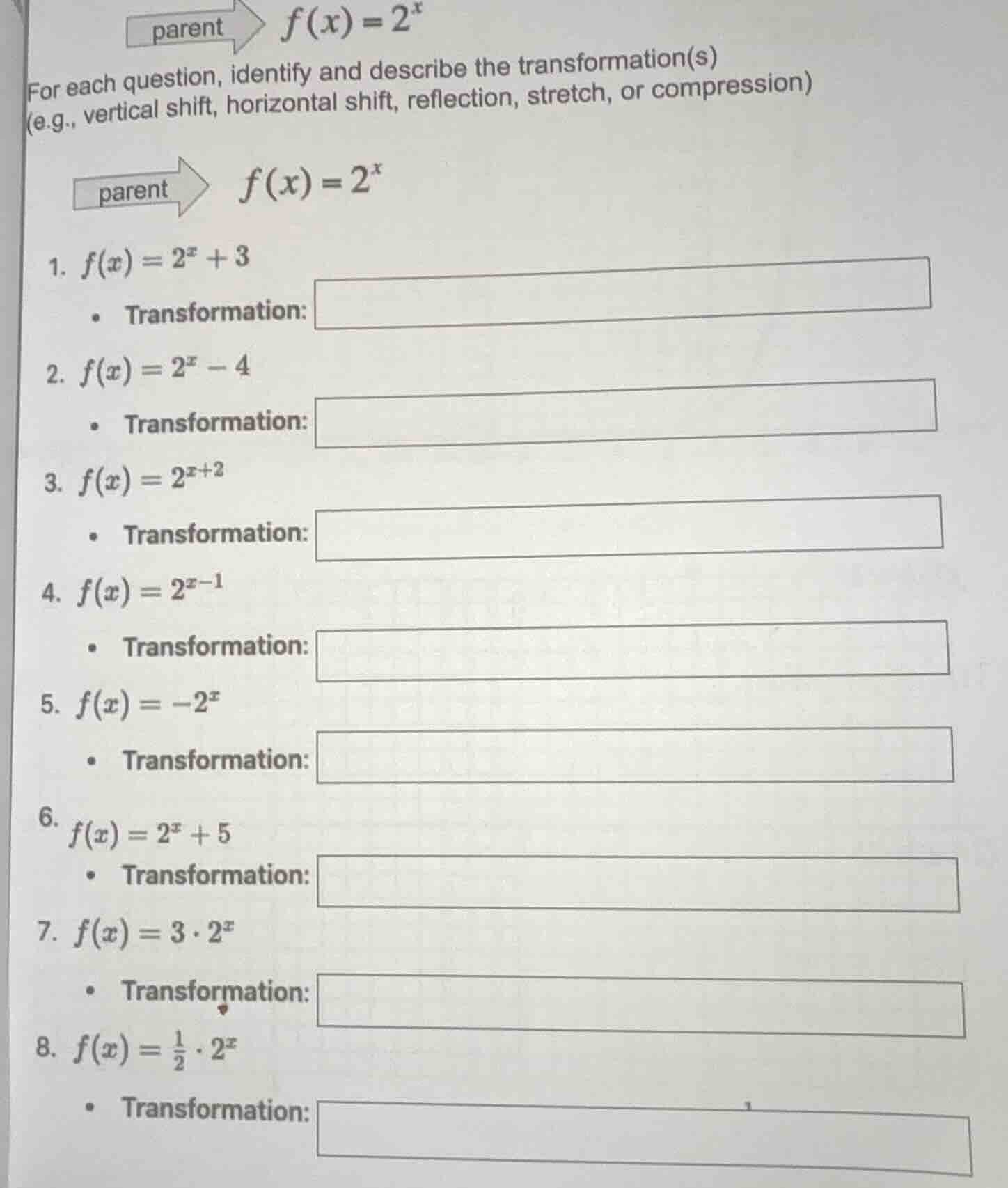
parent ( f(x) = 2^x )
for each question, identify and describe the transformation(s) (e.g., vertical shift, horizontal shift, reflection, stretch, or compression)
parent ( f(x) = 2^x )
- ( f(x) = 2^x + 3 )
- transformation:
- ( f(x) = 2^x - 4 )
- transformation:
- ( f(x) = 2^{x + 2} )
- transformation:
- ( f(x) = 2^{x - 1} )
- transformation:
- ( f(x) = -2^x )
- transformation:
- ( f(x) = 2^x + 5 )
- transformation:
- ( f(x) = 3 cdot 2^x )
- transformation:
- ( f(x) = \frac{1}{2} cdot 2^x )
- transformation:
1. $f(x) = 2^x + 3$
Step1: Recall vertical shift rule
For a function $y = f(x)+k$, if $k>0$, it's a vertical shift up by $k$ units. Here, $f(x)=2^x$, new function is $2^x + 3$, so $k = 3>0$.
Step2: Determine transformation
So the transformation is a vertical shift up by 3 units.
Step1: Recall vertical shift rule
For $y = f(x)+k$, if $k<0$, it's a vertical shift down by $|k|$ units. Here, $k=-4$, so $|k| = 4$.
Step2: Determine transformation
Thus, the transformation is a vertical shift down by 4 units.
Step1: Recall horizontal shift rule
For a function $y = f(x + h)$, if $h>0$, it's a horizontal shift left by $h$ units. Here, $f(x)=2^x$, new function is $2^{x+2}$, so $h = 2>0$.
Step2: Determine transformation
So the transformation is a horizontal shift left by 2 units.

Snap & solve any problem in the app
Get step-by-step solutions on Sovi AI
Photo-based solutions with guided steps
Explore more problems and detailed explanations
Vertical shift up by 3 units