QUESTION IMAGE
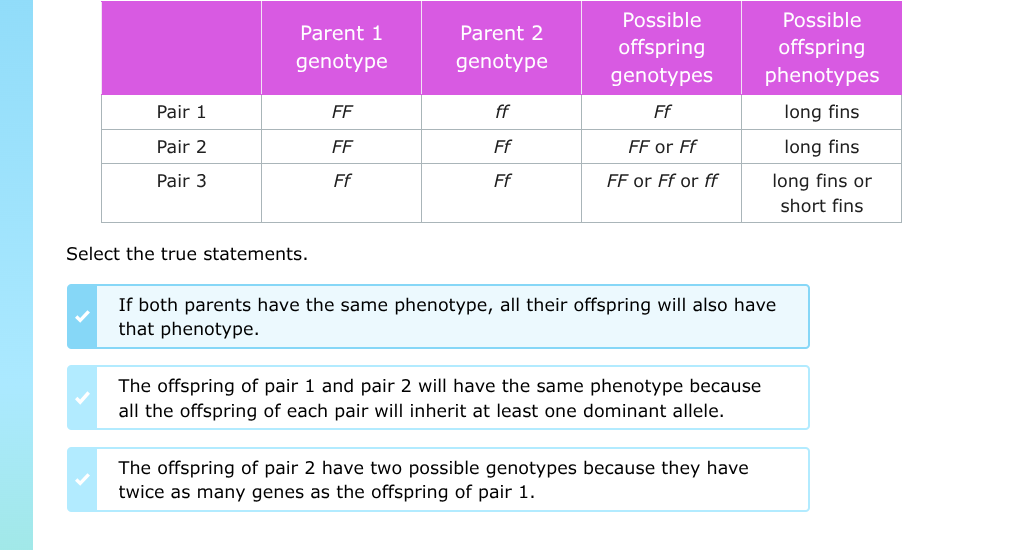
Question
| parent 1 genotype | parent 2 genotype | possible offspring genotypes | possible offspring phenotypes | |
|---|---|---|---|---|
| pair 2 | ff | ff | ff or ff | long fins |
| pair 3 | ff | ff | ff or ff or ff | long fins or short fins |
select the true statements.
- if both parents have the same phenotype, all their offspring will also have that phenotype.
- the offspring of pair 1 and pair 2 will have the same phenotype because all the offspring of each pair will inherit at least one dominant allele.
- the offspring of pair 2 have two possible genotypes because they have twice as many genes as the offspring of pair 1.
Response
To determine the true statements, we analyze each one:
Statement 1: "If both parents have the same phenotype, all their offspring will also have that phenotype."
- For Pair 3, both parents have the long fins phenotype (since \( Ff \) shows the dominant trait). However, their offspring can have \( ff \) (short fins), which is a different phenotype. Thus, this statement is false.
Statement 2: "The offspring of pair 1 and pair 2 will have the same phenotype because all the offspring of each pair will inherit at least one dominant allele."
- Pair 1: Parent 1 (\( FF \)) gives \( F \), Parent 2 (\( ff \)) gives \( f \) → Offspring \( Ff \) (long fins, dominant \( F \)).
- Pair 2: Parent 1 (\( FF \)) gives \( F \), Parent 2 (\( Ff \)) gives \( F \) or \( f \) → Offspring \( FF \) (long fins) or \( Ff \) (long fins).
- In both pairs, offspring inherit at least one \( F \) (dominant allele), so all have long fins. This statement is true.
Statement 3: "The offspring of pair 2 have two possible genotypes because they have twice as many genes as the offspring of pair 1."
- Offspring of Pair 1: Only \( Ff \) (1 genotype). Offspring of Pair 2: \( FF \) or \( Ff \) (2 genotypes). However, offspring do not have "twice as many genes"—all organisms have the same number of genes (or alleles per gene) in this context. The difference in genotypes comes from parental alleles, not gene count. Thus, this statement is false.
Brief Explanations
- Statement 1 is false (Pair 3 shows offspring can have different phenotypes).
- Statement 2 is true (both pairs’ offspring inherit a dominant \( F \), so long fins).
- Statement 3 is false (genotype difference is from alleles, not gene count).

Snap & solve any problem in the app
Get step-by-step solutions on Sovi AI
Photo-based solutions with guided steps
Explore more problems and detailed explanations
The true statement is: "The offspring of pair 1 and pair 2 will have the same phenotype because all the offspring of each pair will inherit at least one dominant allele."