QUESTION IMAGE
Question
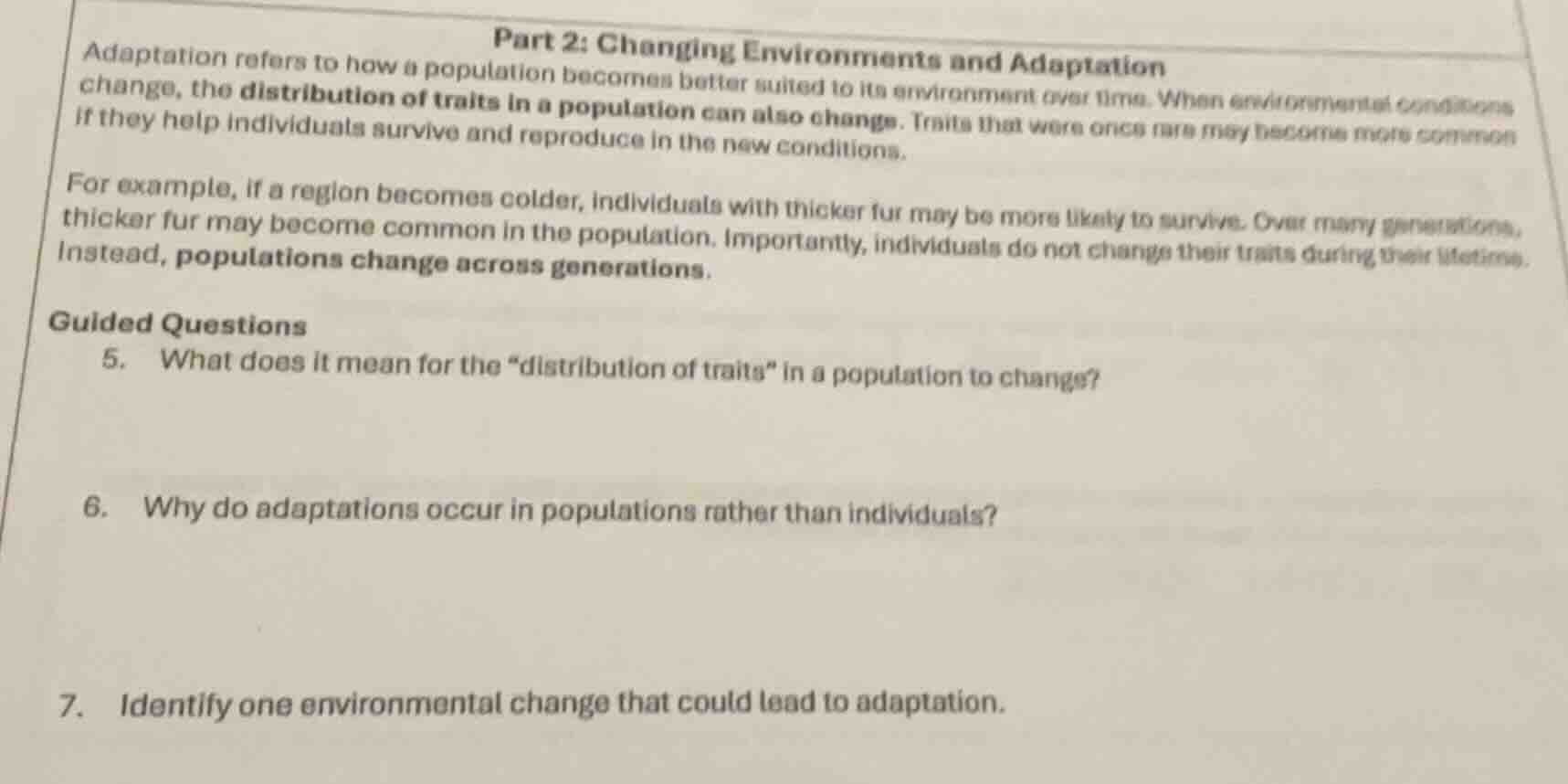
part 2: changing environments and adaptation
adaptation refers to how a population becomes better suited to its environment over time. when environmental conditions change, the distribution of traits in a population can also change. traits that were once rare may become more common if they help individuals survive and reproduce in the new conditions.
for example, if a region becomes colder, individuals with thicker fur may be more likely to survive. over many generations, thicker fur may become common in the population. importantly, individuals do not change their traits during their lifetime. instead, populations change across generations.
guided questions
- what does it mean for the \distribution of traits\ in a population to change?
- why do adaptations occur in populations rather than individuals?
- identify one environmental change that could lead to adaptation.
Question 5
When the "distribution of traits" changes, it means the frequency of different traits in a population shifts. For example, a trait that was rare (like thick fur in a warm region) becomes more common, or a common trait becomes rare, as environmental changes favor certain traits for survival and reproduction.
Adaptations occur in populations (across generations) because individuals cannot change their inherited traits during their lifetime. Evolutionary change happens as favorable traits are passed to offspring, and over generations, the population’s trait distribution changes (e.g., thicker fur spreads in a colder region over many generations, not within one individual’s life).
One example is a region becoming drier (environmental change: reduced rainfall). Plants with traits like deep roots (to access water) or thick cuticles (to reduce water loss) would be more likely to survive and reproduce. Over generations, these drought - resistant traits would become more common in the plant population (adaptation).

Snap & solve any problem in the app
Get step-by-step solutions on Sovi AI
Photo-based solutions with guided steps
Explore more problems and detailed explanations
It means the frequency of different traits in the population shifts—traits that help survival/reproduction in new conditions become more common, and less favorable traits become rarer.