QUESTION IMAGE
Question
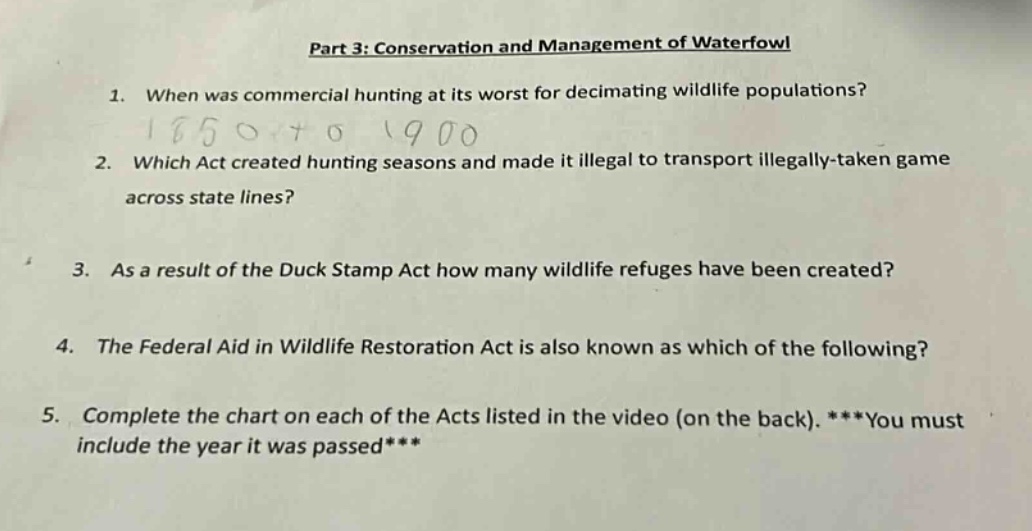
part 3: conservation and management of waterfowl
- when was commercial hunting at its worst for decimating wildlife populations?
- which act created hunting seasons and made it illegal to transport illegally - taken game across state lines?
- as a result of the duck stamp act how many wildlife refuges have been created?
- the federal aid in wildlife restoration act is also known as which of the following?
- complete the chart on each of the acts listed in the video (on the back). you must include the year it was passed
These questions are related to the conservation and management of waterfowl, focusing on historical events, legislative acts, and their impacts. Here are the answers to each question:
Question 1
Commercial hunting was at its worst for decimating wildlife populations, particularly waterfowl, in the late 19th and early 20th centuries (around the late 1800s to early 1900s). This was due to unregulated hunting, market hunting (for food, feathers, etc.), and lack of conservation measures, leading to drastic declines in many wildlife species, including waterfowl.
The Migratory Bird Hunting Stamp Act (also known as the Duck Stamp Act) focused on duck stamps, while the Lacey Act (1900) addressed illegal wildlife trade. However, the Migratory Bird Hunting and Conservation Stamp Act (Duck Stamp Act, 1934) established duck stamps for waterfowl conservation, but the act that created hunting seasons and made transporting illegally - taken game across state lines illegal is the Lacey Act of 1900? Wait, no, the Migratory Bird Treaty Act (1918) regulated hunting of migratory birds. Wait, the correct act for creating hunting seasons and regulating transport of illegally - taken game across state lines is the Lacey Act (1900)? No, the Migratory Bird Hunting Stamp Act (Duck Stamp Act, 1934) is about duck stamps. Wait, the question is about creating hunting seasons and making it illegal to transport illegally - taken game across state lines. The correct act is the Lacey Act of 1900? No, the Migratory Bird Treaty Act (1918) is about protecting migratory birds. Wait, maybe the Federal Migratory Bird Hunting and Conservation Stamp Act (Duck Stamp Act, 1934) is not it. Wait, the Lacey Act (1900) prohibits the transport of illegally taken wildlife across state lines and also helped in regulating hunting. But the act that created hunting seasons for migratory birds and regulated transport of illegally - taken game across state lines is the Migratory Bird Treaty Act (1918)? No, the Migratory Bird Treaty Act is about protecting migratory birds from over - hunting. Wait, the correct answer is the Lacey Act of 1900? No, let's recall: The Lacey Act (1900) is the first federal law protecting wildlife, making it illegal to transport illegally taken game across state lines. And hunting seasons for migratory birds were established through various regulations, but the act that is associated with creating hunting seasons and regulating transport of illegally - taken game across state lines is the Lacey Act? Wait, no, the Migratory Bird Hunting Stamp Act (Duck Stamp Act, 1934) is for duck stamps. Wait, maybe the question is about the Migratory Bird Hunting and Conservation Stamp Act (Duck Stamp Act)? No, the Duck Stamp Act is about purchasing stamps to hunt waterfowl and funding refuges. Wait, I think I made a mistake. The correct act that created hunting seasons and made it illegal to transport illegally - taken game across state lines is the Lacey Act of 1900.
As a result of the Duck Stamp Act (Migratory Bird Hunting and Conservation Stamp Act, 1934), over 50 wildlife refuges have been created. The revenue from duck stamp sales has been used to acquire land for wildlife refuges, and to date, more than 50 refuges have been established using these funds.

Snap & solve any problem in the app
Get step-by-step solutions on Sovi AI
Photo-based solutions with guided steps
Explore more problems and detailed explanations
Late 19th to early 20th centuries (e.g., around 1880 - 1910)