QUESTION IMAGE
Question
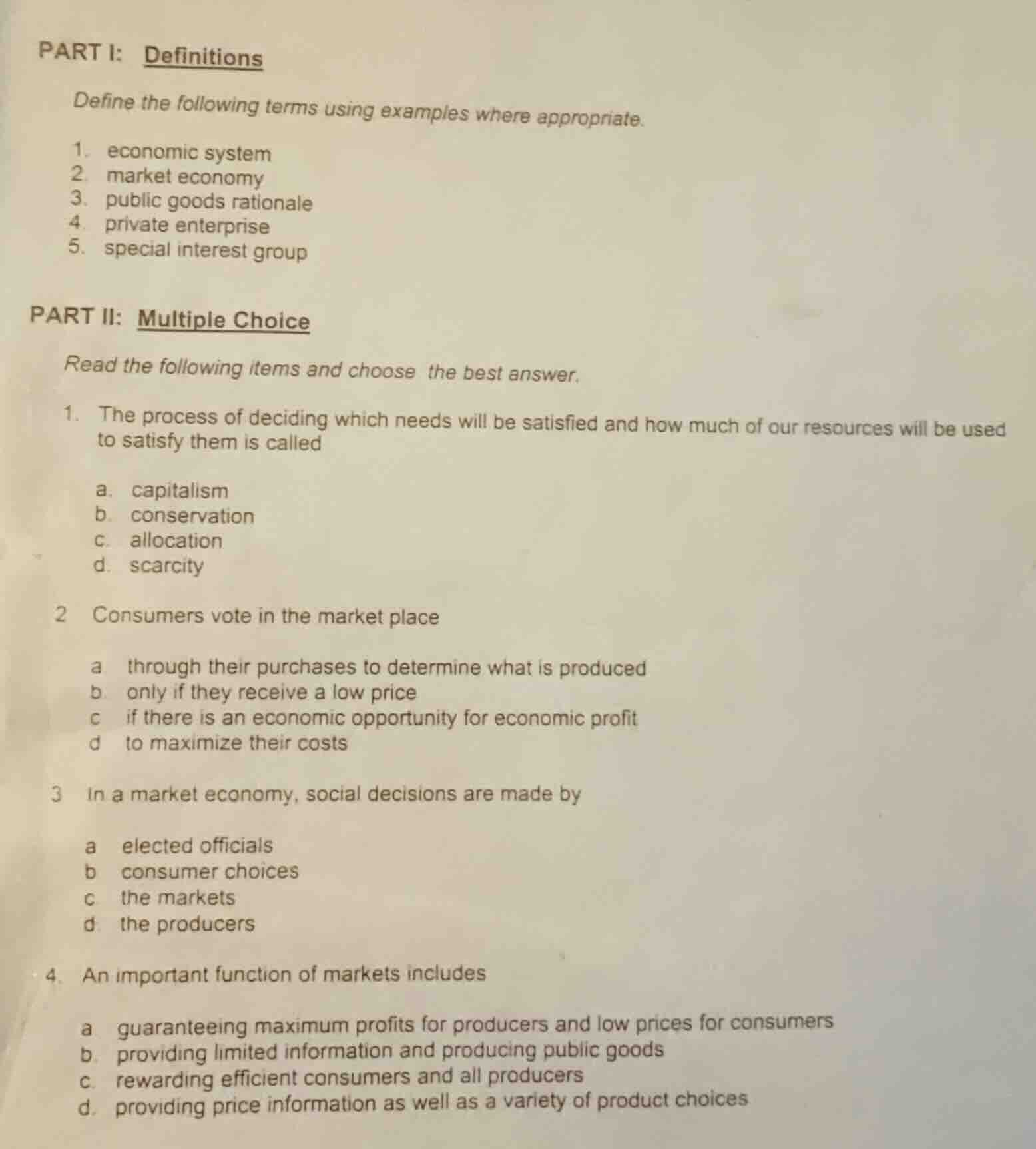
part i: definitions
define the following terms using examples where appropriate.
- economic system
- market economy
- public goods rationale
- private enterprise
- special interest group
part ii: multiple choice
read the following items and choose the best answer.
- the process of deciding which needs will be satisfied and how much of our resources will be used to satisfy them is called
a. capitalism
b. conservation
c. allocation
d. scarcity
- consumers vote in the market place
a. through their purchases to determine what is produced
b. only if they receive a low price
c. if there is an economic opportunity for economic profit
d. to maximize their costs
- in a market economy, social decisions are made by
a. elected officials
b. consumer choices
c. the markets
d. the producers
- an important function of markets includes
a. guaranteeing maximum profits for producers and low prices for consumers
b. providing limited information and producing public goods
c. rewarding efficient consumers and all producers
d. providing price information as well as a variety of product choices
---
PART I: Definitions
- economic system: A framework organizing resource allocation, production, and distribution of goods/services in a society. Example: The mixed economy of the U.S., combining private enterprise and government regulation.
- market economy: An economic system where supply, demand, and private ownership drive production and pricing decisions, with minimal government intervention. Example: Hong Kong's largely unregulated market for most consumer goods.
- public goods rationale: The economic argument that governments should fund and provide non-excludable, non-rival goods (where one person's use doesn't reduce access for others) because private markets will underproduce them. Example: National defense, as it protects all citizens regardless of payment.
- private enterprise: A system where individuals or private businesses (not the government) own and operate productive resources to earn profit. Example: A locally owned café that sets its own menu and prices.
- special interest group: A group of people with shared economic or political goals that advocates for policies benefiting their specific group. Example: A farmers' lobby pushing for agricultural subsidies.
- The term describes assigning scarce resources to meet specific needs.
- Consumers signal preferences through what they choose to buy, shaping production.
- Market economies rely on decentralized interactions of buyers and sellers (markets) to make social and economic decisions.
- Markets core functions include transmitting price signals and offering a range of products to consumers.

Snap & solve any problem in the app
Get step-by-step solutions on Sovi AI
Photo-based solutions with guided steps
Explore more problems and detailed explanations
- economic system: A societal framework for organizing resource use, production, and distribution of goods/services (e.g., the U.S. mixed economy).
- market economy: An economic system driven by supply, demand, and private ownership with limited government oversight (e.g., Hong Kong's consumer goods market).
- public goods rationale: The argument that governments must provide non-excludable, non-rival goods (e.g., national defense) that private markets underproduce.
- private enterprise: A system where private entities own/operate productive resources for profit (e.g., a local independent café).
- special interest group: A coalition advocating for policies benefiting its shared economic/political goals (e.g., a farmers' lobby for agricultural subsidies).
---