QUESTION IMAGE
Question
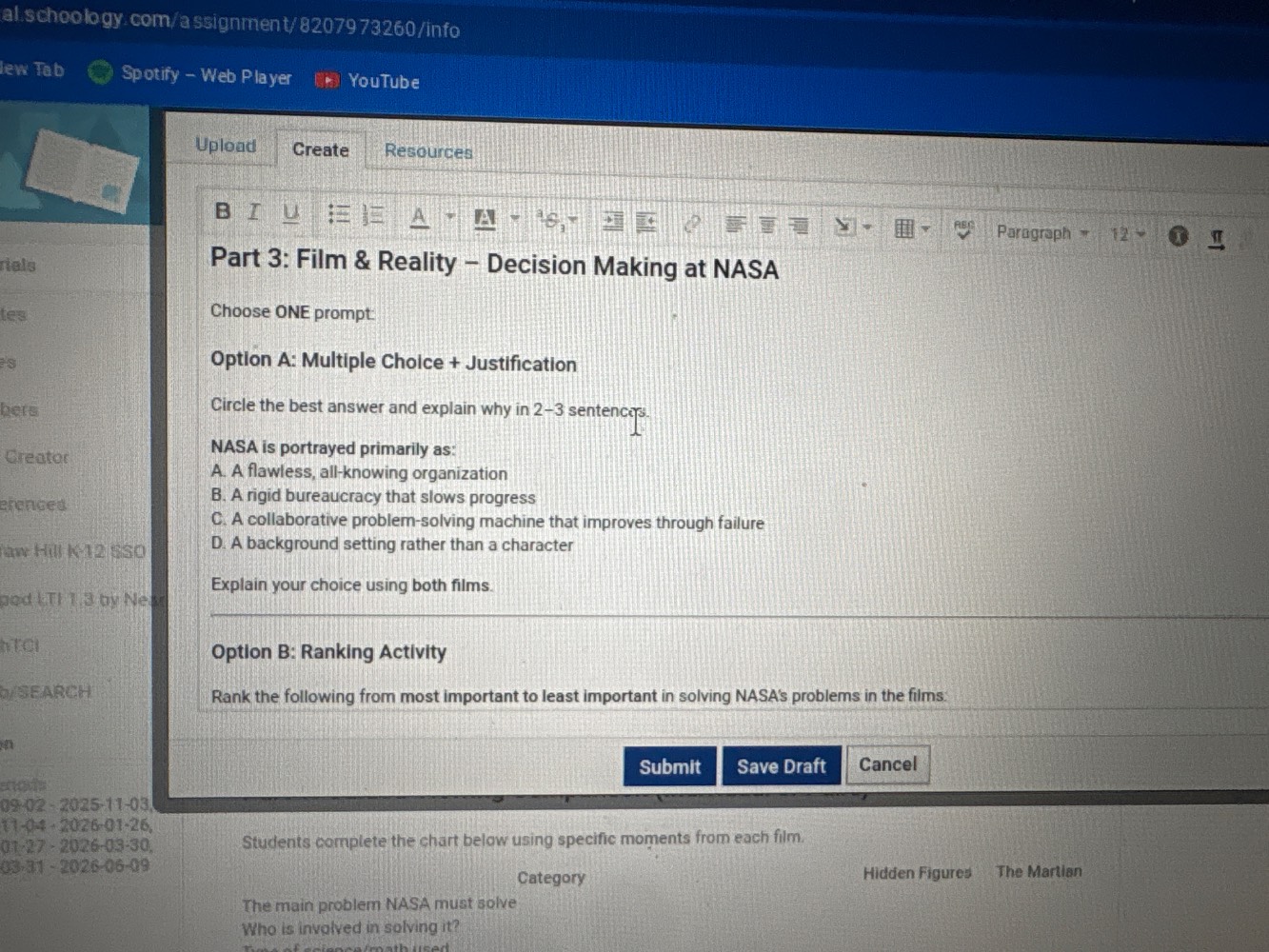
part 3: film & reality – decision making at nasa
choose one prompt:
option a: multiple choice + justification
circle the best answer and explain why in 2–3 sentences.
nasa is portrayed primarily as:
a. a flawless, all - knowing organization
b. a rigid bureaucracy that slows progress
c. a collaborative problem - solving machine that improves through failure
d. a background setting rather than a character
explain your choice using both films.
option b: ranking activity
rank the following from most important to least important in solving nasas problems in the films.
To solve this, we analyze the portrayal of NASA in films (e.g., Hidden Figures and The Martian):
Option A Analysis:
NASA is not portrayed as “flawless” or “all - knowing.” In Hidden Figures, there were internal biases and challenges, and in The Martian, mistakes (like the storm that stranded Mark Watney) showed imperfection. So A is incorrect.
Option B Analysis:
NASA is not a “rigid bureaucracy slowing progress.” In both films, teams worked efficiently to solve crises (e.g., calculating orbits in Hidden Figures, rescuing Watney in The Martian), showing adaptability, not rigidity. So B is incorrect.
Option C Analysis:
In Hidden Figures, NASA teams collaborated (e.g., Katherine Johnson working with others) and learned from past biases. In The Martian, NASA learned from the initial mission failure to mount a rescue, emphasizing collaboration and growth through failure. This matches “a collaborative problem - solving machine that improves through failure.”
Option D Analysis:
NASA is a central “character” (driving plot, making decisions) in both films, not just a background setting. So D is incorrect.

Snap & solve any problem in the app
Get step-by-step solutions on Sovi AI
Photo-based solutions with guided steps
Explore more problems and detailed explanations
C. A collaborative problem - solving machine that improves through failure