QUESTION IMAGE
Question
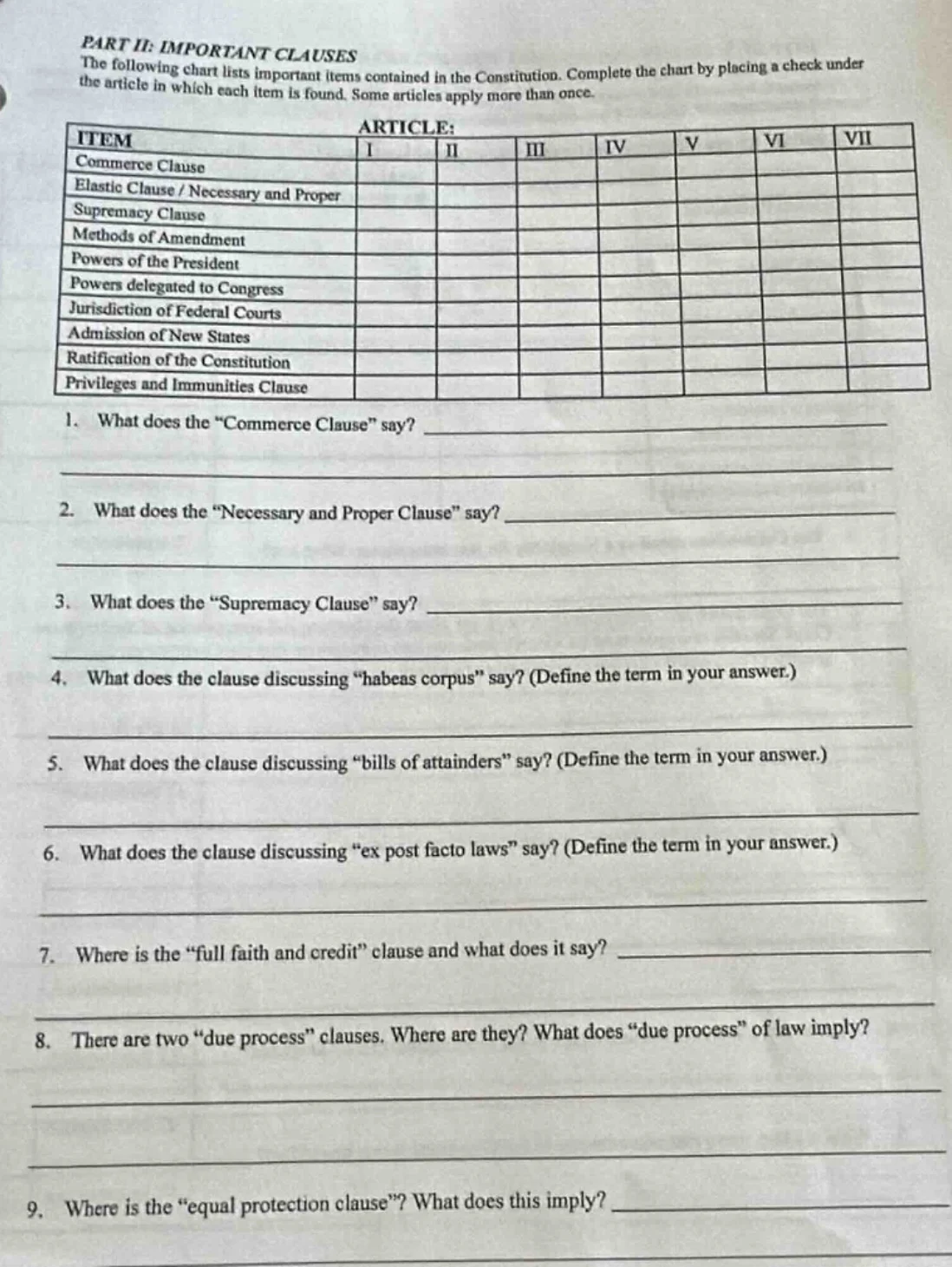
part ii: important clauses
the following chart lists important items contained in the constitution. complete the chart by placing a check under
the article in which each item is found. some articles apply more than once.
| item | article: | ||||||
|---|---|---|---|---|---|---|---|
| commerce clause | |||||||
| elastic clause / necessary and proper | |||||||
| supremacy clause | |||||||
| methods of amendment | |||||||
| powers of the president | |||||||
| powers delegated to congress | |||||||
| jurisdiction of federal courts | |||||||
| admission of new states | |||||||
| ratification of the constitution | |||||||
| privileges and immunities clause |
- what does the \commerce clause\ say?
- what does the
ecessary and proper clause\ say?
- what does the \supremacy clause\ say?
- what does the clause discussing \habeas corpus\ say? (define the term in your answer.)
- what does the clause discussing \bills of attainders\ say? (define the term in your answer.)
- what does the clause discussing \ex post facto laws\ say? (define the term in your answer.)
- where is the \full faith and credit\ clause and what does it say?
- there are two \due process\ clauses. where are they? what does \due process\ of law imply?
- where is the \equal protection clause\? what does this imply?
1. What does the “Commerce Clause” say?
The Commerce Clause (Article I, Section 8, Clause 3) gives Congress the power to regulate commerce with foreign nations, among the several states, and with the Indian tribes.
The Necessary and Proper Clause (also called the Elastic Clause, in Article I, Section 8, Clause 18) allows Congress to make all laws which shall be necessary and proper for carrying into execution the foregoing powers, and all other powers vested by the Constitution in the government of the United States, or in any department or officer thereof.
The Supremacy Clause (Article VI, Clause 2) establishes that the Constitution, federal laws made pursuant to it, and treaties made under the authority of the United States, are the supreme law of the land; and that state judges are bound by them, even if state laws or constitutions conflict.

Snap & solve any problem in the app
Get step-by-step solutions on Sovi AI
Photo-based solutions with guided steps
Explore more problems and detailed explanations
The Commerce Clause (in Article I, Section 8, Clause 3 of the U.S. Constitution) grants Congress the power to regulate commerce with foreign nations, among the several states, and with Indian tribes.