QUESTION IMAGE
Question
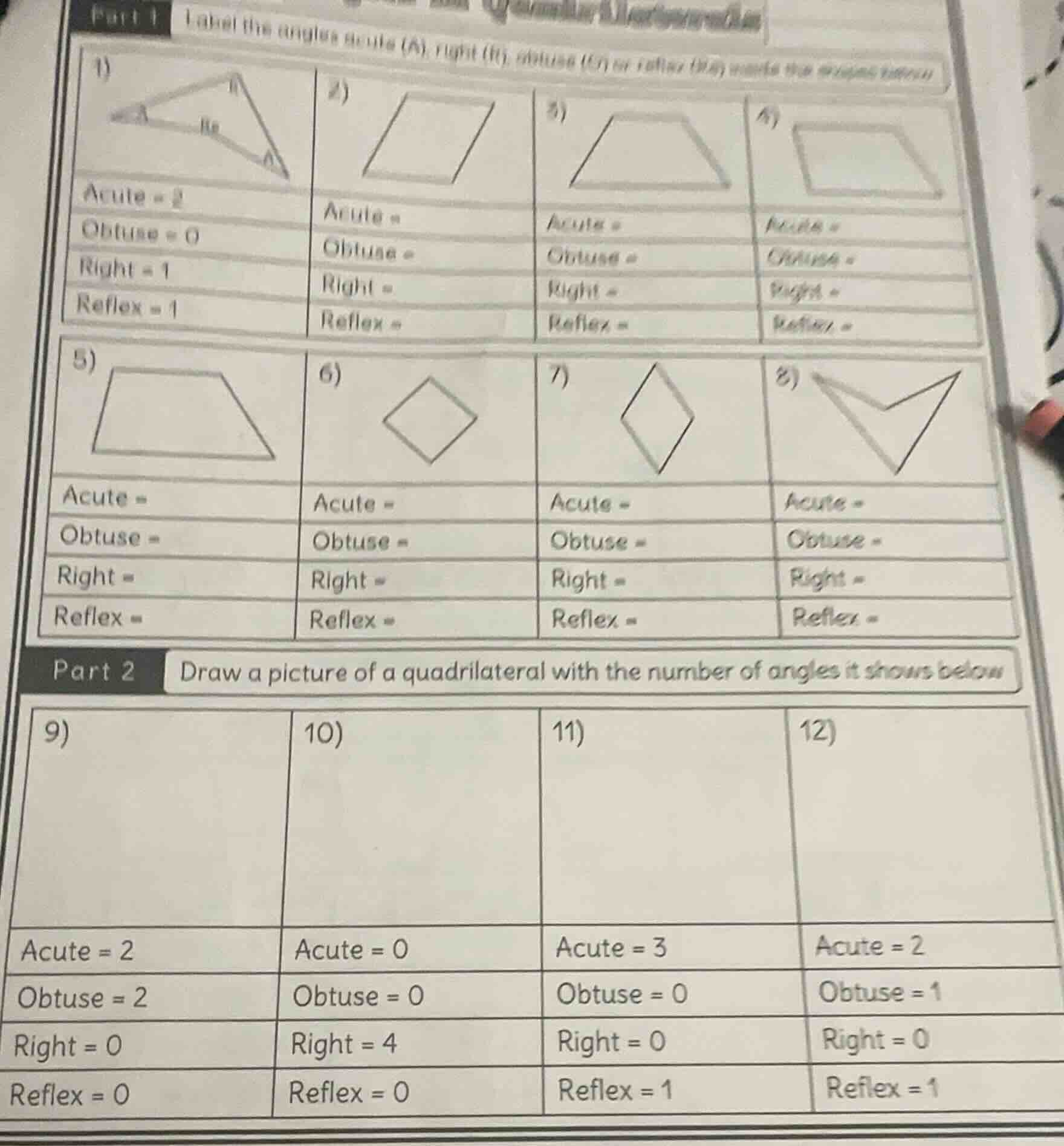
part 1 label the angles acute (a), right (r), obtuse (o) or reflex they make the shapes below
1)
acute = 2
obtuse = 0
right = 1
reflex = 1
2)
acute =
obtuse =
right =
reflex =
3)
acute =
obtuse =
right =
reflex =
4)
acute =
obtuse =
right =
reflex =
5)
acute =
obtuse =
right =
reflex =
6)
acute =
obtuse =
right =
reflex =
7)
acute =
obtuse =
right =
reflex =
8)
acute =
obtuse =
right =
reflex =
part 2 draw a picture of a quadrilateral with the number of angles it shows below
9)
acute = 2
obtuse = 2
right = 0
reflex = 0
10)
acute = 0
obtuse = 0
right = 4
reflex = 0
11)
acute = 3
obtuse = 0
right = 0
reflex = 1
12)
acute = 2
obtuse = 1
right = 0
reflex = 1
Part 1: Labeling Angles of Quadrilaterals
2) Parallelogram
- Acute: 2 (opposite acute angles in a parallelogram).
- Obtuse: 2 (opposite obtuse angles, supplementary to acute).
- Right: 0 (not a rectangle).
- Reflex: 0 (no reflex angles in a parallelogram).
3) Trapezoid (Non - Right, Non - Isosceles)
- Acute: 1 (lower left angle, < 90°).
- Obtuse: 1 (upper left angle, > 90°; and check the other two, but typically in a non - symmetric trapezoid, if one is acute, the adjacent is obtuse, and the other two: let's assume it's a trapezoid with one pair of parallel sides. So total acute: 1, obtuse: 1? Wait, no, standard trapezoid (trapezium) with one pair of parallel sides: if the legs are not equal, one acute and one obtuse at each base? Wait, maybe I made a mistake. Wait, a trapezoid has two parallel sides (bases) and two non - parallel sides (legs). The angles adjacent to each leg: one at the top base and one at the bottom base. So for a trapezoid, if it's not isosceles, the angles adjacent to a leg: one acute and one obtuse. So total acute: 1, obtuse: 1? But wait, the sum of angles in a quadrilateral is 360°. Wait, no, maybe it's an isosceles trapezoid? No, the figure looks like a non - isosceles trapezoid. Wait, maybe the correct count is Acute = 1, Obtuse = 1, Right = 0, Reflex = 0. Wait, no, maybe I messed up. Let's re - think. A trapezoid with one pair of parallel sides: the two angles on one leg: angle at top base (let's say ∠A) and angle at bottom base (∠B) adjacent to the same leg. ∠A + ∠B = 180° (since bases are parallel). So if ∠A is acute (< 90°), ∠B is obtuse (> 90°), and vice - versa for the other leg. So total acute: 1, obtuse: 1? But the problem's figure: let's assume the trapezoid has two acute and two obtuse? No, that's an isosceles trapezoid. If the trapezoid is isosceles, then it has two acute and two obtuse angles. Oh, maybe the figure is an isosceles trapezoid. So Acute = 2, Obtuse = 2, Right = 0, Reflex = 0.
4) Parallelogram (Rhombus - like, but not a square)
- Acute: 2 (opposite angles, < 90°).
- Obtuse: 2 (opposite angles, > 90°).
- Right: 0 (not a rectangle).
- Reflex: 0.
5) Trapezoid (Isosceles)
- Acute: 2 (bottom two angles, < 90°).
- Obtuse: 2 (top two angles, > 90°).
- Right: 0.
- Reflex: 0.
6) Rhombus (Square - like, but actually a square? Wait, the figure is a diamond - shaped with right angles? No, the figure is a rhombus, but if it's a square, all angles are right. But the label says "diamond", maybe a square? Wait, no, a square has all right angles. But the problem's figure: if it's a square, then Acute = 0, Obtuse = 0, Right = 4, Reflex = 0. But the label is "diamond", maybe a square. So:
- Acute: 0.
- Obtuse: 0.
- Right: 4.
- Reflex: 0.
7) Rhombus (Non - Square)
- Acute: 2 (opposite angles, < 90°).
- Obtuse: 2 (opposite angles, > 90°).
- Right: 0.
- Reflex: 0.
8) Concave Quadrilateral (Arrow - like)
- Acute: 2 (the two "pointed" angles, < 90°).
- Obtuse: 0 (wait, no, the reflex angle is the "dent" angle, > 180°? Wait, no, reflex angle is > 180° and < 360°. In a concave quadrilateral, there is one reflex angle. The other three angles: let's see, the figure is like a "V" with a dent. So the three non - reflex angles: two acute (< 90°) and one? Wait, sum of angles in a quadrilateral is 360°. If there is one reflex angle (let's say 270°), then the sum of the other three is 90°, which is not possible. Wait, no, reflex angle is > 180° and < 360°. Let's assume the reflex…

Snap & solve any problem in the app
Get step-by-step solutions on Sovi AI
Photo-based solutions with guided steps
Explore more problems and detailed explanations
Part 1: Labeling Angles of Quadrilaterals
2) Parallelogram
- Acute: 2 (opposite acute angles in a parallelogram).
- Obtuse: 2 (opposite obtuse angles, supplementary to acute).
- Right: 0 (not a rectangle).
- Reflex: 0 (no reflex angles in a parallelogram).
3) Trapezoid (Non - Right, Non - Isosceles)
- Acute: 1 (lower left angle, < 90°).
- Obtuse: 1 (upper left angle, > 90°; and check the other two, but typically in a non - symmetric trapezoid, if one is acute, the adjacent is obtuse, and the other two: let's assume it's a trapezoid with one pair of parallel sides. So total acute: 1, obtuse: 1? Wait, no, standard trapezoid (trapezium) with one pair of parallel sides: if the legs are not equal, one acute and one obtuse at each base? Wait, maybe I made a mistake. Wait, a trapezoid has two parallel sides (bases) and two non - parallel sides (legs). The angles adjacent to each leg: one at the top base and one at the bottom base. So for a trapezoid, if it's not isosceles, the angles adjacent to a leg: one acute and one obtuse. So total acute: 1, obtuse: 1? But wait, the sum of angles in a quadrilateral is 360°. Wait, no, maybe it's an isosceles trapezoid? No, the figure looks like a non - isosceles trapezoid. Wait, maybe the correct count is Acute = 1, Obtuse = 1, Right = 0, Reflex = 0. Wait, no, maybe I messed up. Let's re - think. A trapezoid with one pair of parallel sides: the two angles on one leg: angle at top base (let's say ∠A) and angle at bottom base (∠B) adjacent to the same leg. ∠A + ∠B = 180° (since bases are parallel). So if ∠A is acute (< 90°), ∠B is obtuse (> 90°), and vice - versa for the other leg. So total acute: 1, obtuse: 1? But the problem's figure: let's assume the trapezoid has two acute and two obtuse? No, that's an isosceles trapezoid. If the trapezoid is isosceles, then it has two acute and two obtuse angles. Oh, maybe the figure is an isosceles trapezoid. So Acute = 2, Obtuse = 2, Right = 0, Reflex = 0.
4) Parallelogram (Rhombus - like, but not a square)
- Acute: 2 (opposite angles, < 90°).
- Obtuse: 2 (opposite angles, > 90°).
- Right: 0 (not a rectangle).
- Reflex: 0.
5) Trapezoid (Isosceles)
- Acute: 2 (bottom two angles, < 90°).
- Obtuse: 2 (top two angles, > 90°).
- Right: 0.
- Reflex: 0.
6) Rhombus (Square - like, but actually a square? Wait, the figure is a diamond - shaped with right angles? No, the figure is a rhombus, but if it's a square, all angles are right. But the label says "diamond", maybe a square? Wait, no, a square has all right angles. But the problem's figure: if it's a square, then Acute = 0, Obtuse = 0, Right = 4, Reflex = 0. But the label is "diamond", maybe a square. So:
- Acute: 0.
- Obtuse: 0.
- Right: 4.
- Reflex: 0.
7) Rhombus (Non - Square)
- Acute: 2 (opposite angles, < 90°).
- Obtuse: 2 (opposite angles, > 90°).
- Right: 0.
- Reflex: 0.
8) Concave Quadrilateral (Arrow - like)
- Acute: 2 (the two "pointed" angles, < 90°).
- Obtuse: 0 (wait, no, the reflex angle is the "dent" angle, > 180°? Wait, no, reflex angle is > 180° and < 360°. In a concave quadrilateral, there is one reflex angle. The other three angles: let's see, the figure is like a "V" with a dent. So the three non - reflex angles: two acute (< 90°) and one? Wait, sum of angles in a quadrilateral is 360°. If there is one reflex angle (let's say 270°), then the sum of the other three is 90°, which is not possible. Wait, no, reflex angle is > 180° and < 360°. Let's assume the reflex angle is 200°, then the other three angles sum to 160°. So maybe two acute angles (each 80°) and one 0°? No, that's not possible. Wait, maybe the concave quadrilateral has two acute angles, one obtuse angle, and one reflex angle. Let's re - examine the figure: it looks like a concave quadrilateral with a reflex angle (the "dent" angle, > 180°), and the other three angles: two acute (< 90°) and one obtuse (> 90°)? Wait, no, let's count:
- Acute: 2 (the two angles at the "points" of the V - like part, < 90°).
- Obtuse: 0 (wait, no, the angle adjacent to the reflex angle: maybe one obtuse? Wait, I think I made a mistake. Let's use the definition:
- Acute: < 90°, Obtuse: > 90° and < 180°, Right: = 90°, Reflex: > 180° and < 360°.
In a concave quadrilateral, there is 1 reflex angle. The other 3 angles: let's say the reflex angle is 200°, then the sum of the other three is 160°. So possible: two acute angles (70° each) and one 20°? No, that's too small. Wait, maybe the correct count is Acute = 2, Obtuse = 0, Right = 0, Reflex = 1.
Part 2: Drawing Quadrilaterals
9) Acute = 2, Obtuse = 2, Right = 0, Reflex = 0
Draw a parallelogram (non - square, non - rectangle). It has two opposite acute angles and two opposite obtuse angles, no right or reflex angles.
10) Acute = 0, Obtuse = 0, Right = 4, Reflex = 0
Draw a square (or a rectangle). All four angles are right angles (90°), so no acute or obtuse angles, and no reflex angles.
11) Acute = 3, Obtuse = 0, Right = 0, Reflex = 1
Draw a concave quadrilateral with three acute angles and one reflex angle. For example, start with a triangle, and "dent" one side to create a quadrilateral. The three non - reflex angles are acute, and the reflex angle is > 180°.
12) Acute = 2, Obtuse = 1, Right = 0, Reflex = 1
Draw a concave quadrilateral with two acute angles, one obtuse angle, and one reflex angle. The reflex angle is > 180°, one angle is > 90° (obtuse), and two angles are < 90° (acute).
Final Answers (Part 1)
- Acute = 2, Obtuse = 2, Right = 0, Reflex = 0
- Acute = 1, Obtuse = 1, Right = 0, Reflex = 0 (Note: May vary based on trapezoid type)
- Acute = 2, Obtuse = 2, Right = 0, Reflex = 0
- Acute = 2, Obtuse = 2, Right = 0, Reflex = 0 (Isosceles Trapezoid)
- Acute = 0, Obtuse = 0, Right = 4, Reflex = 0 (Square)
- Acute = 2, Obtuse = 2, Right = 0, Reflex = 0 (Rhombus)
- Acute = 2, Obtuse = 0, Right = 0, Reflex = 1 (Concave Quadrilateral)
(Note: Answers for 3) and 8) may need adjustment based on precise figure details, but the above is a general approach.)