QUESTION IMAGE
Question
part 1: membrane transport
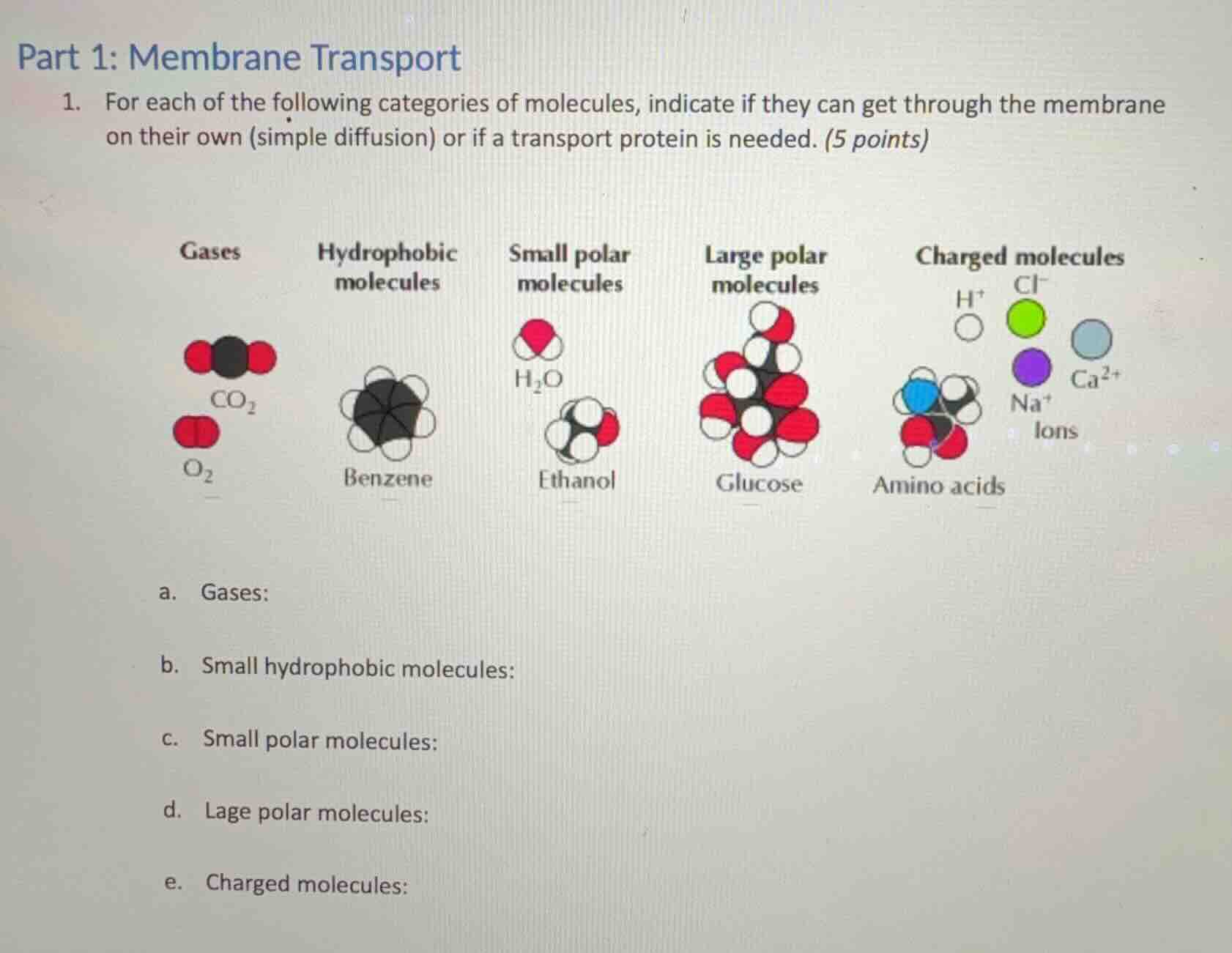
- for each of the following categories of molecules, indicate if they can get through the membrane on their own (simple diffusion) or if a transport protein is needed. (5 points)
gases
hydrophobic molecules
small polar molecules
large polar molecules
charged molecules
$ce{co_{2}}$
$ce{o_{2}}$
benzene
$ce{h_{2}o}$
ethanol
glucose
amino acids
$ce{h^{+}}$
$ce{cl^{-}}$
$ce{na^{+}}$
$ce{ca^{2+}}$
ions
a. gases:
b. small hydrophobic molecules:
c. small polar molecules:
d. lage polar molecules:
e. charged molecules:
- Gases are small, nonpolar, and can freely cross the lipid bilayer via simple diffusion.
- Small hydrophobic molecules dissolve in the lipid bilayer, so they use simple diffusion.
- Small polar molecules are small enough to pass through the bilayer's gaps via simple diffusion (some may use channels, but simple diffusion is possible).
- Large polar molecules are too big and polar to cross the lipid bilayer on their own, requiring transport proteins.
- Charged molecules/ions are repelled by the hydrophobic bilayer interior, so they need transport proteins.

Snap & solve any problem in the app
Get step-by-step solutions on Sovi AI
Photo-based solutions with guided steps
Explore more problems and detailed explanations
a. Gases: Can get through on their own (simple diffusion)
b. Small hydrophobic molecules: Can get through on their own (simple diffusion)
c. Small polar molecules: Can get through on their own (simple diffusion)
d. Large polar molecules: Need a transport protein
e. Charged molecules: Need a transport protein