QUESTION IMAGE
Question
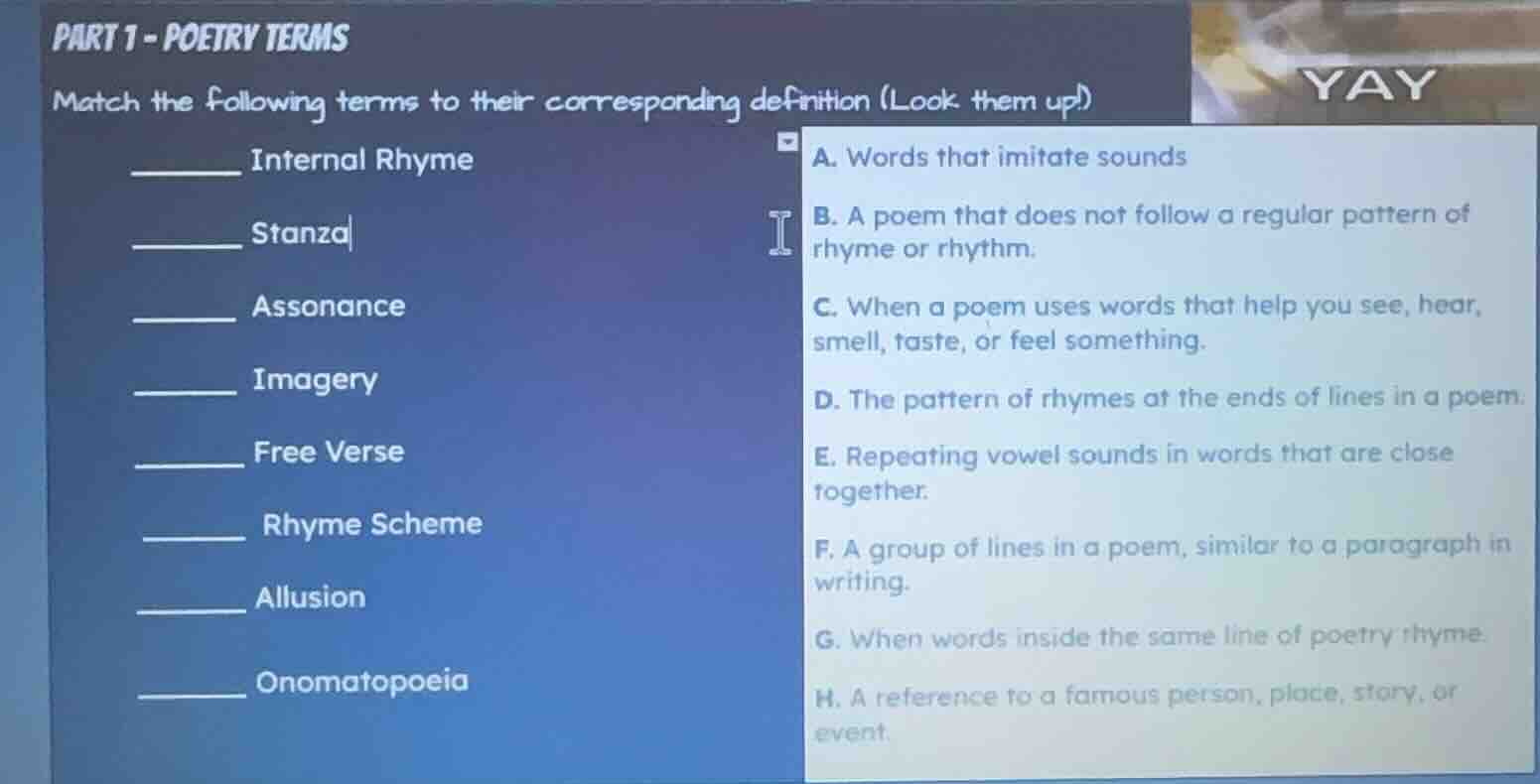
part 1 - poetry terms
match the following terms to their corresponding definition (look them up!)
______ internal rhyme
______ stanza
______ assonance
______ imagery
______ free verse
______ rhyme scheme
______ allusion
______ onomatopoeia
a. words that imitate sounds
b. a poem that does not follow a regular pattern of rhyme or rhythm.
c. when a poem uses words that help you see, hear, smell, taste, or feel something.
d. the pattern of rhymes at the ends of lines in a poem.
e. repeating vowel sounds in words that are close together.
f. a group of lines in a poem, similar to a paragraph in writing.
g. when words inside the same line of poetry rhyme.
h. a reference to a famous person, place, story, or event.
- Internal Rhyme: Matches G as it's about rhyming within a line.
- Stanza: Matches F as a stanza is a group of lines like a paragraph.
- Assonance: Matches E as it's repeating vowel sounds close together.
- Imagery: Matches C as it uses words for sensory experiences.
- Free Verse: Matches B as it has no regular rhyme/rhythm pattern.
- Rhyme Scheme: Matches D as it's the pattern of rhymes at line ends.
- Allusion: Matches H as it's a reference to famous things.
- Onomatopoeia: Matches A as it's words imitating sounds.

Snap & solve any problem in the app
Get step-by-step solutions on Sovi AI
Photo-based solutions with guided steps
Explore more problems and detailed explanations
Internal Rhyme: G. When words inside the same line of poetry rhyme.
Stanza: F. A group of lines in a poem, similar to a paragraph in writing.
Assonance: E. Repeating vowel sounds in words that are close together.
Imagery: C. When a poem uses words that help you see, hear, smell, taste, or feel something.
Free Verse: B. A poem that does not follow a regular pattern of rhyme or rhythm.
Rhyme Scheme: D. The pattern of rhymes at the ends of lines in a poem.
Allusion: H. A reference to a famous person, place, story, or event.
Onomatopoeia: A. Words that imitate sounds.