QUESTION IMAGE
Question
part 2: polar ecosystems
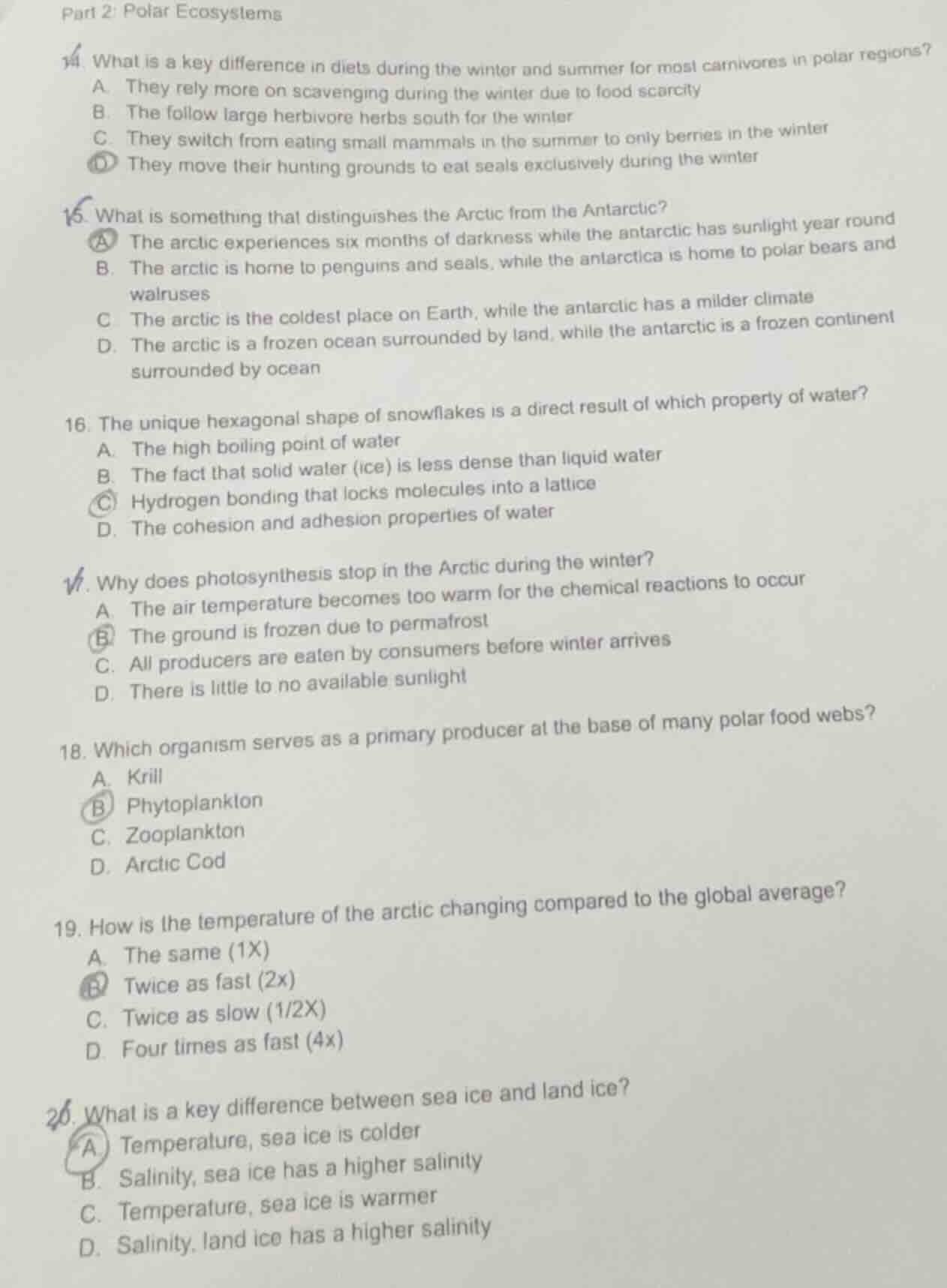
- what is a key difference in diets during the winter and summer for most carnivores in polar regions?
a. they rely more on scavenging during the winter due to food scarcity
b. the follow large herbivore herbs south for the winter
c. they switch from eating small mammals in the summer to only berries in the winter
d. they move their hunting grounds to eat seals exclusively during the winter
- what is something that distinguishes the arctic from the antarctic?
a. the arctic experiences six months of darkness while the antarctic has sunlight year round
b. the arctic is home to penguins and seals, while the antarctica is home to polar bears and walruses
c. the arctic is the coldest place on earth, while the antarctic has a milder climate
d. the arctic is a frozen ocean surrounded by land, while the antarctic is a frozen continent surrounded by ocean
- the unique hexagonal shape of snowflakes is a direct result of which property of water?
a. the high boiling point of water
b. the fact that solid water (ice) is less dense than liquid water
c. hydrogen bonding that locks molecules into a lattice
d. the cohesion and adhesion properties of water
- why does photosynthesis stop in the arctic during the winter?
a. the air temperature becomes too warm for the chemical reactions to occur
b. the ground is frozen due to permafrost
c. all producers are eaten by consumers before winter arrives
d. there is little to no available sunlight
- which organism serves as a primary producer at the base of many polar food webs?
a. krill
b. phytoplankton
c. zooplankton
d. arctic cod
- how is the temperature of the arctic changing compared to the global average?
a. the same (1x)
b. twice as fast (2x)
c. twice as slow (1/2x)
d. four times as fast (4x)
- what is a key difference between sea ice and land ice?
a. temperature, sea ice is colder
b. salinity, sea ice has a higher salinity
c. temperature, sea ice is warmer
d. salinity, land ice has a higher salinity
- Polar carnivores face winter food scarcity, so scavenging becomes more critical as hunting opportunities drop.
- The Arctic is an ocean covered by sea ice, bordered by landmasses; Antarctica is a continental landmass surrounded by oceans.
- Water's hydrogen bonding forms a hexagonal lattice as it freezes, creating snowflakes' shape.
- The Arctic has months of near-total darkness in winter, removing the sunlight needed for photosynthesis.
- Phytoplankton are photosynthetic organisms that form the base of most polar marine food webs.
- The Arctic is warming at approximately twice the rate of the global average due to polar amplification.
- Land ice forms from freshwater, while sea ice forms from seawater but expels most salt as it freezes, leaving land ice with higher salinity than fully formed sea ice.

Snap & solve any problem in the app
Get step-by-step solutions on Sovi AI
Photo-based solutions with guided steps
Explore more problems and detailed explanations
- A. They rely more on scavenging during the winter due to food scarcity
- D. The arctic is a frozen ocean surrounded by land, while the antarctic is a frozen continent surrounded by ocean
- C. Hydrogen bonding that locks molecules into a lattice
- D. There is little to no available sunlight
- B. Phytoplankton
- B. Twice as fast (2x)
- D. Salinity, land ice has a higher salinity