QUESTION IMAGE
Question
part b
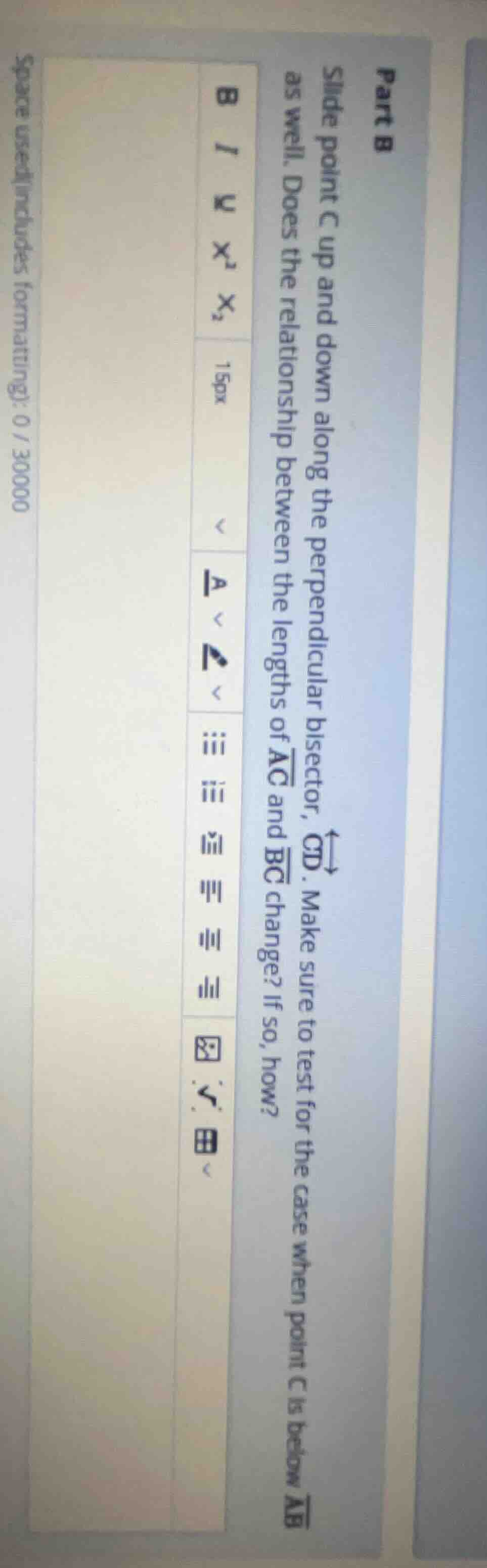
slide point c up and down along the perpendicular bisector, \overleftrightarrow{cd}. make sure to test for the case when point c is below \overline{ab} as well. does the relationship between the lengths of \overline{ac} and \overline{bc} change? if so, how?
A perpendicular bisector of a segment is a line that is perpendicular to the segment and passes through its midpoint. By the definition and theorem of perpendicular bisectors, any point on the perpendicular bisector of a segment is equidistant from the endpoints of the segment. This holds true whether the point is above or below the original segment. So as point C slides along $\overleftrightarrow{CD}$ (the perpendicular bisector of $\overline{AB}$), the lengths of $\overline{AC}$ and $\overline{BC}$ remain equal at all positions of C, and their relationship does not change.

Snap & solve any problem in the app
Get step-by-step solutions on Sovi AI
Photo-based solutions with guided steps
Explore more problems and detailed explanations
The relationship between the lengths of $\overline{AC}$ and $\overline{BC}$ does not change. For any position of point C on $\overleftrightarrow{CD}$ (including when C is below $\overline{AB}$), $\overline{AC} = \overline{BC}$, as all points on the perpendicular bisector of a segment are equidistant from the segment's endpoints.