QUESTION IMAGE
Question
partially correct
answer all the questions before selecting check.
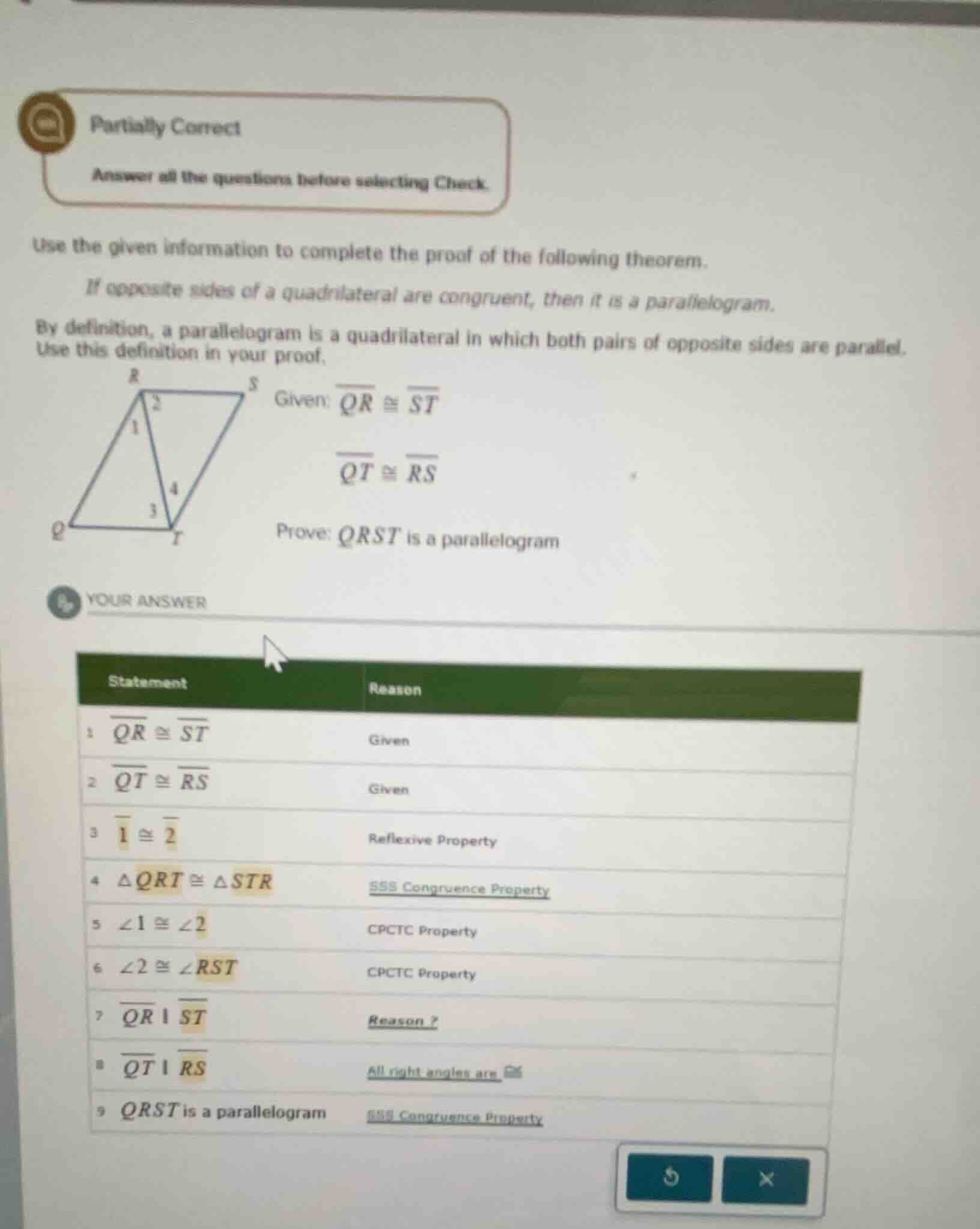
use the given information to complete the proof of the following theorem.
if opposite sides of a quadrilateral are congruent, then it is a parallelogram.
by definition, a parallelogram is a quadrilateral in which both pairs of opposite sides are parallel.
use this definition in your proof.
given: $overline{qr} \cong \overline{st}$
$overline{qt} \cong \overline{rs}$
prove: qrst is a parallelogram
your answer
statement reason
1 $overline{qr} \cong \overline{st}$ given
2 $overline{qt} \cong \overline{rs}$ given
3 $\boldsymbol{1} \cong \boldsymbol{2}$ reflexive property
4 $\triangle qrt \cong \triangle str$ sss congruence property
5 $\angle 1 \cong \angle 2$ cpctc property
6 $\angle 2 \cong \angle rst$ cpctc property
7 $overline{qr} \parallel \overline{st}$ reason?
8 $overline{qt} \parallel \overline{rs}$ all right angles are
9 qrst is a parallelogram sss congruence property
Step1: Analyze Statement 3
The reflexive property for congruence of a segment (or angle) states that a figure is congruent to itself. In the diagram, the common side for triangles \( \triangle QRT \) and \( \triangle STR \) is \( \overline{RT} \). So the correct statement for step 3 should be \( \overline{RT} \cong \overline{RT} \) (since \( \overline{RT} \) is the same segment, by reflexive property of congruence). The original answer had \( \angle 1 \cong \angle 2 \) which is incorrect for reflexive property (reflexive is for a figure with itself, not two different angles here).
Step2: Analyze Statement 4
To prove \( \triangle QRT \cong \triangle STR \), we have \( \overline{QR} \cong \overline{ST} \) (given), \( \overline{QT} \cong \overline{RS} \) (given), and \( \overline{RT} \cong \overline{RT} \) (reflexive). So by SSS (Side - Side - Side) congruence criterion, \( \triangle QRT \cong \triangle STR \). This part was correct in the original (the triangles are congruent by SSS).
Step3: Analyze Statement 5
CPCTC (Corresponding Parts of Congruent Triangles are Congruent) says that if two triangles are congruent, their corresponding angles are congruent. In \( \triangle QRT \) and \( \triangle STR \), \( \angle QRT \) (which is \( \angle 1+\angle 2 \)?) Wait, no. Wait, \( \triangle QRT \cong \triangle STR \), so corresponding angles: \( \angle QRT \) (angle at \( R \) in \( \triangle QRT \)) corresponds to \( \angle STR \) (angle at \( T \) in \( \triangle STR \))? Wait, maybe better to label the triangles. \( \triangle QRT \) has vertices \( Q, R, T \) and \( \triangle STR \) has vertices \( S, T, R \). So corresponding angles: \( \angle Q \) corresponds to \( \angle S \), \( \angle R \) (at \( R \) in \( \triangle QRT \)) corresponds to \( \angle T \) (at \( T \) in \( \triangle STR \)), \( \angle T \) (at \( T \) in \( \triangle QRT \)) corresponds to \( \angle R \) (at \( R \) in \( \triangle STR \)). Wait, maybe the original statement 5: \( \angle 1 \cong \angle 4 \) (if \( \angle 1 \) is in \( \triangle QRT \) and \( \angle 4 \) is in \( \triangle STR \))? Wait, maybe the error in statement 3 led to error in statement 5. Let's re - do:
- \( \overline{QR} \cong \overline{ST} \) (Given)
- \( \overline{QT} \cong \overline{RS} \) (Given)
- \( \overline{RT} \cong \overline{RT} \) (Reflexive Property of Congruence)
- \( \triangle QRT \cong \triangle STR \) (SSS Congruence Criterion)
- \( \angle QRT \cong \angle STR \) (CPCTC) and \( \angle RQT \cong \angle TSR \) (CPCTC), \( \angle RTQ \cong \angle RST \) (CPCTC)
- For \( \overline{QR} \parallel \overline{ST} \): We can use the Alternate Interior Angles Theorem. If \( \angle QRT \cong \angle STR \) (from CPCTC), then \( \overline{QR} \parallel \overline{ST} \) because alternate interior angles are congruent.
- Similarly, for \( \overline{QT} \parallel \overline{RS} \): If \( \angle RTQ \cong \angle RST \) (from CPCTC), then \( \overline{QT} \parallel \overline{RS} \) by Alternate Interior Angles Theorem.
- Since both pairs of opposite sides are parallel (\( \overline{QR} \parallel \overline{ST} \) and \( \overline{QT} \parallel \overline{RS} \)), \( QRST \) is a parallelogram (by definition of parallelogram).

Snap & solve any problem in the app
Get step-by-step solutions on Sovi AI
Photo-based solutions with guided steps
Explore more problems and detailed explanations
To correct the proof:
Statement 3:
\( \boldsymbol{\overline{RT} \cong \overline{RT}} \) (Reflexive Property of Congruence)
Statement 5:
Using CPCTC, the correct corresponding angles would be, for example, \( \boldsymbol{\angle QRT \cong \angle STR} \) (or other correct corresponding angles from the congruent triangles \( \triangle QRT \) and \( \triangle STR \))
Statement 7 (Reason for \( \overline{QR} \parallel \overline{ST} \)):
\( \boldsymbol{\text{Alternate Interior Angles Theorem}} \) (If alternate interior angles are congruent, then the lines are parallel. Since \( \angle QRT \cong \angle STR \) (from CPCTC), \( \overline{QR} \parallel \overline{ST} \))
Statement 8 (Reason for \( \overline{QT} \parallel \overline{RS} \)):
\( \boldsymbol{\text{Alternate Interior Angles Theorem}} \) (Similar to above, using the other pair of corresponding angles from CPCTC)
Statement 9 (Reason for \( QRST \) being a parallelogram):
\( \boldsymbol{\text{Definition of Parallelogram}} \) (A quadrilateral with both pairs of opposite sides parallel is a parallelogram. Since \( \overline{QR} \parallel \overline{ST} \) and \( \overline{QT} \parallel \overline{RS} \), \( QRST \) is a parallelogram)