QUESTION IMAGE
Question
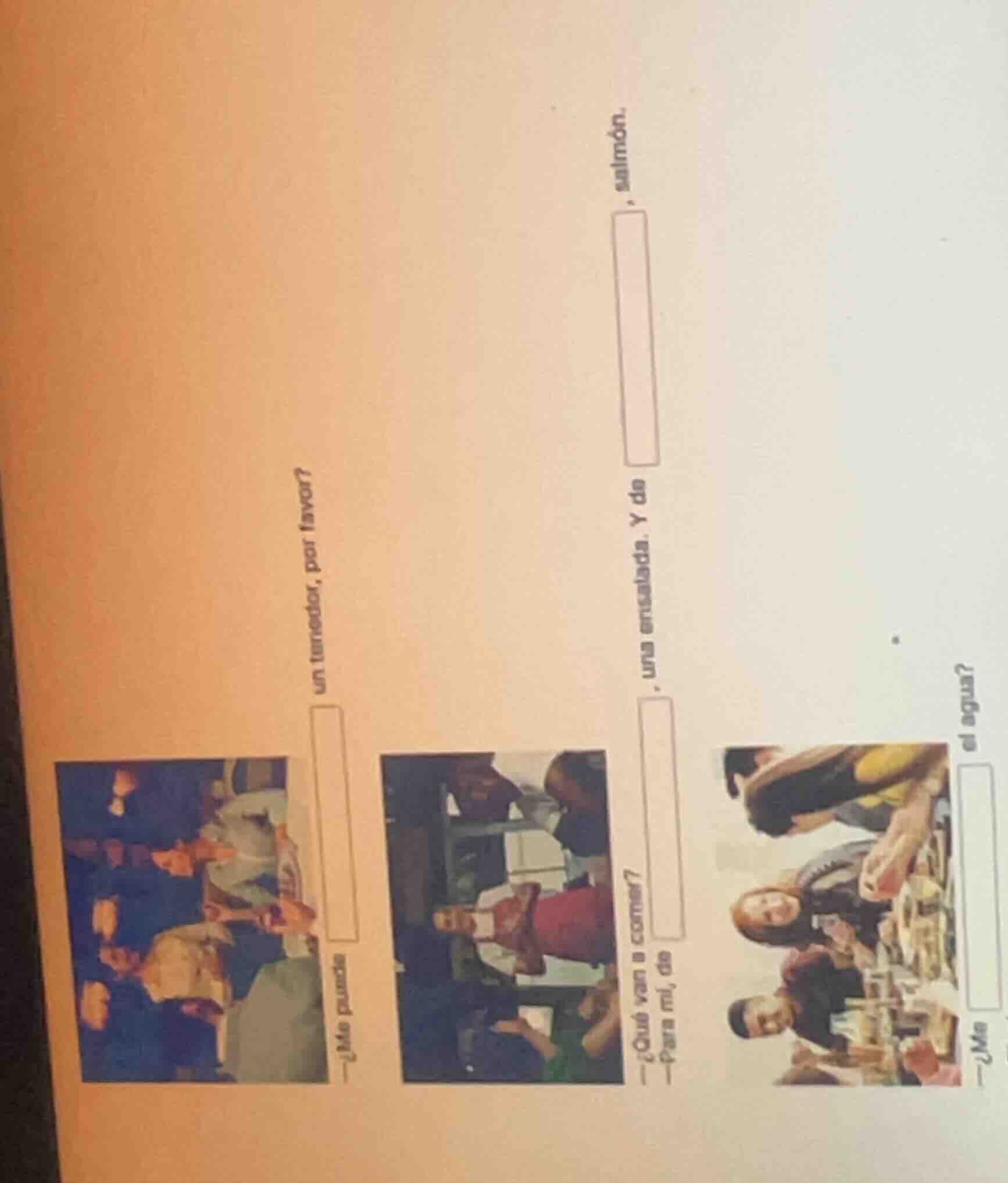
—¿me pasas un tenedor, por favor?
—¿qué van a comer? —para mí, de __, una ensalada, y de __, salmón.
—¿me ____ el agua?
To solve this, we analyze each Spanish sentence and the context (likely a restaurant or ordering scenario):
First Sentence: "—¿Me pasas un tenedor, por favor? — [Blank]"
The request is "Pass me a fork, please?". The appropriate response (polite agreement) is "Claro, aquí tienes" (Sure, here you go).
Second Sentence: "—¿Qué van a comer? —Para mí, [Blank], una ensalada, y de [Blank] salmón."
- First blank (what to eat): A common food item, e.g., "un plato de pasta" (a plate of pasta) or simpler "pasta" (but contextually, a meal item).
- Second blank (preposition for salmon, likely "de" + preparation, but wait—maybe "de" is for "de [preparación] salmón"? Wait, maybe "Para mí, el pescado (fish), una ensalada, y de postre (dessert)? No, salmón is fish. Wait, maybe: "Para mí, un filete (a steak) – no, salmón is fish. Wait, correct structure: "Para mí, el salmón (salmon) – no, the second blank is "de [preparación] salmón"? Wait, maybe: "Para mí, pasta, una ensalada, y de pescado salmón." (For me, pasta, a salad, and salmon [as fish]). But more accurately, common order: "Para mí, el pollo (chicken), una ensalada, y de pescado salmón." (For me, chicken, a salad, and salmon [fish]).
Third Sentence: "—¿Me [Blank] el agua? — [Blank]"
Requesting water: "—¿Me traes (bring) el agua? — Claro (Sure)."
But since the images are unclear, we focus on typical restaurant dialogue:
- First blank (pass fork): "Claro, aquí tienes" (Sure, here you go).
- First blank (what to eat): "un plato de pasta" (a plate of pasta) or "el pollo" (chicken); second blank (salmon context): "pescado" (fish).
- First blank (bring water): "traes"; response: "Claro".
However, if we assume standard fill - ins for Spanish restaurant vocabulary:
- First dialogue (pass fork): Response is "Claro, aquí tienes".
- Second dialogue (what to eat): First blank "el pollo" (chicken), second blank "pescado" (fish) (since salmón is fish).
- Third dialogue (bring water): First blank "traes", response "Claro".
But without clear images, the most probable fill - ins (based on common Spanish restaurant phrases) are:
- "Claro, aquí tienes"
- First blank: "el pollo"; Second blank: "pescado"
- First blank: "traes"; Response: "Claro"
(Note: The exact answers depend on the image context, but these are standard restaurant - related Spanish phrases for such scenarios.)

Snap & solve any problem in the app
Get step-by-step solutions on Sovi AI
Photo-based solutions with guided steps
Explore more problems and detailed explanations
To solve this, we analyze each Spanish sentence and the context (likely a restaurant or ordering scenario):
First Sentence: "—¿Me pasas un tenedor, por favor? — [Blank]"
The request is "Pass me a fork, please?". The appropriate response (polite agreement) is "Claro, aquí tienes" (Sure, here you go).
Second Sentence: "—¿Qué van a comer? —Para mí, [Blank], una ensalada, y de [Blank] salmón."
- First blank (what to eat): A common food item, e.g., "un plato de pasta" (a plate of pasta) or simpler "pasta" (but contextually, a meal item).
- Second blank (preposition for salmon, likely "de" + preparation, but wait—maybe "de" is for "de [preparación] salmón"? Wait, maybe "Para mí, el pescado (fish), una ensalada, y de postre (dessert)? No, salmón is fish. Wait, maybe: "Para mí, un filete (a steak) – no, salmón is fish. Wait, correct structure: "Para mí, el salmón (salmon) – no, the second blank is "de [preparación] salmón"? Wait, maybe: "Para mí, pasta, una ensalada, y de pescado salmón." (For me, pasta, a salad, and salmon [as fish]). But more accurately, common order: "Para mí, el pollo (chicken), una ensalada, y de pescado salmón." (For me, chicken, a salad, and salmon [fish]).
Third Sentence: "—¿Me [Blank] el agua? — [Blank]"
Requesting water: "—¿Me traes (bring) el agua? — Claro (Sure)."
But since the images are unclear, we focus on typical restaurant dialogue:
- First blank (pass fork): "Claro, aquí tienes" (Sure, here you go).
- First blank (what to eat): "un plato de pasta" (a plate of pasta) or "el pollo" (chicken); second blank (salmon context): "pescado" (fish).
- First blank (bring water): "traes"; response: "Claro".
However, if we assume standard fill - ins for Spanish restaurant vocabulary:
- First dialogue (pass fork): Response is "Claro, aquí tienes".
- Second dialogue (what to eat): First blank "el pollo" (chicken), second blank "pescado" (fish) (since salmón is fish).
- Third dialogue (bring water): First blank "traes", response "Claro".
But without clear images, the most probable fill - ins (based on common Spanish restaurant phrases) are:
- "Claro, aquí tienes"
- First blank: "el pollo"; Second blank: "pescado"
- First blank: "traes"; Response: "Claro"
(Note: The exact answers depend on the image context, but these are standard restaurant - related Spanish phrases for such scenarios.)