QUESTION IMAGE
Question
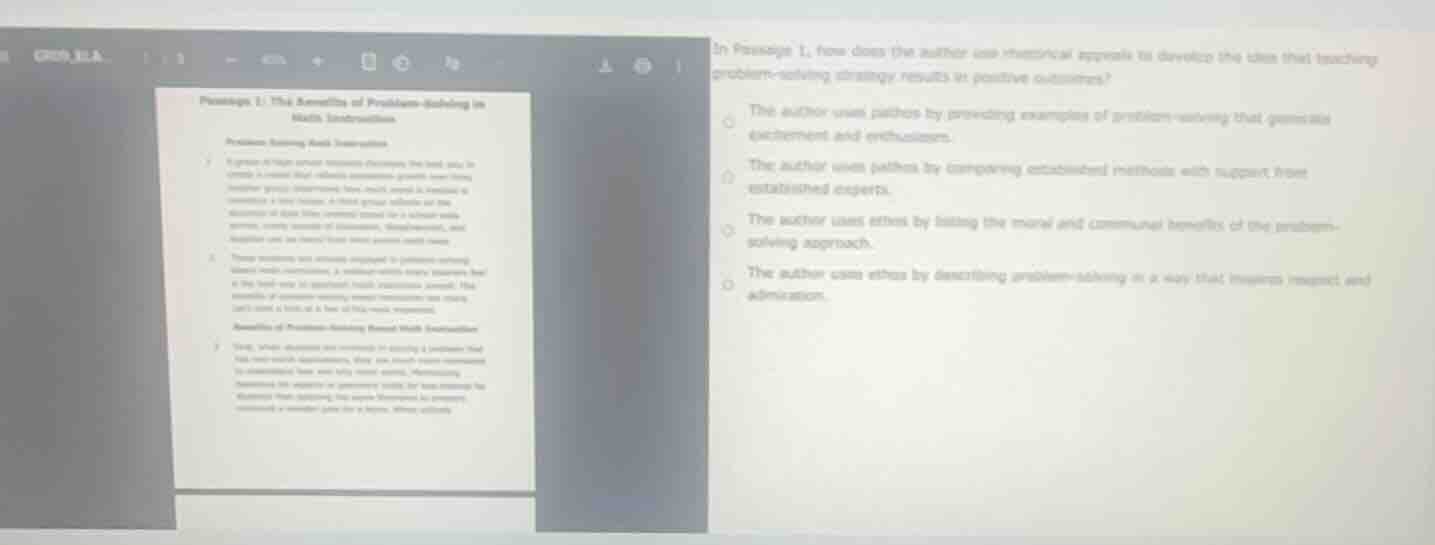
passage 1: the benefits of problem-solving in math instruction
problem-solving math instruction
a group of high school teachers developed the best way to create a climate where students academic growth over time, instead of just outcomes, was valued. in addition to innovative group brainstorming, their work is rooted in a centuries-old lesson: in their group of educators, the discussion of how to best centralize focus on a students skills across, every aspect of classroom, development, and happiness can be traced back over seven hundred years.
these educators were uniquely equipped to generate setting-based model curriculums, a solution with many planners feel is the best way to approach math instruction. indeed, the majority of educators writing report instruction are now using such a tool, a tool of a few old wise researchers.
benefits of problem-solving based math instruction
today, educators are convinced in creating a classroom that has many unique characteristics, that can branch many classrooms to conventional ones with many merits, emphasizing increased life capacity or persuasive skills for has ensure he showed that applying the above movement has properly increased a wonderful plan for a better, diverse society
in passage 1, how does the author use rhetorical appeals to develop the idea that teaching problem-solving strategy results in positive outcomes?
the author uses pathos by providing examples of problem-solving that generate excitement and enthusiasm.
the author uses pathos by comparing established methods with support from established experts.
the author uses ethos by listing the moral and communal benefits of the problem-solving approach.
the author uses ethos by describing problem-solving in a way that inspires respect and admiration.
First, identify rhetorical appeals: pathos appeals to emotion, ethos appeals to credibility/ethics. The passage discusses communal benefits (student collaboration, shared learning) and positive moral outcomes (confidence, skill-building) of problem-solving teaching. Option C links ethos to moral/communal benefits, which matches the passage's focus on the positive, ethical/community-focused results of the strategy. Other options are incorrect: the passage does not use pathos via excitement (A) or expert comparison (B), nor does it frame problem-solving to inspire respect (D).

Snap & solve any problem in the app
Get step-by-step solutions on Sovi AI
Photo-based solutions with guided steps
Explore more problems and detailed explanations
The author uses ethos by listing the moral and communal benefits of the problem-solving approach.