QUESTION IMAGE
Question
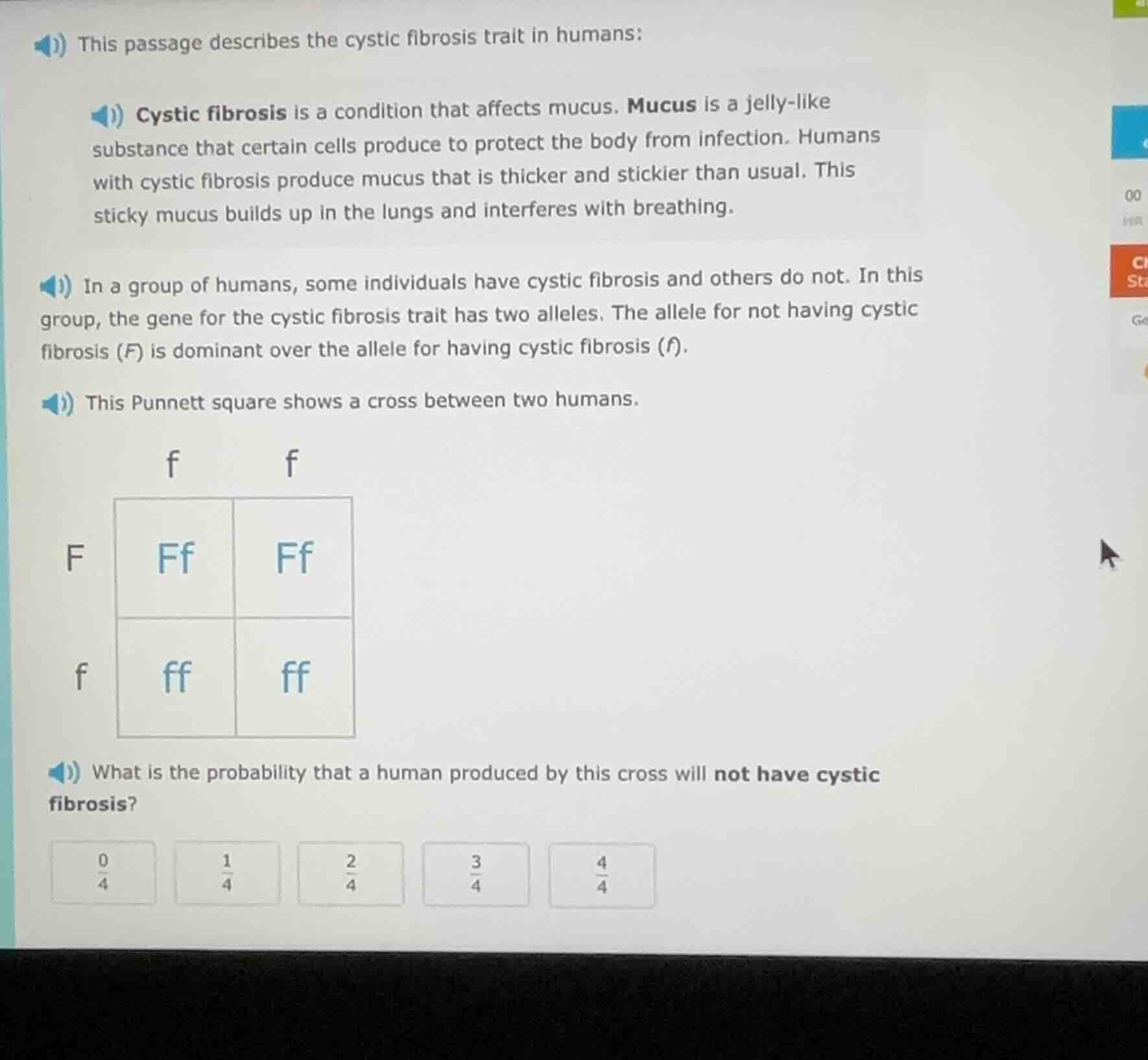
this passage describes the cystic fibrosis trait in humans: cystic fibrosis is a condition that affects mucus. mucus is a jelly - like substance that certain cells produce to protect the body from infection. humans with cystic fibrosis produce mucus that is thicker and stickier than usual. this sticky mucus builds up in the lungs and interferes with breathing. in a group of humans, some individuals have cystic fibrosis and others do not. in this group, the gene for the cystic fibrosis trait has two alleles. the allele for not having cystic fibrosis (f) is dominant over the allele for having cystic fibrosis (f). this punnett square shows a cross between two humans. (punnett square with top row f, f; left column f, f; cells: ff, ff, ff, ff) what is the probability that a human produced by this cross will not have cystic fibrosis? options: 0/4, 1/4, 2/4, 3/4, 4/4
Step1: Determine genotypes without cystic fibrosis
From the passage, the dominant allele \( F \) (not having cystic fibrosis) and recessive \( f \) (having it). Genotypes \( Ff \) will not have cystic fibrosis (since \( F \) is dominant), and \( ff \) will have it. Looking at the Punnett square, the genotypes are \( Ff, Ff, ff, ff \). So the number of genotypes without cystic fibrosis (\( Ff \)) is 2.
Step2: Calculate total number of offspring
The Punnett square has 4 cells, so total number of possible offspring genotypes is 4.
Step3: Calculate probability
Probability is the number of favorable outcomes (no cystic fibrosis) divided by total outcomes. So probability \( = \frac{\text{Number of } Ff}{\text{Total genotypes}} = \frac{2}{4} \).

Snap & solve any problem in the app
Get step-by-step solutions on Sovi AI
Photo-based solutions with guided steps
Explore more problems and detailed explanations
\(\frac{2}{4}\) (corresponding to the option with \(\frac{2}{4}\))