QUESTION IMAGE
Question
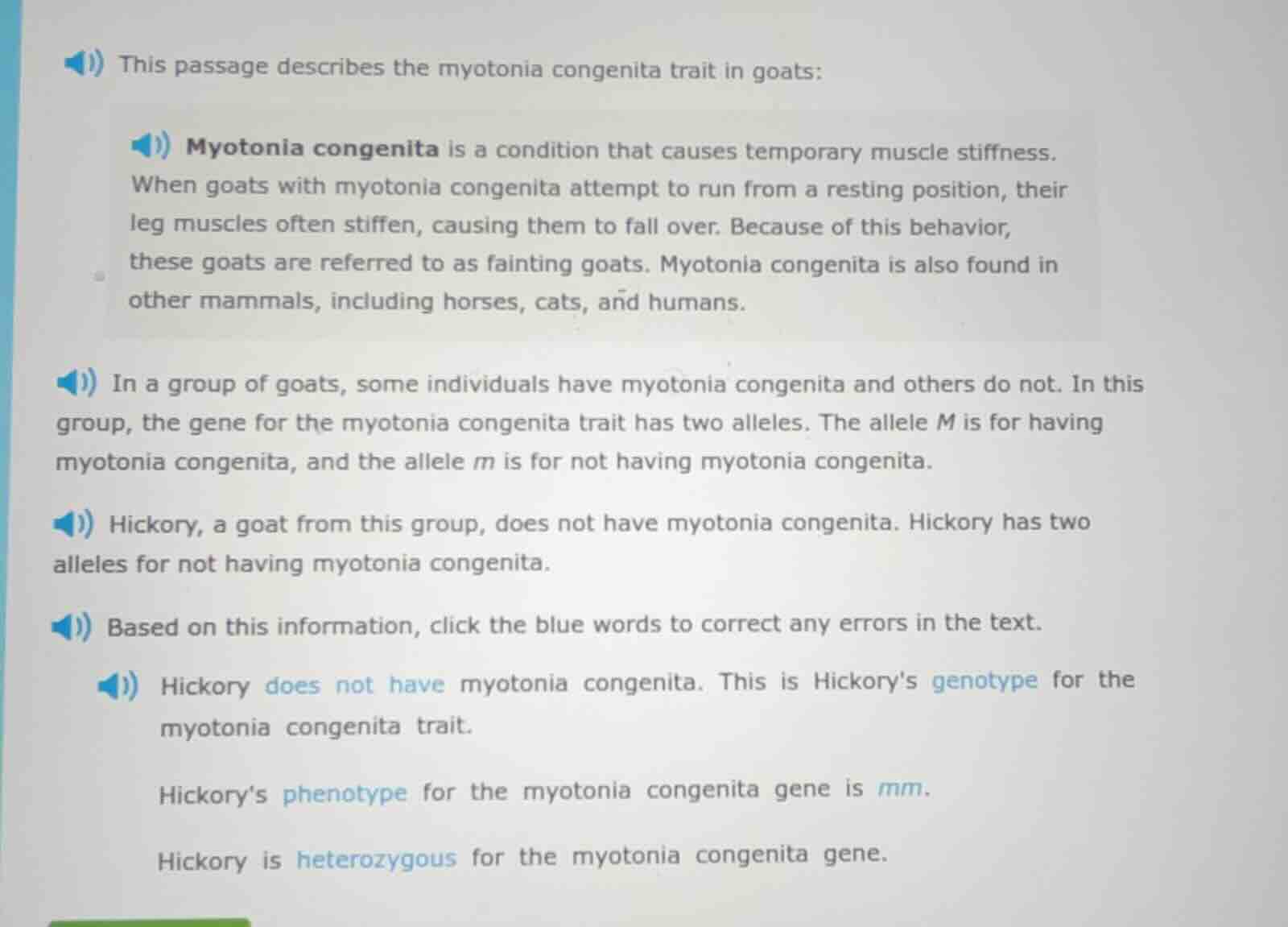
this passage describes the myotonia congenita trait in goats:
myotonia congenita is a condition that causes temporary muscle stiffness. when goats with myotonia congenita attempt to run from a resting position, their leg muscles often stiffen, causing them to fall over. because of this behavior, these goats are referred to as fainting goats. myotonia congenita is also found in other mammals, including horses, cats, and humans.
in a group of goats, some individuals have myotonia congenita and others do not. in this group, the gene for the myotonia congenita trait has two alleles. the allele m is for having myotonia congenita, and the allele m is for not having myotonia congenita.
hickory, a goat from this group, does not have myotonia congenita. hickory has two alleles for not having myotonia congenita.
based on this information, click the blue words to correct any errors in the text.
hickory does not have myotonia congenita. this is hickorys genotype for the myotonia congenita trait.
hickorys phenotype for the myotonia congenita gene is mm.
hickory is heterozygous for the myotonia congenita gene.
- A phenotype is the observable physical trait, while a genotype is the genetic makeup. "Does not have myotonia congenita" is the observable trait, so it is the phenotype, not genotype.
- Hickory's genetic makeup (two alleles for not having the condition) is $mm$, which is the genotype, not phenotype.
- An organism with two identical alleles (here, $mm$) is homozygous, not heterozygous.

Snap & solve any problem in the app
Get step-by-step solutions on Sovi AI
Photo-based solutions with guided steps
Explore more problems and detailed explanations
- Hickory does not have myotonia congenita. This is Hickory's phenotype for the myotonia congenita trait.
- Hickory's genotype for the myotonia congenita gene is $mm$.
- Hickory is homozygous for the myotonia congenita gene.