QUESTION IMAGE
Question
passage 2: romantic love is a fairy tale
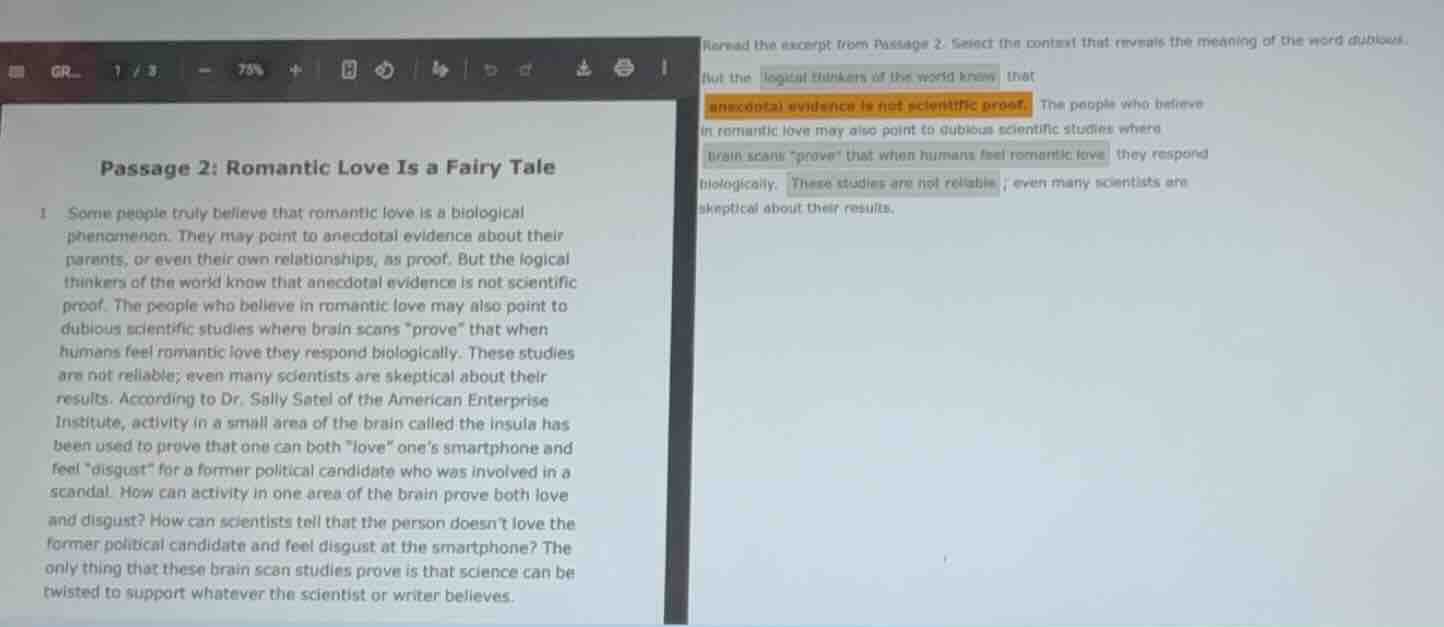
1 some people truly believe that romantic love is a biological phenomenon. they may point to anecdotal evidence about their parents, or even their own relationships, as proof. but the logical thinkers of the world know that anecdotal evidence is not scientific proof. the people who believe in romantic love may also point to dubious scientific studies where brain scans \prove\ that when humans feel romantic love they respond biologically. these studies are not reliable; even many scientists are skeptical about their results. according to dr. sally satel of the american enterprise institute, activity in a small area of the brain called the insula has been used to prove that one can both \love\ ones smartphone and feel \disgust\ for a former political candidate who was involved in a scandal. how can activity in one area of the brain prove both love and disgust? how can scientists tell that the person doesnt love the former political candidate and feel disgust at the smartphone? the only thing that these brain scan studies prove is that science can be twisted to support whatever the scientist or writer believes.
read the excerpt from passage 2. select the context that reveals the meaning of the word dubious.
but the logical thinkers of the world know that
anecdotal evidence is not scientific proof. the people who believe
in romantic love may also point to dubious scientific studies where
brain scans \prove\ that when humans feel romantic love they respond
biologically. these studies are not reliable ; even many scientists are
skeptical about their results.
The context that reveals the meaning of "dubious" is the clause that directly describes the nature of these studies: they lack reliability and are met with skepticism from scientists, which defines "dubious" as untrustworthy or questionable.

Snap & solve any problem in the app
Get step-by-step solutions on Sovi AI
Photo-based solutions with guided steps
Explore more problems and detailed explanations
These studies are not reliable; even many scientists are skeptical about their results.