QUESTION IMAGE
Question
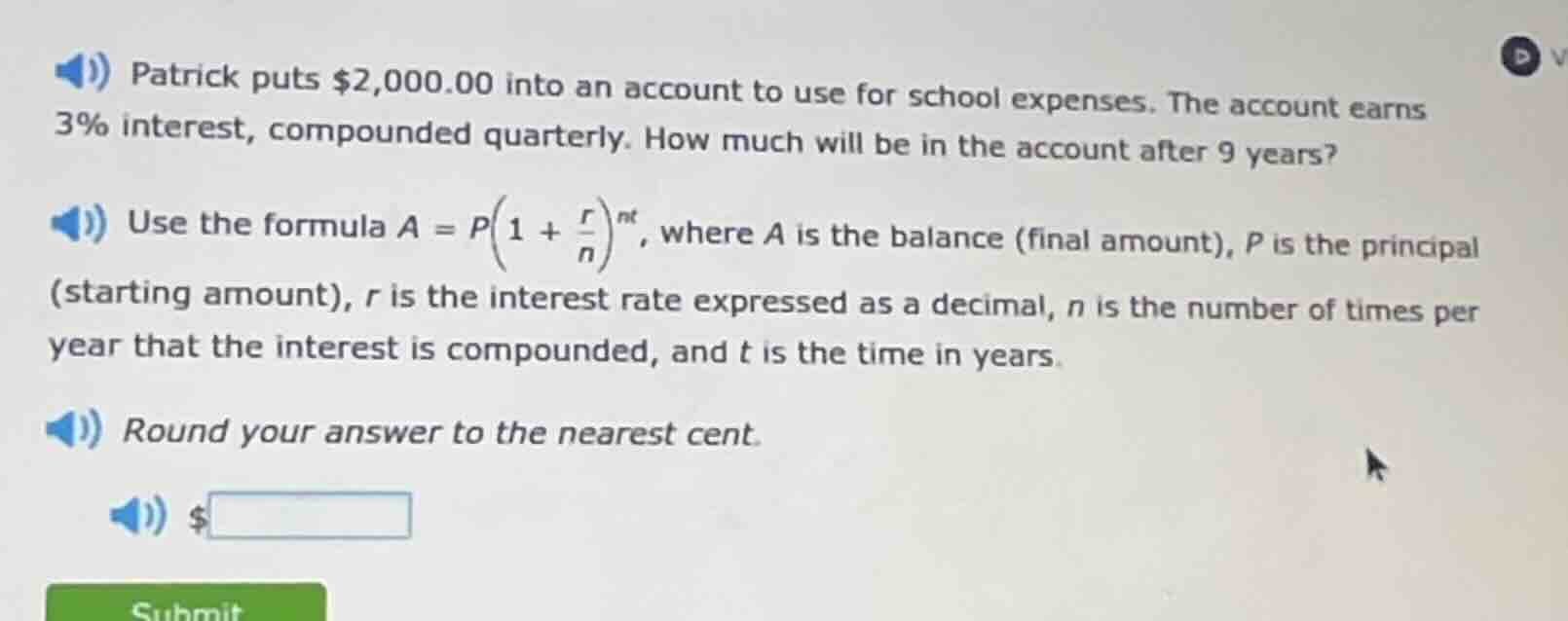
patrick puts $2,000.00 into an account to use for school expenses. the account earns 3% interest, compounded quarterly. how much will be in the account after 9 years?
use the formula $a = p\left(1 + \frac{r}{n}\
ight)^{nt}$, where $a$ is the balance (final amount), $p$ is the principal (starting amount), $r$ is the interest rate expressed as a decimal, $n$ is the number of times per year that the interest is compounded, and $t$ is the time in years.
round your answer to the nearest cent.
$
Step1: Identify given values
$P = 2000$, $r = 0.03$, $n = 4$, $t = 9$
Step2: Calculate exponent $nt$
$nt = 4 \times 9 = 36$
Step3: Calculate $\frac{r}{n}$
$\frac{r}{n} = \frac{0.03}{4} = 0.0075$
Step4: Calculate $1+\frac{r}{n}$
$1 + 0.0075 = 1.0075$
Step5: Compute $(1+\frac{r}{n})^{nt}$
$1.0075^{36} \approx 1.306893$
Step6: Calculate final amount $A$
$A = 2000 \times 1.306893$

Snap & solve any problem in the app
Get step-by-step solutions on Sovi AI
Photo-based solutions with guided steps
Explore more problems and detailed explanations
$2613.79$