QUESTION IMAGE
Question
pattern 2: autosomal dominant
again, autosomal traits affect males and females equally. an autosomal dominant
trait only requires 1 dominant allele for an individual to show the trait, so affected
individuals have a homozygous dominant or heterozygous genotype. unaffected
individuals will be homozygous recessive. \t\t\t\texpression of dimples, an autosomal dominant trait.
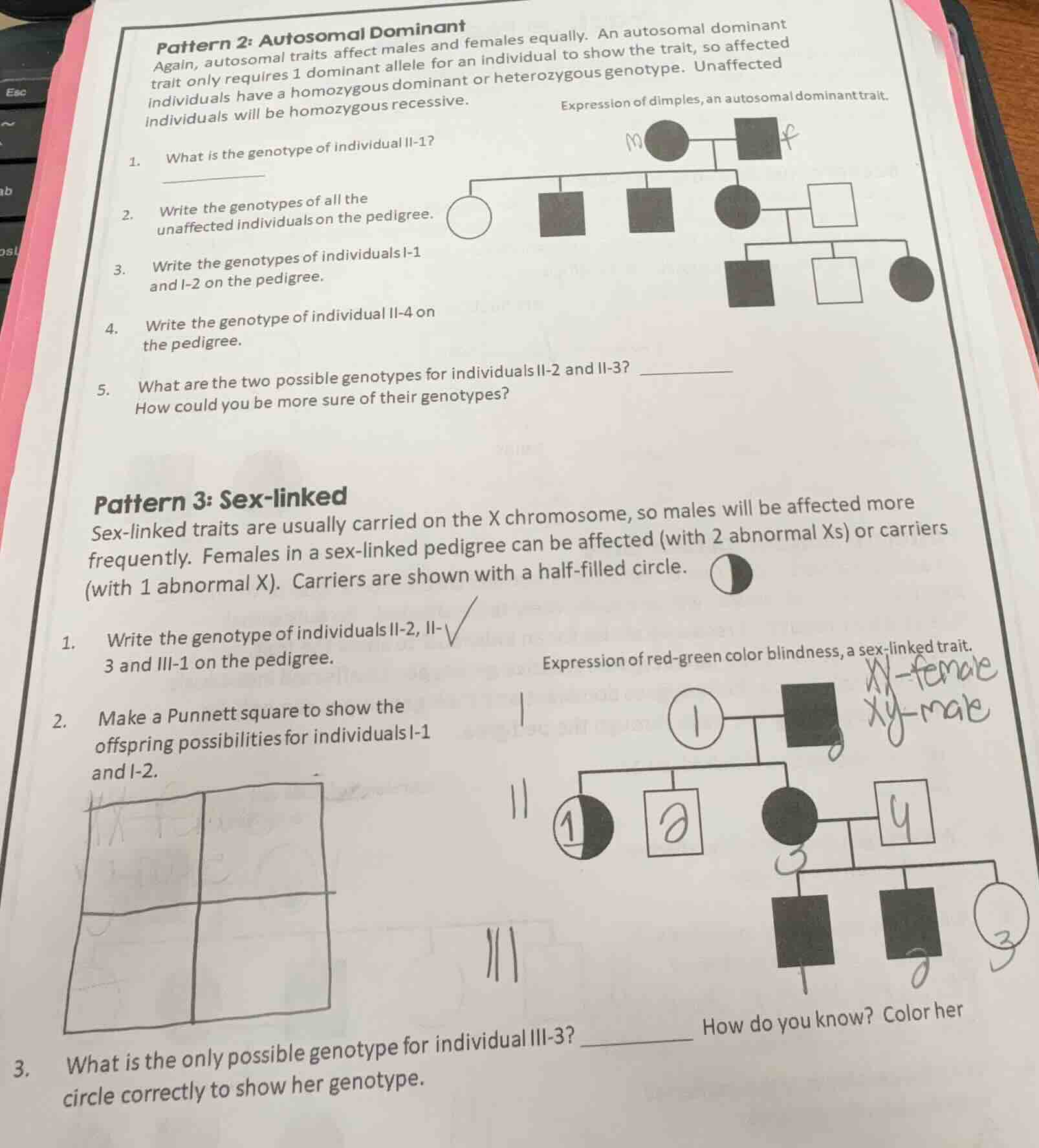
- \twhat is the genotype of individual ii - 1?
\t_________
- \twrite the genotypes of all the
\tunaffected individuals on the pedigree.
- \twrite the genotypes of individuals i - 1
\tand i - 2 on the pedigree.
- \twrite the genotype of individual ii - 4 on
\tthe pedigree.
- \twhat are the two possible genotypes for individuals ii - 2 and ii - 3? ________
\thow could you be more sure of their genotypes?
pattern 3: sex - linked
sex - linked traits are usually carried on the x chromosome, so males will be affected more
frequently. females in a sex - linked pedigree can be affected (with 2 abnormal xs) or carriers
(with 1 abnormal x). carriers are shown with a half - filled circle.
- \twrite the genotype of individuals ii - 2, ii - 3 and iii - 1 on the pedigree. \t\t\t\texpression of red - green color blindness, a sex - linked trait.
- \tmake a punnett square to show the
\toffspring possibilities for individuals i - 1
\tand i - 2.
- \twhat is the only possible genotype for individual iii - 3? ________ how do you know? color her
\tcircle correctly to show her genotype.
Pattern 2: Autosomal Dominant (Question 1: Genotype of II - 1)
Step 1: Recall Autosomal Dominant Rules
In autosomal dominant inheritance, affected individuals have at least one dominant allele (\(A\)), so their genotypes are \(AA\) (homozygous dominant) or \(Aa\) (heterozygous). Unaffected individuals are homozygous recessive (\(aa\)).
Step 2: Analyze Pedigree for II - 1
Individual II - 1 is unaffected (white circle). From the autosomal dominant rules, unaffected individuals must be homozygous recessive. So the genotype is \(aa\).
Step 1: Identify Unaffected Individuals
Looking at the pedigree, the white - colored shapes (circles for females, squares for males) are unaffected. These are II - 1 (white circle), the white square in the second generation (spouse of II - 4), and the white square in the third generation (offspring of II - 4 and her spouse).
Step 2: Assign Genotypes
Using the autosomal dominant rule (unaffected = \(aa\)), all these unaffected individuals have the genotype \(aa\).
Step 1: Analyze I - 1 and I - 2 Phenotype
I - 1 (black circle) and I - 2 (black square) are affected (autosomal dominant trait). They have an unaffected offspring (II - 1, \(aa\)).
Step 2: Determine Genotypes
For an affected individual to have an unaffected (\(aa\)) offspring, each parent must contribute a recessive allele (\(a\)). Since they are affected, they must also have a dominant allele (\(A\)). So their genotypes are \(Aa\) (heterozygous), because if they were \(AA\), they couldn't have an \(aa\) offspring (as they would only pass on \(A\)).

Snap & solve any problem in the app
Get step-by-step solutions on Sovi AI
Photo-based solutions with guided steps
Explore more problems and detailed explanations
\(aa\)