QUESTION IMAGE
Question
pattern i: autosomal recessive
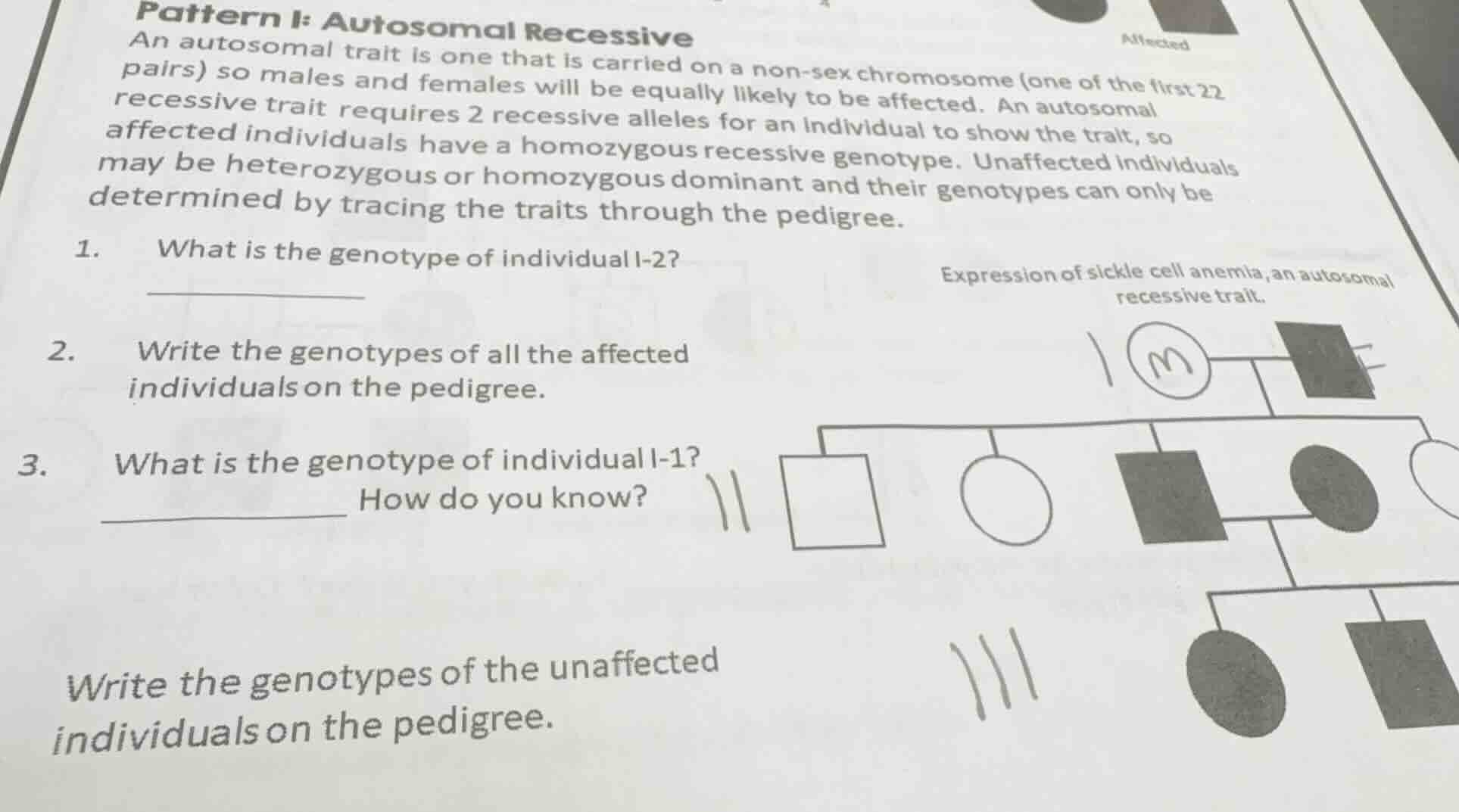
an autosomal trait is one that is carried on a non - sex chromosome (one of the first 22 pairs) so males and females will be equally likely to be affected. an autosomal recessive trait requires 2 recessive alleles for an individual to show the trait, so affected individuals have a homozygous recessive genotype. unaffected individuals may be heterozygous or homozygous dominant and their genotypes can only be determined by tracing the traits through the pedigree.
- what is the genotype of individual i - 2?
expression of sickle cell anemia, an autosomal recessive trait.
- write the genotypes of all the affected individuals on the pedigree.
- what is the genotype of individual i - 1?
how do you know?
write the genotypes of the unaffected individuals on the pedigree.
To solve these pedigree analysis questions for autosomal recessive inheritance (using sickle cell anemia as the trait, where the recessive allele is typically represented as \( s \) and the dominant as \( S \)):
Question 1: Genotype of Individual I-2
Since I-2 is affected (shows sickle cell anemia), and autosomal recessive traits require two recessive alleles, the genotype must be homozygous recessive.
Step 1: Recall autosomal recessive rules
Affected individuals have \( ss \) (homozygous recessive) because two recessive alleles are needed to express the trait.
Step 2: Apply to I-2
I-2 is affected, so genotype is \( ss \).
Question 2: Genotypes of All Affected Individuals
Affected individuals (shaded in the pedigree) have the autosomal recessive trait, so they must be \( ss \) (homozygous recessive). Identify all shaded shapes (circles = females, squares = males) and assign \( ss \) to each.
Question 3: Genotype of Individual I-1
I-1 is unaffected but has an affected child (since I-2 is \( ss \) and they have offspring). To have an affected child, I-1 must carry one recessive allele (to pass to the child) but not show the trait (so she is heterozygous).
Step 1: Analyze offspring
I-1 and I-2 ( \( ss \)) have offspring. If I-1 were \( SS \) (homozygous dominant), all offspring would be \( Ss \) (unaffected), but the pedigree shows affected offspring? Wait, no—wait, the pedigree: I-1 is unshaded (unaffected), I-2 is shaded (affected, \( ss \)). Their offspring: some are affected (shaded) and some are not? Wait, no—wait, the key is: an unaffected parent with an affected partner ( \( ss \)) must be heterozygous ( \( Ss \)) to pass a recessive allele.
Step 2: Deduce genotype
I-1 is unaffected (so not \( ss \)) but has an affected child (who needs an \( s \) from each parent). Since I-2 gives \( s \), I-1 must give \( s \) to the affected child, so I-1 must carry an \( s \) (but not show the trait, so she is \( Ss \)).
Writing Genotypes of Unaffected Individuals
Unaffected individuals are either \( SS \) (homozygous dominant) or \( Ss \) (heterozygous). To determine:
- If an unaffected individual has an affected parent ( \( ss \)), they must be \( Ss \) (since they get \( s \) from the affected parent and \( S \) from the other).
- If both parents are unaffected but have affected children, they are \( Ss \) (carriers).
- If an unaffected individual has no affected relatives (or only dominant relatives), they could be \( SS \) or \( Ss \), but in this pedigree, most unaffected with affected family members are \( Ss \).
Final Answers (Summarized)
- Genotype of I-2: \( \boldsymbol{ss} \)
- All affected individuals: \( \boldsymbol{ss} \) (each shaded circle/square)
- Genotype of I-1: \( \boldsymbol{Ss} \) (because she is unaffected but has an affected partner ( \( ss \)) and must pass an \( s \) allele to affected offspring, so she is heterozygous).
(Note: For the last part, "Write the genotypes of the unaffected individuals"—unaffected individuals are either \( Ss \) (carriers) or \( SS \), but in this pedigree, most will be \( Ss \) if they have affected relatives. For example, offspring of I-1 ( \( Ss \)) and I-2 ( \( ss \)): unaffected offspring are \( Ss \); unaffected individuals in generation II or III with affected parents/siblings are \( Ss \), while those with no affected relatives could be \( SS \), but the problem likely expects \( Ss \) for those with affected family members.)

Snap & solve any problem in the app
Get step-by-step solutions on Sovi AI
Photo-based solutions with guided steps
Explore more problems and detailed explanations
To solve these pedigree analysis questions for autosomal recessive inheritance (using sickle cell anemia as the trait, where the recessive allele is typically represented as \( s \) and the dominant as \( S \)):
Question 1: Genotype of Individual I-2
Since I-2 is affected (shows sickle cell anemia), and autosomal recessive traits require two recessive alleles, the genotype must be homozygous recessive.
Step 1: Recall autosomal recessive rules
Affected individuals have \( ss \) (homozygous recessive) because two recessive alleles are needed to express the trait.
Step 2: Apply to I-2
I-2 is affected, so genotype is \( ss \).
Question 2: Genotypes of All Affected Individuals
Affected individuals (shaded in the pedigree) have the autosomal recessive trait, so they must be \( ss \) (homozygous recessive). Identify all shaded shapes (circles = females, squares = males) and assign \( ss \) to each.
Question 3: Genotype of Individual I-1
I-1 is unaffected but has an affected child (since I-2 is \( ss \) and they have offspring). To have an affected child, I-1 must carry one recessive allele (to pass to the child) but not show the trait (so she is heterozygous).
Step 1: Analyze offspring
I-1 and I-2 ( \( ss \)) have offspring. If I-1 were \( SS \) (homozygous dominant), all offspring would be \( Ss \) (unaffected), but the pedigree shows affected offspring? Wait, no—wait, the pedigree: I-1 is unshaded (unaffected), I-2 is shaded (affected, \( ss \)). Their offspring: some are affected (shaded) and some are not? Wait, no—wait, the key is: an unaffected parent with an affected partner ( \( ss \)) must be heterozygous ( \( Ss \)) to pass a recessive allele.
Step 2: Deduce genotype
I-1 is unaffected (so not \( ss \)) but has an affected child (who needs an \( s \) from each parent). Since I-2 gives \( s \), I-1 must give \( s \) to the affected child, so I-1 must carry an \( s \) (but not show the trait, so she is \( Ss \)).
Writing Genotypes of Unaffected Individuals
Unaffected individuals are either \( SS \) (homozygous dominant) or \( Ss \) (heterozygous). To determine:
- If an unaffected individual has an affected parent ( \( ss \)), they must be \( Ss \) (since they get \( s \) from the affected parent and \( S \) from the other).
- If both parents are unaffected but have affected children, they are \( Ss \) (carriers).
- If an unaffected individual has no affected relatives (or only dominant relatives), they could be \( SS \) or \( Ss \), but in this pedigree, most unaffected with affected family members are \( Ss \).
Final Answers (Summarized)
- Genotype of I-2: \( \boldsymbol{ss} \)
- All affected individuals: \( \boldsymbol{ss} \) (each shaded circle/square)
- Genotype of I-1: \( \boldsymbol{Ss} \) (because she is unaffected but has an affected partner ( \( ss \)) and must pass an \( s \) allele to affected offspring, so she is heterozygous).
(Note: For the last part, "Write the genotypes of the unaffected individuals"—unaffected individuals are either \( Ss \) (carriers) or \( SS \), but in this pedigree, most will be \( Ss \) if they have affected relatives. For example, offspring of I-1 ( \( Ss \)) and I-2 ( \( ss \)): unaffected offspring are \( Ss \); unaffected individuals in generation II or III with affected parents/siblings are \( Ss \), while those with no affected relatives could be \( SS \), but the problem likely expects \( Ss \) for those with affected family members.)