QUESTION IMAGE
Question
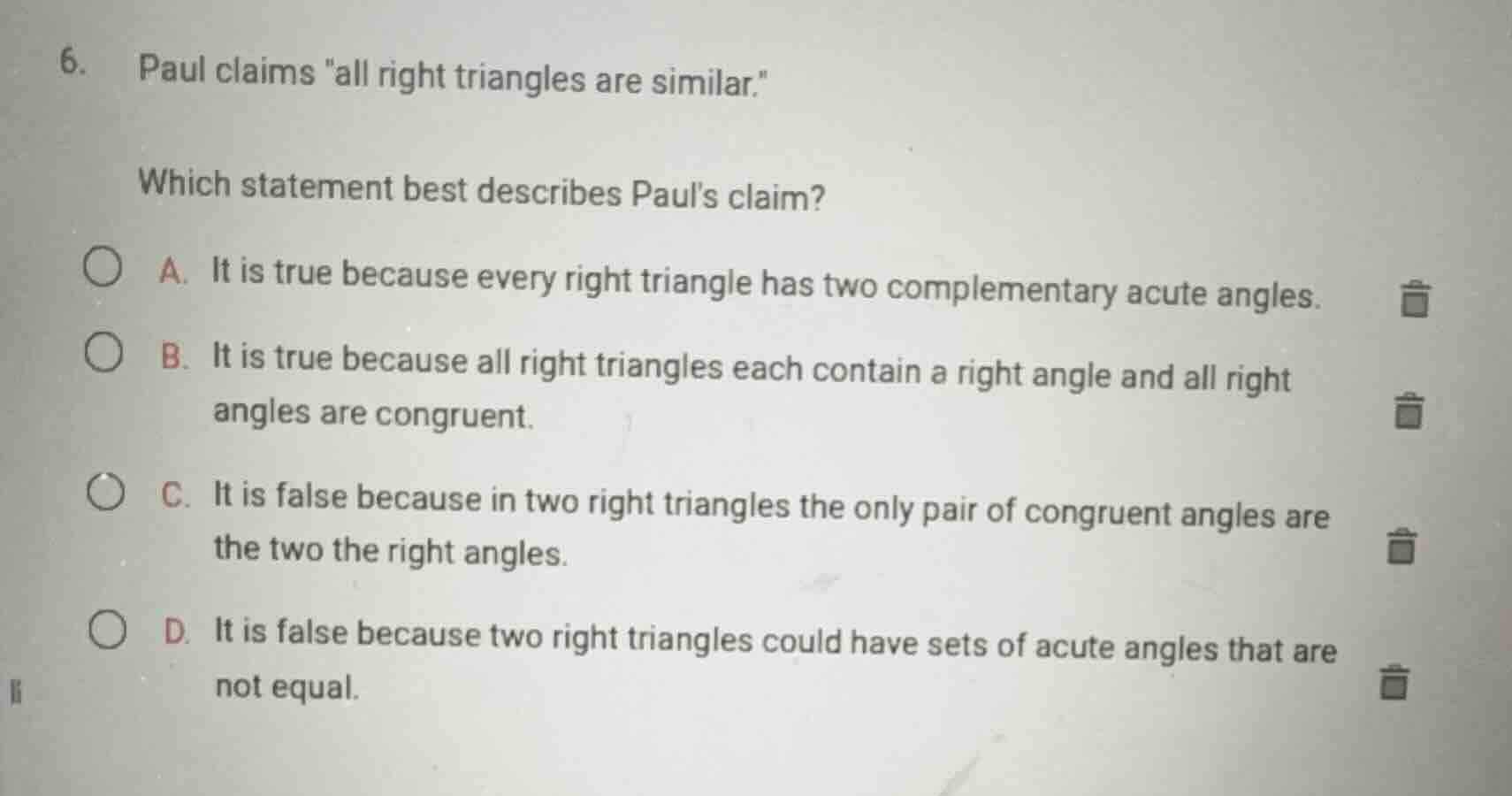
- paul claims \all right triangles are similar.\ which statement best describes pauls claim? a. it is true because every right triangle has two complementary acute angles. b. it is true because all right triangles each contain a right angle and all right angles are congruent. c. it is false because in two right triangles the only pair of congruent angles are the two the right angles. d. it is false because two right triangles could have sets of acute angles that are not equal.
To determine if all right triangles are similar, we use the definition of similar triangles (corresponding angles equal, corresponding sides proportional). A right triangle has one right angle (90°), but the acute angles can vary. For example, one right triangle could have acute angles 30° and 60°, while another could have 45° and 45°. Similarity requires all corresponding angles to be equal. So Paul’s claim is false because two right triangles can have different acute angle measures (e.g., 30 - 60 - 90 vs. 45 - 45 - 90 triangles). Option D correctly explains this: it is false because two right triangles could have sets of acute angles that are not equal. Option A is wrong because having complementary acute angles doesn’t ensure similarity (the acute angles themselves need to be equal, not just complementary). Option B is wrong because only one pair of congruent angles (the right angle) isn’t enough for similarity (we need two pairs, by AA similarity, but the acute angles can differ). Option C is wrong because it’s possible to have another pair of congruent angles (if the acute angles are equal), but the key is they can be unequal, making the claim false.

Snap & solve any problem in the app
Get step-by-step solutions on Sovi AI
Photo-based solutions with guided steps
Explore more problems and detailed explanations
D. It is false because two right triangles could have sets of acute angles that are not equal.