QUESTION IMAGE
Question
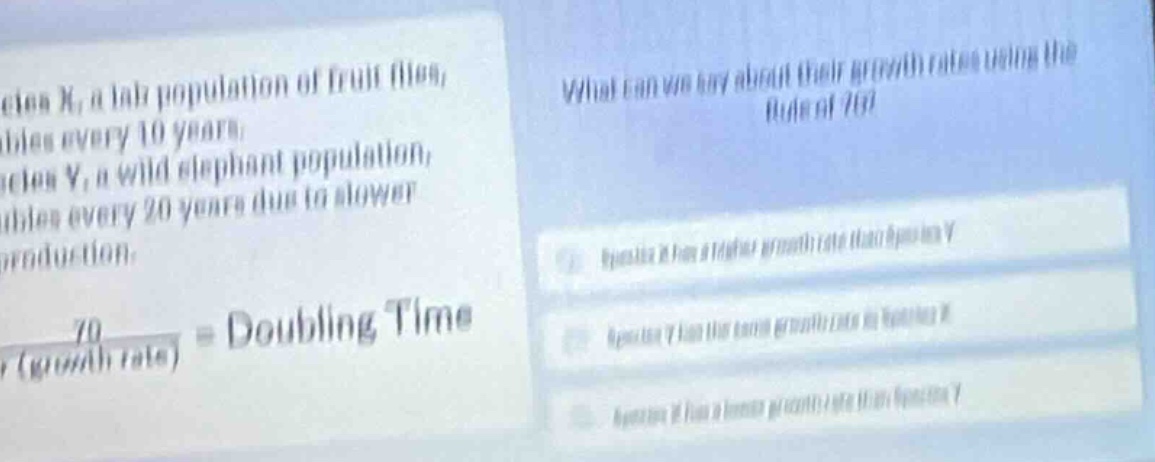
pecies x, a lab population of fruit flies, doubles every 10 years;
species y, a wild elephant population, doubles every 20 years due to slower production.
\\(\frac{70}{r \text{ (growth rate)}} = \text{doubling time}\\)
what can we say about their growth rates using the rule of 70?
- species x has a higher growth rate than species y
- species y has the same growth rate as species x
- species x has a lower growth rate than species y
To solve this, we use the formula for doubling time: $\text{Doubling Time} = \frac{70}{r}$ (where $r$ is the growth rate). We can rearrange this to find the growth rate $r = \frac{70}{\text{Doubling Time}}$.
Step 1: Find the growth rate for Species X
Species X doubles every 10 years, so its doubling time is 10. Using the formula $r = \frac{70}{\text{Doubling Time}}$, we substitute the doubling time:
$r_X = \frac{70}{10} = 7\%$
Step 2: Find the growth rate for Species Y
Species Y doubles every 20 years, so its doubling time is 20. Using the same formula:
$r_Y = \frac{70}{20} = 3.5\%$
Step 3: Compare the growth rates
We found that $r_X = 7\%$ and $r_Y = 3.5\%$. Since $7\% > 3.5\%$, Species X has a higher growth rate than Species Y.

Snap & solve any problem in the app
Get step-by-step solutions on Sovi AI
Photo-based solutions with guided steps
Explore more problems and detailed explanations
Species X has a higher growth rate than Species Y