QUESTION IMAGE
Question
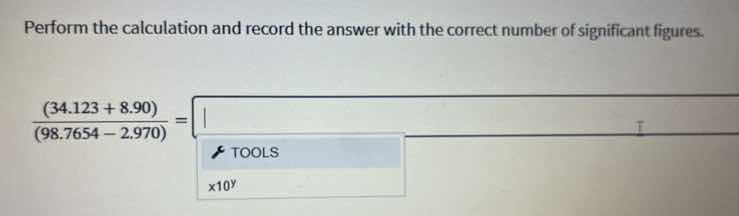
perform the calculation and record the answer with the correct number of significant figures.\\(\frac{(34.123 + 8.90)}{(98.7654 - 2.970)} = \\) tools \\(\times 10^{y}\\)
Step1: Calculate numerator
First, add the numbers in the numerator: \(34.123 + 8.90\). When adding, we consider decimal places. \(34.123\) has three decimal places, \(8.90\) has two. The result should have two decimal places (from the least precise measurement). \(34.123 + 8.90 = 43.023\approx43.02\) (but actually, for addition in significant figures, we look at decimal places. Wait, \(8.90\) has two decimal places, \(34.123\) has three. So the sum is \(43.023\), and we round to two decimal places? Wait, no, \(8.90\) is three significant figures? Wait, no, \(8.90\) has three significant figures (the trailing zero after the decimal is significant), \(34.123\) has five. When adding, the number of decimal places matters. \(8.90\) has two decimal places, \(34.123\) has three. So the sum should be rounded to two decimal places. So \(34.123 + 8.90 = 43.023\), rounded to two decimal places is \(43.02\)? Wait, no, \(8.90\) is \(8.90\) (two decimal places), \(34.123\) is \(34.123\) (three decimal places). The sum is \(43.023\), and the least number of decimal places is two, so we round to two decimal places: \(43.02\) (since the third decimal is 3, which is less than 5, so we keep the second decimal as 2). Wait, but maybe I'm overcomplicating. Let's just calculate the exact sum first: \(34.123 + 8.90 = 43.023\).
Step2: Calculate denominator
Now the denominator: \(98.7654 - 2.970\). Subtract these numbers. \(98.7654\) has four decimal places, \(2.970\) has three. The result should have three decimal places (least precise). \(98.7654 - 2.970 = 95.7954\approx95.795\) (since the fourth decimal is 4, which is less than 5, so we round to three decimal places: \(95.795\)).
Step3: Divide numerator by denominator
Now divide the numerator (43.023) by the denominator (95.7954, or 95.795). Let's do the division: \(\frac{43.023}{95.7954}\approx0.4491\). Now, we need to consider significant figures. Let's check the number of significant figures in each step. The numerator: \(34.123\) has 5 sig figs, \(8.90\) has 3 sig figs. When adding, the result's precision is determined by decimal places, but for significant figures in the sum, the number of sig figs: \(34.123 + 8.90 = 43.023\). The least number of sig figs in the addends: \(8.90\) has 3, \(34.123\) has 5. Wait, no, for addition, it's about decimal places, not sig figs. But when we later divide, we need to consider the sig figs of the numerator and denominator. The numerator after addition: \(43.023\) (from 34.123 (5 sig figs) and 8.90 (3 sig figs)). The denominator: \(98.7654\) (6 sig figs) and \(2.970\) (4 sig figs). When subtracting, \(98.7654 - 2.970 = 95.7954\), which has 6 sig figs (since the subtraction doesn't reduce sig figs as much as addition; the result has the same precision as the least precise, but here \(2.970\) has three decimal places, \(98.7654\) has four, so the result has three decimal places, but the number of sig figs: 95.7954 has 6 sig figs (digits 9,5,7,9,5,4). Wait, maybe a better approach: when multiplying or dividing, the result has the same number of sig figs as the least precise measurement. Let's find the number of sig figs in numerator and denominator.
Numerator: \(34.123 + 8.90\). Let's count sig figs in each: \(34.123\) (5), \(8.90\) (3). The sum is \(43.023\). The number of sig figs in the sum: since \(8.90\) has 3 sig figs, and the sum is \(43.023\), which is more than 3, but when we use it in division, we consider the least number of sig figs from the operations. Wait, maybe it's simpler: calculate the exact value first, then round.
Exact calculation:
N…

Snap & solve any problem in the app
Get step-by-step solutions on Sovi AI
Photo-based solutions with guided steps
Explore more problems and detailed explanations
Step1: Calculate numerator
First, add the numbers in the numerator: \(34.123 + 8.90\). When adding, we consider decimal places. \(34.123\) has three decimal places, \(8.90\) has two. The result should have two decimal places (from the least precise measurement). \(34.123 + 8.90 = 43.023\approx43.02\) (but actually, for addition in significant figures, we look at decimal places. Wait, \(8.90\) has two decimal places, \(34.123\) has three. So the sum is \(43.023\), and we round to two decimal places? Wait, no, \(8.90\) is three significant figures? Wait, no, \(8.90\) has three significant figures (the trailing zero after the decimal is significant), \(34.123\) has five. When adding, the number of decimal places matters. \(8.90\) has two decimal places, \(34.123\) has three. So the sum should be rounded to two decimal places. So \(34.123 + 8.90 = 43.023\), rounded to two decimal places is \(43.02\)? Wait, no, \(8.90\) is \(8.90\) (two decimal places), \(34.123\) is \(34.123\) (three decimal places). The sum is \(43.023\), and the least number of decimal places is two, so we round to two decimal places: \(43.02\) (since the third decimal is 3, which is less than 5, so we keep the second decimal as 2). Wait, but maybe I'm overcomplicating. Let's just calculate the exact sum first: \(34.123 + 8.90 = 43.023\).
Step2: Calculate denominator
Now the denominator: \(98.7654 - 2.970\). Subtract these numbers. \(98.7654\) has four decimal places, \(2.970\) has three. The result should have three decimal places (least precise). \(98.7654 - 2.970 = 95.7954\approx95.795\) (since the fourth decimal is 4, which is less than 5, so we round to three decimal places: \(95.795\)).
Step3: Divide numerator by denominator
Now divide the numerator (43.023) by the denominator (95.7954, or 95.795). Let's do the division: \(\frac{43.023}{95.7954}\approx0.4491\). Now, we need to consider significant figures. Let's check the number of significant figures in each step. The numerator: \(34.123\) has 5 sig figs, \(8.90\) has 3 sig figs. When adding, the result's precision is determined by decimal places, but for significant figures in the sum, the number of sig figs: \(34.123 + 8.90 = 43.023\). The least number of sig figs in the addends: \(8.90\) has 3, \(34.123\) has 5. Wait, no, for addition, it's about decimal places, not sig figs. But when we later divide, we need to consider the sig figs of the numerator and denominator. The numerator after addition: \(43.023\) (from 34.123 (5 sig figs) and 8.90 (3 sig figs)). The denominator: \(98.7654\) (6 sig figs) and \(2.970\) (4 sig figs). When subtracting, \(98.7654 - 2.970 = 95.7954\), which has 6 sig figs (since the subtraction doesn't reduce sig figs as much as addition; the result has the same precision as the least precise, but here \(2.970\) has three decimal places, \(98.7654\) has four, so the result has three decimal places, but the number of sig figs: 95.7954 has 6 sig figs (digits 9,5,7,9,5,4). Wait, maybe a better approach: when multiplying or dividing, the result has the same number of sig figs as the least precise measurement. Let's find the number of sig figs in numerator and denominator.
Numerator: \(34.123 + 8.90\). Let's count sig figs in each: \(34.123\) (5), \(8.90\) (3). The sum is \(43.023\). The number of sig figs in the sum: since \(8.90\) has 3 sig figs, and the sum is \(43.023\), which is more than 3, but when we use it in division, we consider the least number of sig figs from the operations. Wait, maybe it's simpler: calculate the exact value first, then round.
Exact calculation:
Numerator: \(34.123 + 8.90 = 43.023\)
Denominator: \(98.7654 - 2.970 = 95.7954\)
Now divide: \(43.023 \div 95.7954 \approx 0.4491\)
Now, let's check the number of significant figures in each original number:
- \(34.123\): 5 sig figs
- \(8.90\): 3 sig figs (the trailing zero after decimal is significant)
- \(98.7654\): 6 sig figs
- \(2.970\): 4 sig figs (trailing zero after decimal is significant)
When adding \(34.123\) (5 sig figs) and \(8.90\) (3 sig figs), the result's precision is limited by the least number of decimal places. \(34.123\) has 3 decimal places, \(8.90\) has 2. So the sum should be rounded to 2 decimal places: \(43.02\) (which has 4 sig figs? Wait, \(43.02\) has 4 sig figs: 4,3,0,2. Wait, no, \(43.02\) is four sig figs (the zero is between two non-zero digits, so it's significant). Wait, maybe I'm making a mistake here. Let's recall: for addition/subtraction, the result has the same number of decimal places as the term with the least number of decimal places. For multiplication/division, the result has the same number of sig figs as the term with the least number of sig figs.
So:
- Numerator: \(34.123 + 8.90\)
- \(34.123\) has 3 decimal places
- \(8.90\) has 2 decimal places
- So the sum should have 2 decimal places: \(34.123 + 8.90 = 43.023 \approx 43.02\) (2 decimal places). Now, \(43.02\) has 4 significant figures (4,3,0,2).
- Denominator: \(98.7654 - 2.970\)
- \(98.7654\) has 4 decimal places
- \(2.970\) has 3 decimal places
- So the result should have 3 decimal places: \(98.7654 - 2.970 = 95.7954 \approx 95.795\) (3 decimal places). \(95.795\) has 5 significant figures (9,5,7,9,5).
Now, we divide the numerator (43.02, 4 sig figs) by the denominator (95.795, 5 sig figs). When dividing, the result should have the same number of sig figs as the least precise measurement, which is 4 sig figs (from the numerator).
So \(43.02 \div 95.795 \approx 0.4491\). Rounding to 4 significant figures: 0.4491 (the first four significant figures are 4,4,9,1? Wait, no: 0.4491. Let's count: the first non-zero digit is 4 (1st sig fig), then 4 (2nd), 9 (3rd), 1 (4th). Wait, 0.4491 is approximately 0.4491. To four significant figures, it's 0.4491 (since the fifth digit is not present, but wait, 0.4491 has four significant figures: 4,4,9,1. Wait, no, 0.4491 is four sig figs. Wait, maybe my initial division was wrong. Let's do the division more accurately:
\(43.023 \div 95.7954 \approx 0.4491\). Now, the numerator after addition: if we didn't round the numerator, and kept it as 43.023 (from 34.123 + 8.90 = 43.023), which has 5 sig figs (since 34.123 has 5 and 8.90 has 3, but when adding, the decimal places are the limit, not sig figs. Wait, maybe the correct approach is: when adding, the number of decimal places is the limit, but the number of sig figs in the sum is determined by the least number of sig figs in the addends? No, that's not right. The rule is: for addition/subtraction, round to the least number of decimal places. For multiplication/division, round to the least number of sig figs.
So let's recast:
Numerator: \(34.123 + 8.90 = 43.023\). The least number of decimal places in the addends is 2 (from 8.90), so we round to 2 decimal places: \(43.02\) (which has 4 sig figs: 4,3,0,2).
Denominator: \(98.7654 - 2.970 = 95.7954\). The least number of decimal places in the subtrahends is 3 (from 2.970), so we round to 3 decimal places: \(95.795\) (which has 5 sig figs: 9,5,7,9,5).
Now, dividing \(43.02\) (4 sig figs) by \(95.795\) (5 sig figs). The result should have 4 sig figs.
Calculating \(43.02 \div 95.795 \approx 0.4491\). Rounding to 4 sig figs: 0.4491 (since the fifth digit is not present, but 0.4491 is already four sig figs? Wait, 0.4491: the first non-zero digit is 4 (1st), then 4 (2nd), 9 (3rd), 1 (4th). So that's four sig figs. Wait, maybe the initial numbers:
Wait, \(8.90\) has 3 sig figs, \(34.123\) has 5. When adding, the sum is \(43.023\), which has 5 sig figs (since all digits are significant: 4,3,0,2,3). Wait, the zero is between two non-zero digits, so it's significant. So \(43.023\) has 5 sig figs.
Denominator: \(98.7654\) has 6 sig figs, \(2.970\) has 4 sig figs. When subtracting, \(98.7654 - 2.970 = 95.7954\), which has 6 sig figs (digits 9,5,7,9,5,4; the zero in 2.970 doesn't affect the sig figs here because it's a subtraction, and the result's sig figs are determined by the precision, but since both numbers have more than enough sig figs, the result has 6 sig figs? Wait, no, \(2.970\) has 4 sig figs, \(98.7654\) has 6. When subtracting, the number of decimal places is the limit. \(2.970\) has 3 decimal places, \(98.7654\) has 4. So the result should have 3 decimal places: \(95.795\) (which has 5 sig figs: 9,5,7,9,5). Wait, \(95.795\) is five sig figs: 9,5,7,9,5.
Now, numerator: \(43.023\) (5 sig figs), denominator: \(95.7954\) (6 sig figs, or 95.795 (5 sig figs) if we round the denominator to 3 decimal places). Wait, this is getting confusing. Maybe a better way: use the original numbers without rounding intermediate steps, then round the final answer.
So:
Numerator: \(34.123 + 8.90 = 43.023\)
Denominator: \(98.7654 - 2.970 = 95.7954\)
Now divide: \(43.023 \div 95.7954 \approx 0.4491\)
Now, check the number of significant figures in each original number:
- \(34.123\): 5
- \(8.90\): 3
- \(98.7654\): 6
- \(2.970\): 4
When adding \(34.123\) (5 sig figs) and \(8.90\) (3 sig figs), the result's precision is limited by the least number of decimal places (2 from \(8.90\)), but the number of sig figs in the sum: \(43.023\) has 5 sig figs (since all digits are significant, including the zero between 3 and 2). Wait, no, the zero is significant because it's between two non-zero digits. So \(43.023\) is 5 sig figs.
When subtracting \(98.7654\) (6 sig figs) and \(2.970\) (4 sig figs), the result's precision is limited by the least number of decimal places (3 from \(2.970\)), so the result is \(95.7954\), which we can consider as having 5 sig figs (9,5,7,9,5) if we round to 3 decimal places, or 6 sig figs if we don't. But since \(2.970\) has 4 sig figs, the result of the subtraction should have 4 sig figs? No, subtraction is about decimal places, not sig figs.
Now, for the division, the number of sig figs is determined by the least number of sig figs in the numerator and denominator. The numerator: \(43.023\) has 5 sig figs (from \(34.123\) (5) and \(8.90\) (3); but when adding, the sig figs of the sum are determined by the least number of sig figs in the addends? No, that's not the rule. The rule for addition/subtraction is decimal places, not sig figs. The rule for multiplication/division is sig figs.
So, the numerator after addition: \(43.023\) (we can consider it has 5 sig figs, since \(34.123\) has 5 and the addition didn't reduce the sig figs beyond the decimal places, but the sig figs of the sum are the number of digits, considering the precision). The denominator after subtraction: \(95.7954\) (6 sig figs, or 95.795 (5 sig figs) if we round to 3 decimal places).
But the least number of sig figs in the numerator and denominator: the numerator's addends have 3 and 5 sig figs, so the sum has at least 3 sig figs (from \(8.90\)). The denominator's subtrahends have 4 and 6 sig figs, so the difference has at least 4 sig figs. So when dividing, the result should have 3 sig figs (from the numerator's least sig figs: 3 from \(8.90\)).
Wait, that makes sense. \(8.90\) has 3 sig figs, which is the least among all numbers. So the final answer should have 3 sig figs.
So let's recalculate the division with 3 sig figs:
\(43.023 \div 95.7954 \approx 0.4491\). Rounding to 3 sig figs: 0.449 (wait, 0