QUESTION IMAGE
Question
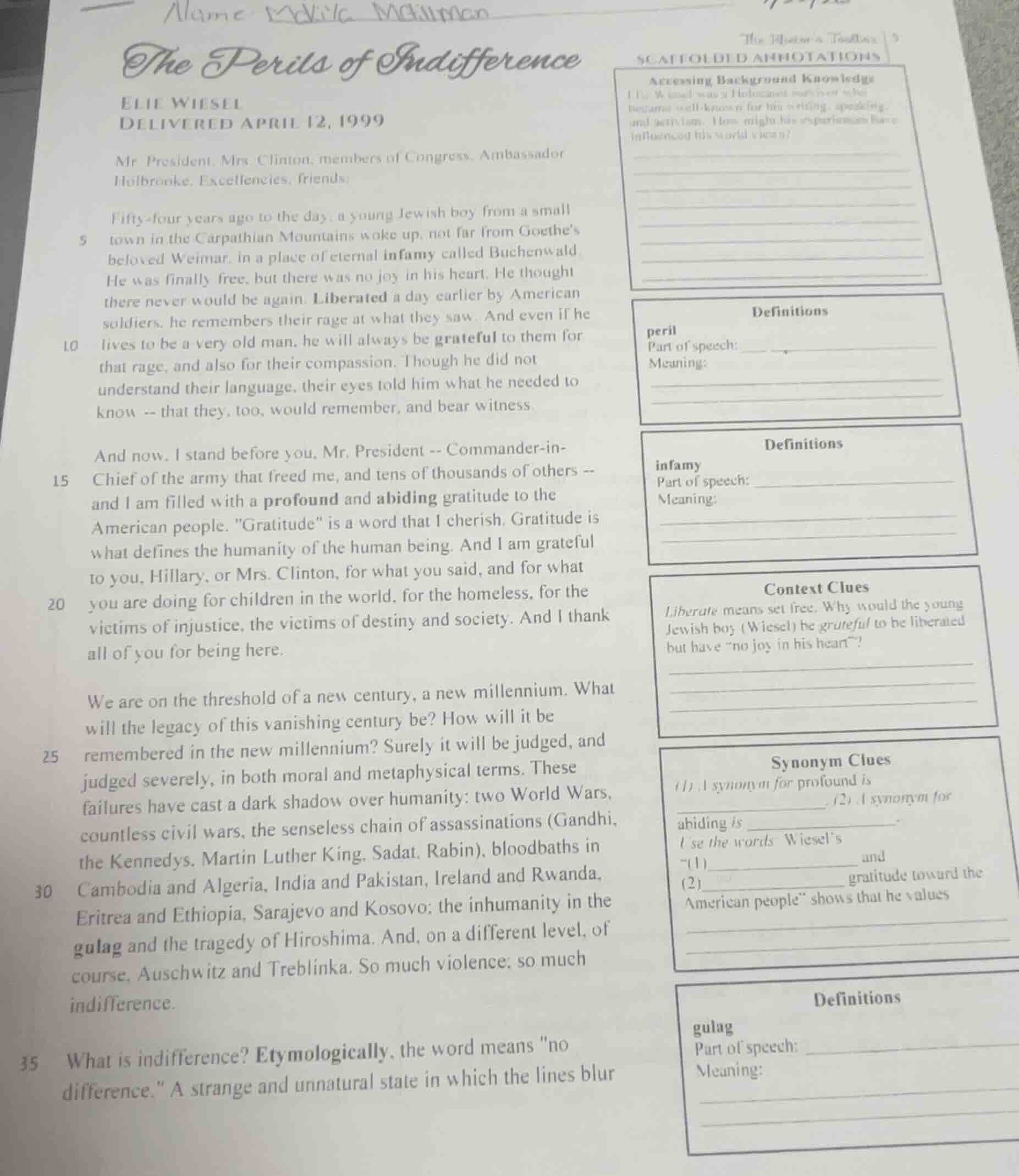
the perils of indifference
elie wiesel
delivered april 12, 1999
mr president, mrs clinton, members of congress, ambassador holbrooke, excellencies, friends:
fifty - four years ago to the day, a young jewish boy from a small town in the carpathian mountains woke up, not far from goethe’s beloved weimar, in a place of eternal infamy called buchenwald. he was finally free, but there was no joy in his heart. he thought there never would be again. liberated a day earlier by american soldiers, he remembers their rage at what they saw. and even if he lives to be a very old man, he will always be grateful to them for that rage, and also for their compassion. though he did not understand their language, their eyes told him what he needed to know -- that they, too, would remember, and bear witness.
and now, i stand before you, mr. president -- commander - in - chief of the army that freed me, and tens of thousands of others -- and i am filled with a profound and abiding gratitude to the american people. \gratitude\ is a word that i cherish. gratitude is what defines the humanity of the human being. and i am grateful to you, hillary, or mrs. clinton, for what you said, and for what you are doing for children in the world, for the homeless, for the victims of injustice, the victims of destiny and society. and i thank all of you for being here.
we are on the threshold of a new century, a new millennium. what will the legacy of this vanishing century be? how will it be remembered in the new millennium? surely it will be judged, and judged severely, in both moral and metaphysical terms. these failures have cast a dark shadow over humanity: two world wars, countless civil wars, the senseless chain of assassinations (gandhi, the kennedys, martin luther king, sadat, rabin), bloodbaths in cambodia and algeria, india and pakistan, ireland and rwanda, eritrea and ethiopia, sarajevo and kosovo; the inhumanity in the gulag and the tragedy of hiroshima. and, on a different level, of course, auschwitz and treblinka. so much violence, so much indifference.
what is indifference? etymologically, the word means
o difference.\ a strange and unnatural state in which the lines blur
the rators toolkit
scaffolded annotations
accessing background knowledge
elie wiesel was a holocaust survivor who became well - known for his writing, speaking, and activism. how might his experiences have influenced his world view?
definitions
peril
part of speech:
meaning:
definitions
infamy
part of speech:
meaning:
context clues
liberate means set free. why would the young jewish boy (wiesel) be grateful to be liberated but have
o joy in his heart\?
synonym clues
(1) a synonym for profound is
(2) a synonym for abiding is
use the words wiesel’s \(1) and (2) gratitude toward the american people\ shows that he values
definitions
gulag
part of speech:
meaning:
Accessing Background Knowledge:
Elie Wiesel was a Holocaust survivor who lost most of his family in the concentration camps. His trauma and firsthand experience of systemic genocide and global indifference to Jewish suffering shaped his worldview to center on bearing witness to atrocities, advocating for human rights, and warning against ignoring the suffering of others.
Definitions (peril):
- Part of speech: Noun
- Meaning: Serious and immediate danger.
Definitions (infamy):
- Part of speech: Noun
- Meaning: The state of being well-known for some bad or wicked act; extreme dishonor or disgrace.
Context Clues:
Wiesel was grateful to be liberated from the horrors of Buchenwald, but he felt no joy because he had lost his entire family and witnessed unspeakable violence and death in the camp. The trauma of the Holocaust robbed him of the ability to feel joy even at his freedom.
Synonym Clues:
(1) A synonym for profound is deep.
(2) A synonym for abiding is lasting.
Wiesel's "(1) deep and (2) lasting gratitude toward the American people" shows that he values the compassion and action of the soldiers who freed him, as well as their willingness to bear witness to the crimes of the Holocaust.
Definitions (gulag):
- Part of speech: Noun
- Meaning: A system of forced labor camps in the former Soviet Union, known for harsh conditions and political repression; also used to refer to the camps themselves.

Snap & solve any problem in the app
Get step-by-step solutions on Sovi AI
Photo-based solutions with guided steps
Explore more problems and detailed explanations
Accessing Background Knowledge:
Elie Wiesel's Holocaust experience, including losing his family and enduring concentration camps, led him to prioritize bearing witness to atrocities, advocating for human rights, and condemning indifference to suffering.
Definitions (peril):
Part of speech: Noun
Meaning: Serious, immediate danger.
Definitions (infamy):
Part of speech: Noun
Meaning: Disgrace from wicked, well-known acts.
Context Clues:
Wiesel was grateful for liberation but felt no joy because he lost his family and endured unthinkable trauma in the concentration camp, which stripped him of the capacity for joy even in freedom.
Synonym Clues:
(1) deep; (2) lasting
Wiesel's deep and lasting gratitude shows he values the American soldiers' compassion, rescue, and willingness to bear witness to the Holocaust.
Definitions (gulag):
Part of speech: Noun
Meaning: Soviet forced-labor camp system (or the camps themselves), marked by harsh repression.